Specific risk prediction models performed best for pediatric clinical deterioration in low- and middle-income countries
Predicting Clinical Deterioration and Mortality at Differing Stages During Hospitalization: A Systematic Review of Risk Prediction Models in Children in Low- and Middle-Income Countries
Systematic review and meta-analysisUnclear result
Which risk prediction models best predict clinical deterioration in children in low- and middle-income countries?
Who
1
Children aged 0-18 years in low- and middle-income countries · Emergency department, pediatric ward, or pediatric intensive care unit
Compared
Emergency department models: SICK
Pediatric ward models: PEDIA-immediate score
Pediatric intensive care unit models: PELOD
Main outcome
Clinical deterioration and mortality
Bottom line: Specific risk prediction models perform best by setting, but they are not routinely used in low- and middle-income countries.
Limitation: There was a high risk of bias in all studies.
J Pediatr · 2023-04-29Download image
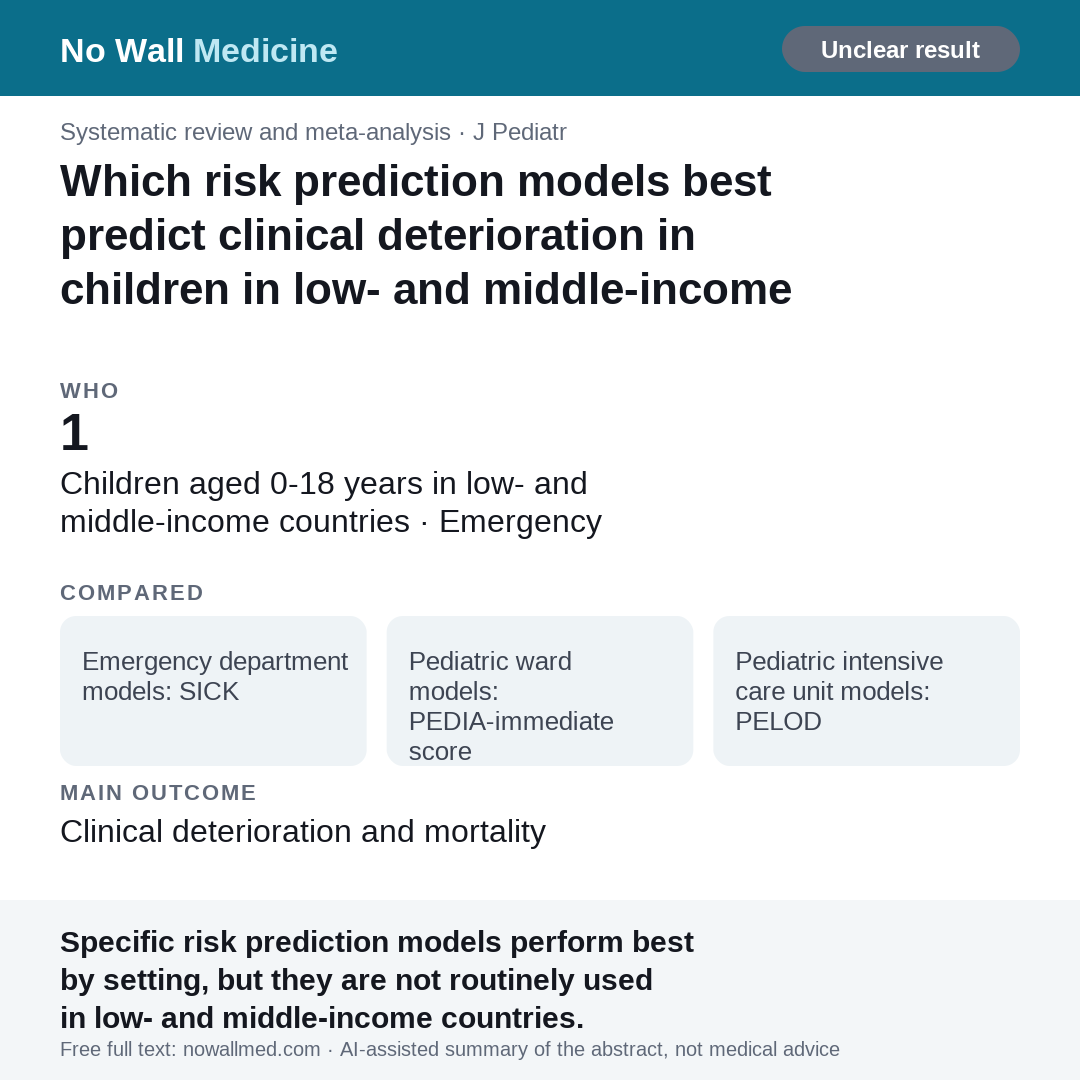
Clinical question: Which risk prediction models best predict clinical deterioration in children in low- and middle-income countries?
Why it matters: It was unknown which risk prediction models best estimate clinical deterioration in children at different stages of hospital admission in low- and middle-income countries.
Key points
- Researchers reviewed 78 publications containing 67 unique predictive models involving 1.5 million children in low- and middle-income countries.
- The SICK model performed best in emergency departments, while pSOFA and PEDIA-immediate scores performed best in pediatric wards.
- The pSOFA and pediatric logistic organ dysfunction (PELOD) models were the best performing models for pediatric intensive care units.
Limitation the authors note: There was a high risk of bias in all studies included in the review.
Headline and key points written with AI from the paper’s abstract, with every number checked against it. Read the paper before relying on them.
Was this summary helpful?
Subject terms
Cite this article
van den Brink DA, de Vries ISA, Datema M, Perot L, Sommers R, Daams J. Predicting Clinical Deterioration and Mortality at Differing Stages During Hospitalization: A Systematic Review of Risk Prediction Models in Children in Low- and Middle-Income Countries. J Pediatr. 2023. doi:10.1016/j.jpeds.2023.113448
Spotted a mistake? Suggest a correction
Top studies every Monday
The week’s key trials and guidelines in your specialties, plus any topics you follow. By email, free.
Get the weekly digest