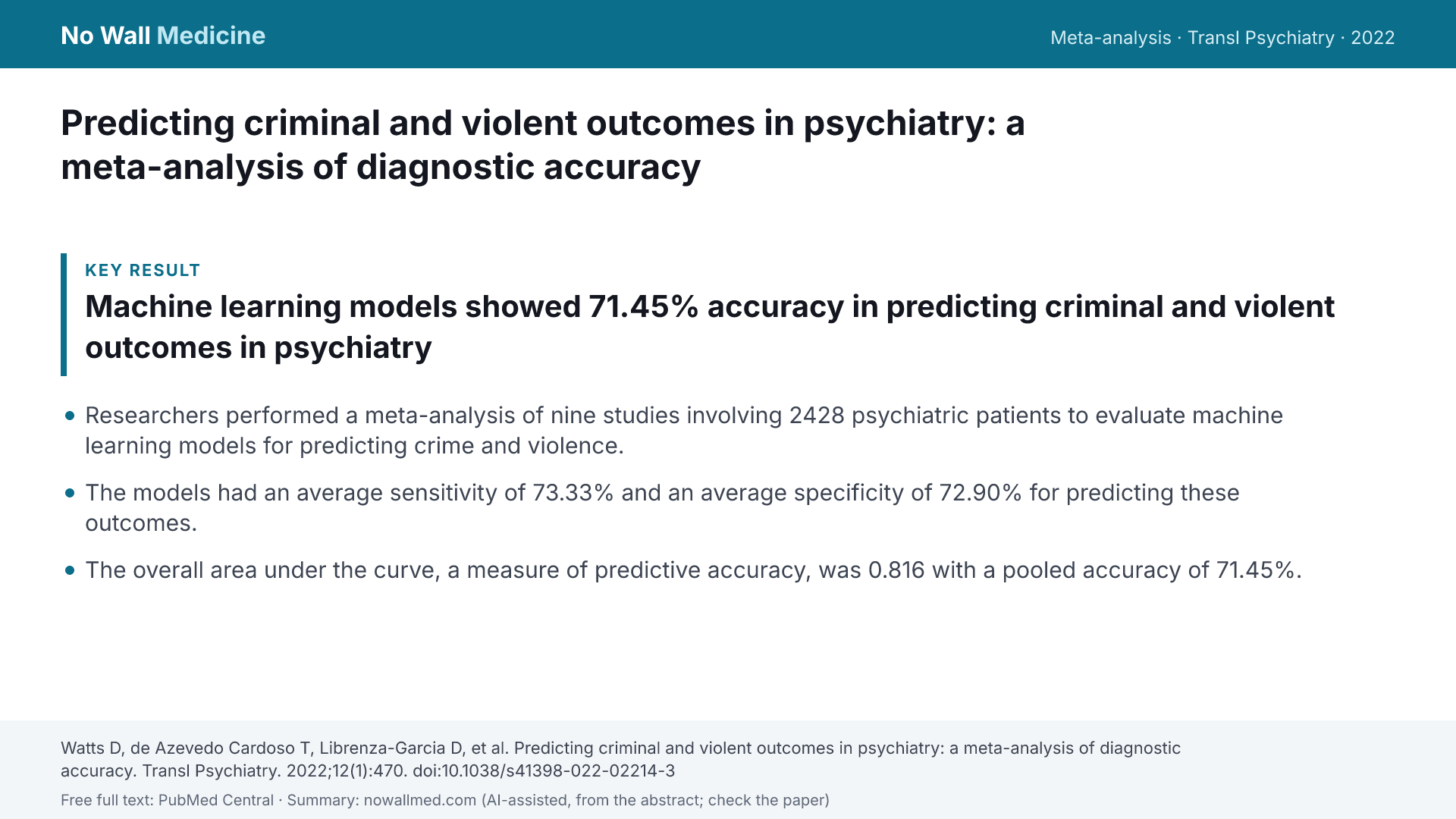
Machine learning models showed 71.45% accuracy in predicting criminal and violent outcomes in psychiatry
Predicting criminal and violent outcomes in psychiatry: a meta-analysis of diagnostic accuracy
Why it matters: There is a lack of objective and highly accurate tools to predict criminal and violent events at an individual level in people with mental illness.
Key points
- Researchers performed a meta-analysis of nine studies involving 2428 psychiatric patients to evaluate machine learning models for predicting crime and violence.
- The models had an average sensitivity of 73.33% and an average specificity of 72.90% for predicting these outcomes.
- The overall area under the curve, a measure of predictive accuracy, was 0.816 with a pooled accuracy of 71.45%.
Headline and key points written with AI from the paper’s abstract, with every number checked against it. Read the paper before relying on them.
Was this summary helpful?
Subject terms
Cite this article
Watts D, de Azevedo Cardoso T, Librenza-Garcia D, et al. Predicting criminal and violent outcomes in psychiatry: a meta-analysis of diagnostic accuracy. Transl Psychiatry. 2022. doi:10.1038/s41398-022-02214-3
Spotted a mistake? Suggest a correction