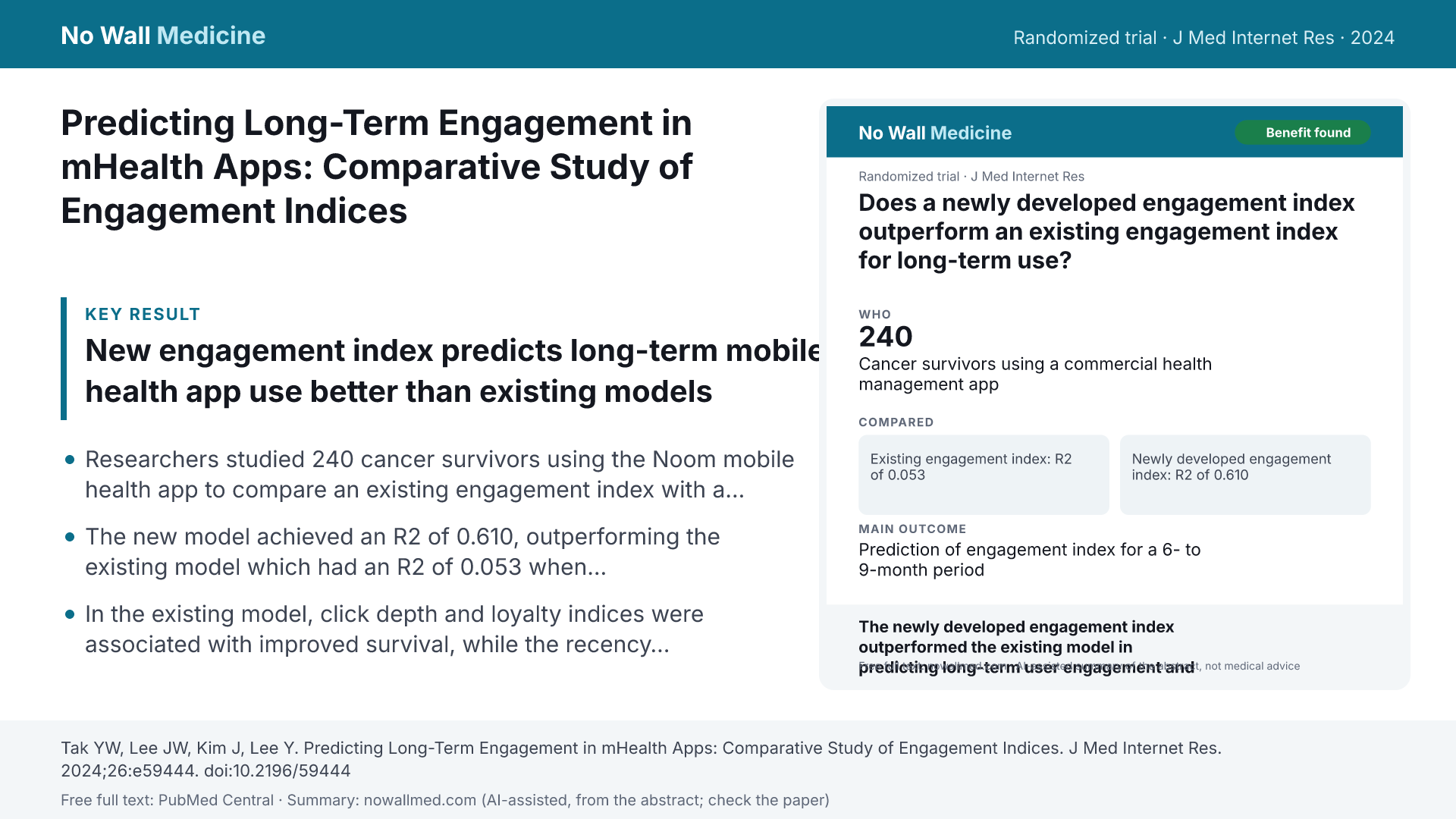
New engagement index predicts long-term mobile health app use better than existing models
Predicting Long-Term Engagement in mHealth Apps: Comparative Study of Engagement Indices
Randomized trialBenefit found
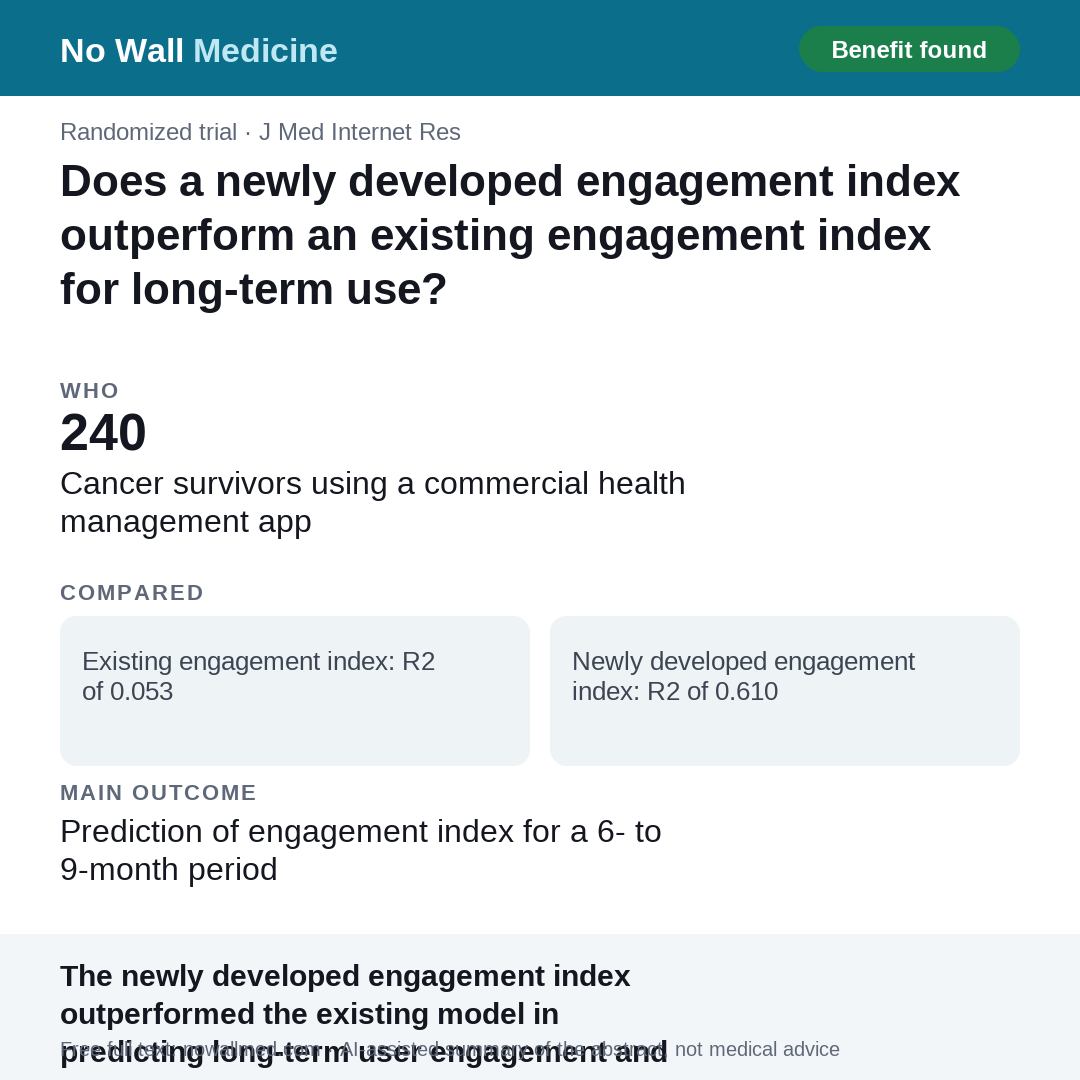
Does a newly developed engagement index outperform an existing engagement index for long-term use?
Who
240
Cancer survivors using a commercial health management app
Compared
Existing engagement index: R2 of 0.053
Newly developed engagement index: R2 of 0.610
Main outcome
Prediction of engagement index for a 6- to 9-month period
Result: mean squared error 0.025 (compared to 0.096)
Bottom line: The newly developed engagement index outperformed the existing model in predicting long-term user engagement and compliance.
Limitation: The study suggests future research should address the subjectivity of the engagement index.
J Med Internet Res · 2024-09-09Download image
Clinical question: Does a newly developed engagement index outperform an existing engagement index for long-term use?
Why it matters: There are currently no established tools capable of quantitatively measuring long-term engagement in digital health care applications.
Key points
- Researchers studied 240 cancer survivors using the Noom mobile health app to compare an existing engagement index with a newly developed version.
- The new model achieved an R2 of 0.610, outperforming the existing model which had an R2 of 0.053 when predicting engagement between 3 to 9 months.
- In the existing model, click depth and loyalty indices were associated with improved survival, while the recency index showed no significant association.
Headline and key points written with AI from the paper’s abstract, with every number checked against it. Read the paper before relying on them.
Was this summary helpful?
Subject terms
Cite this article
Tak YW, Lee JW, Kim J, Lee Y. Predicting Long-Term Engagement in mHealth Apps: Comparative Study of Engagement Indices. J Med Internet Res. 2024. doi:10.2196/59444
Spotted a mistake? Suggest a correction