Artificial intelligence studies for predicting traumatic brain injury outcomes show low methodological quality
Predicting outcomes after moderate and severe traumatic brain injury using artificial intelligence: a systematic review
Systematic reviewUnclear result
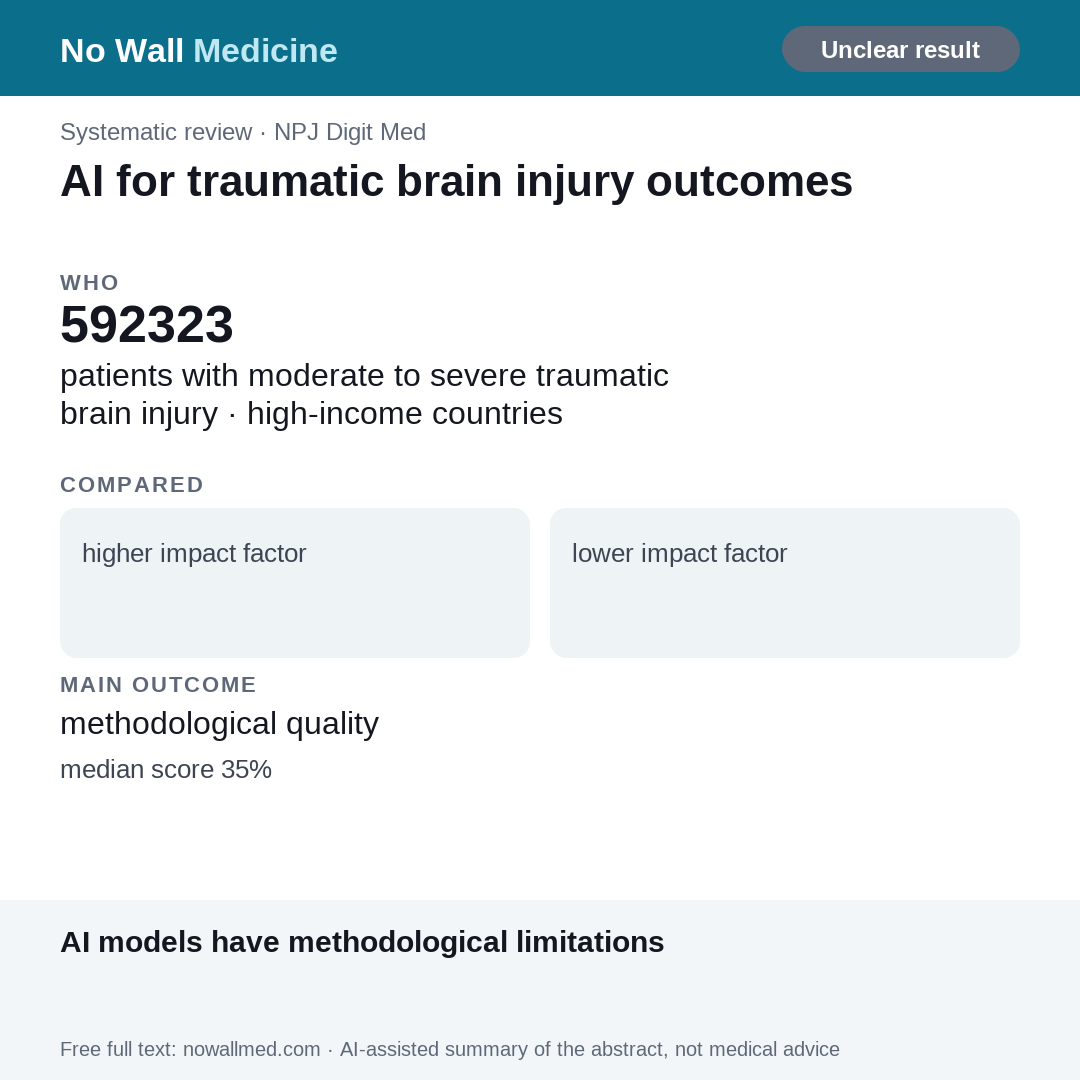
AI for traumatic brain injury outcomes
Who
592323
patients with moderate to severe traumatic brain injury · high-income countries
Compared
higher impact factor
lower impact factor
Main outcome
methodological quality
Result: median score 35%
Bottom line: AI models have methodological limitations
Limitation: lack of diverse development datasets
NPJ Digit Med · 2025-06-18Download image
Why it matters: The implementation gap between artificial intelligence model development and clinical use may be explained by poorly characterized methodological standards in existing research.
Key points
- Researchers reviewed 39 studies involving 592,323 patients with moderate to severe traumatic brain injury to evaluate artificial intelligence methods for predicting outcomes.
- The studies showed low scores in methodological conduct with a median of 35%, robustness of results at 20%, and reproducibility at 35%.
- Higher journal impact factor, larger sample size, more recent publication year, and data from high-income countries were associated with higher quality scores.
Limitation the authors note: The APPRAISE-AI tool used for evaluation is recently developed and requires ongoing measurement property assessment.
Headline and key points written with AI from the paper’s abstract, with every number checked against it. Read the paper before relying on them.
Cite this article
Malhotra AK, Shakil H, Smith CW, Huang YQ, Kwong JCC, Thorpe KE. Predicting outcomes after moderate and severe traumatic brain injury using artificial intelligence: a systematic review. NPJ Digit Med. 2025. doi:10.1038/s41746-025-01714-y
Spotted a mistake? Suggest a correction
Top studies every Monday
The week’s key trials and guidelines in your specialties, plus any topics you follow. By email, free.
Get the weekly digest