External validation of models predicting care home admission risk shows varying accuracy and incomplete reporting
Predicting short- to medium-term care home admission risk in older adults: a systematic review of externally validated models
Systematic review of external validationsMixed results
How accurately do prediction models predict care home admission risk in older adults?
Who
Adults aged 65 years or older
Compared
1-year prediction models with acceptable discrimination: area under the receiver operating characteristic curve 0.70-0.79
1-year prediction models with poor discrimination: area under the receiver operating characteristic curve < 0.70
Main outcome
Model discrimination and calibration for care home admission risk
Bottom line: Prediction models showed at best acceptable discrimination and often failed to account for competing mortality risk.
Limitation: Risk of bias was mostly high due to not reporting model calibration.
Age Ageing · 2024-05-10Download image
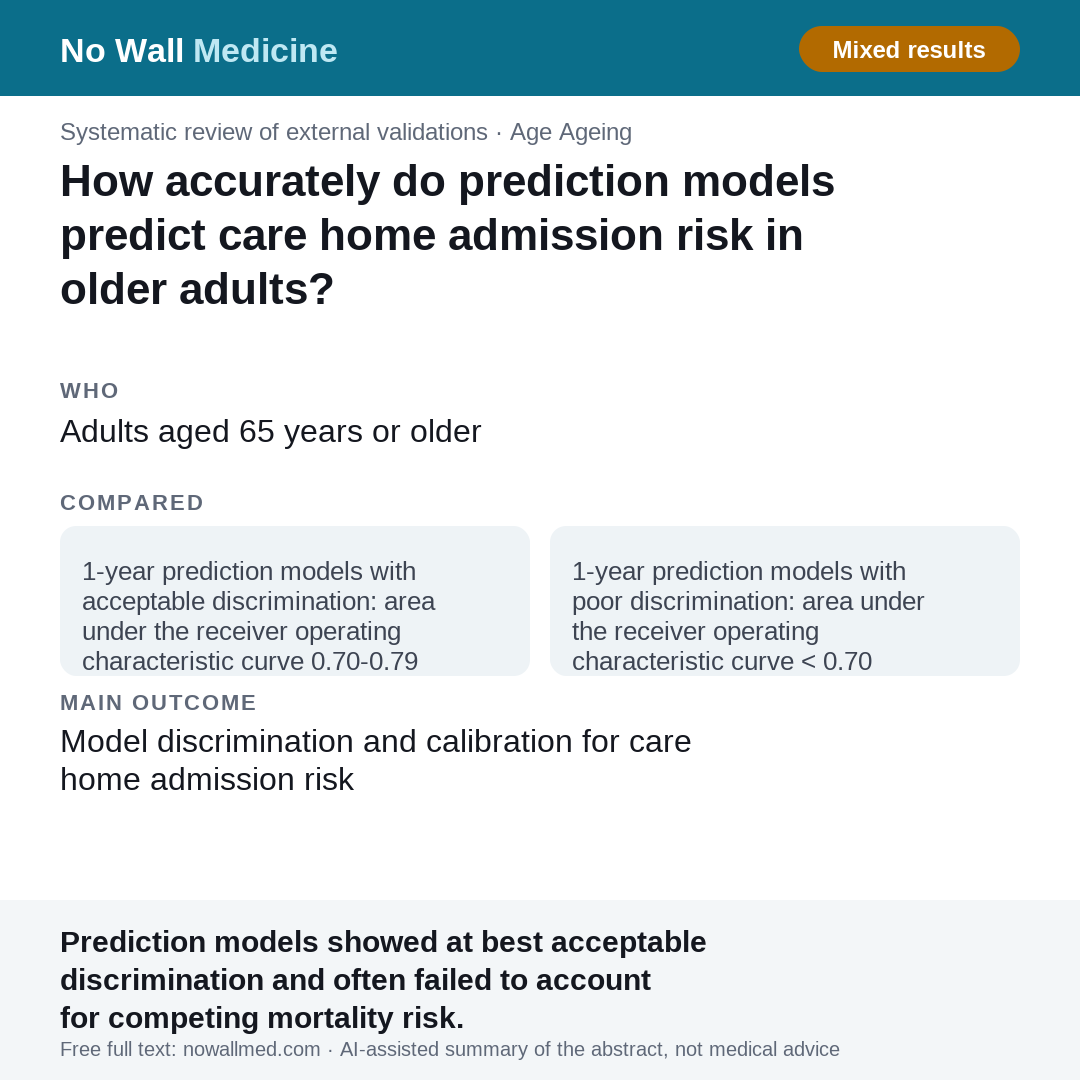
Clinical question: How accurately do prediction models predict care home admission risk in older adults?
Why it matters: It is unknown how accurately existing prediction models for care home admission perform when tested on different datasets and whether they account for mortality risks.
Key points
- Researchers reviewed five studies involving nine unique prediction models for care home admission in adults aged 65 years or older with up to 3 years of follow-up.
- For 1-year predictions, three models had acceptable discrimination with an area under the receiver operating characteristic curve of 0.70-0.79, while three others had poor discrimination with an area under the receiver operating characteristic curve < 0.70.
- The models mostly used morbidities, such as neurological or psychiatric diseases, and physical function as predictors, but none accounted for competing mortality risk.
Limitation the authors note: The authors noted that model reporting was incomplete, risk of bias was mostly high due to missing calibration data, and no models accounted for competing mortality risk.
Headline and key points written with AI from the paper’s abstract, with every number checked against it. Read the paper before relying on them.
Was this summary helpful?
Subject terms
Cite this article
Ho L, Pugh C, Seth S, Arakelyan S, Lone NI, Lyall MJ. Predicting short- to medium-term care home admission risk in older adults: a systematic review of externally validated models. Age Ageing. 2024. doi:10.1093/ageing/afae088
Spotted a mistake? Suggest a correction
Top studies every Monday
The week’s key trials and guidelines in your specialties, plus any topics you follow. By email, free.
Get the weekly digest