Subclavian artery revascularization linked to lower stroke and spinal cord ischemia risks in aortic repair
Predicting the need for subclavian artery revascularization in thoracic endovascular aortic repair: A systematic review and meta-analysis
Meta-analysis of 76 studiesMixed results
Is left subclavian artery revascularization effective in thoracic endovascular aortic repair?
Who
Patients undergoing thoracic endovascular aortic repair
Compared
Revascularization
Non-revascularization
Main outcome
Stroke, spinal cord ischemia, arm ischemia, and mortality
Result: OR 0.67 (95% CI 0.45-0.98) for stroke
Bottom line: Revascularization reduces stroke, spinal cord ischemia, and arm ischemia risks but increases reintervention risk and does not impact mortality.
J Vasc Surg · 2024-04-15Download image
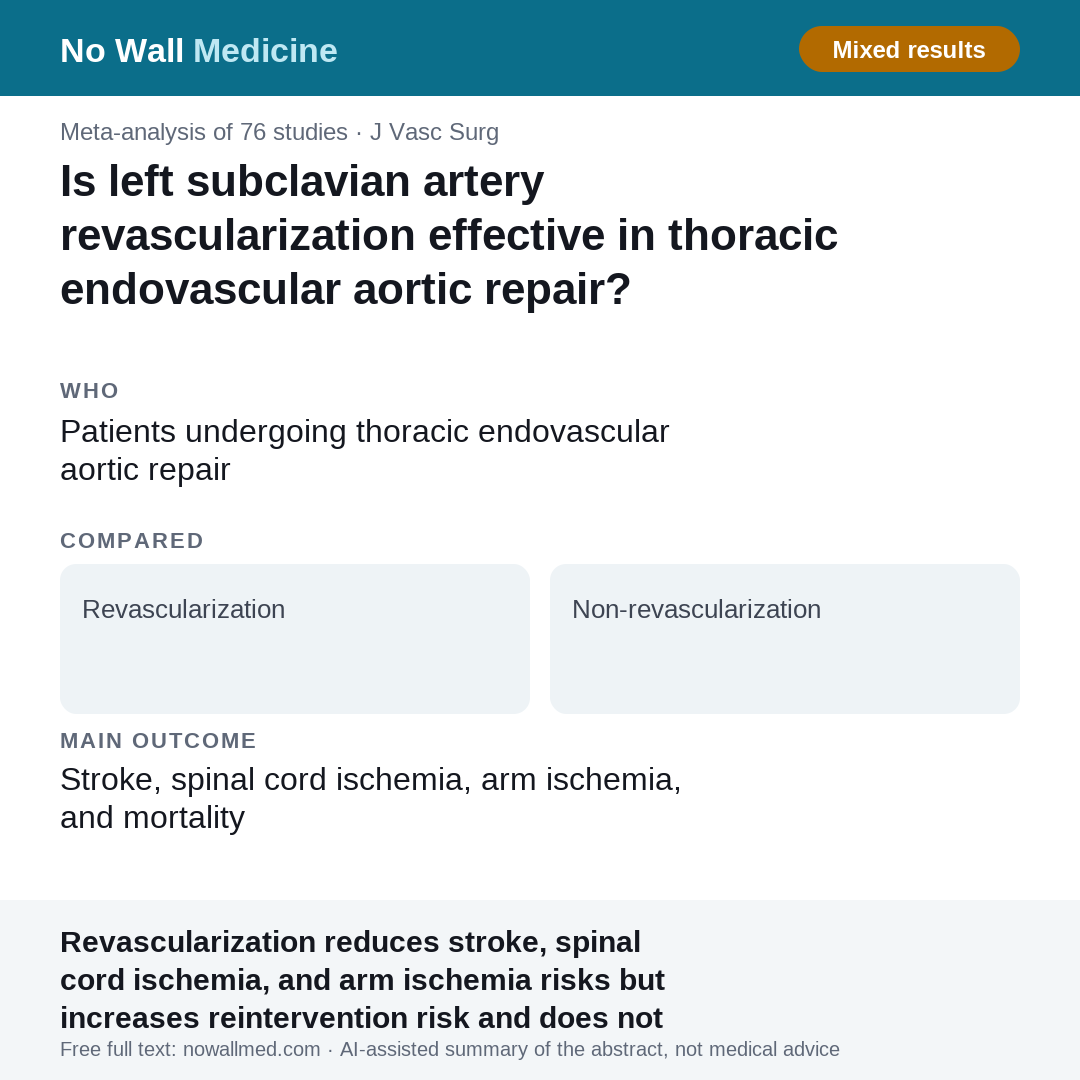
Clinical question: Is left subclavian artery revascularization effective in thoracic endovascular aortic repair?
Why it matters: It is unclear which patients benefit most from left subclavian artery revascularization during thoracic endovascular aortic repair.
Key points
- Researchers analyzed 76 studies involving thousands of patients to compare left subclavian artery revascularization with non-revascularization during thoracic endovascular aortic repair.
- Revascularization was associated with lower risks of stroke (OR, 0.67; 95% CI, 0.45-0.98), spinal cord ischemia (OR, 0.75; 95% CI, 0.56-0.99), and arm ischemia (OR, 0.09; 95% CI, 0.01-0.59).
- The procedure was associated with a higher risk of reintervention (OR, 1.98; 95% CI, 1.03-3.83) but showed no significant difference in mortality (OR, 0.77; 95% CI, 0.53-1.12).
Headline and key points written with AI from the paper’s abstract, with every number checked against it. Read the paper before relying on them.
Topics
Cite this article
Alanezi T, Altoijry A, AlSheikh S, Al-Mubarak H, Alhamzah M, Alomran F. Predicting the need for subclavian artery revascularization in thoracic endovascular aortic repair: A systematic review and meta-analysis. J Vasc Surg. 2024. doi:10.1016/j.jvs.2024.04.023
Spotted a mistake? Suggest a correction
Top studies every Monday
The week’s key trials and guidelines in your specialties, plus any topics you follow. By email, free.
Get the weekly digest