Mathematical models show excellent ability to distinguish who will develop heart failure in communities
Prediction models for heart failure in the community: A systematic review and meta-analysis
Meta-analysis of 36 studiesUnclear result
Heart failure prediction models effective
Who
general population in community
Compared
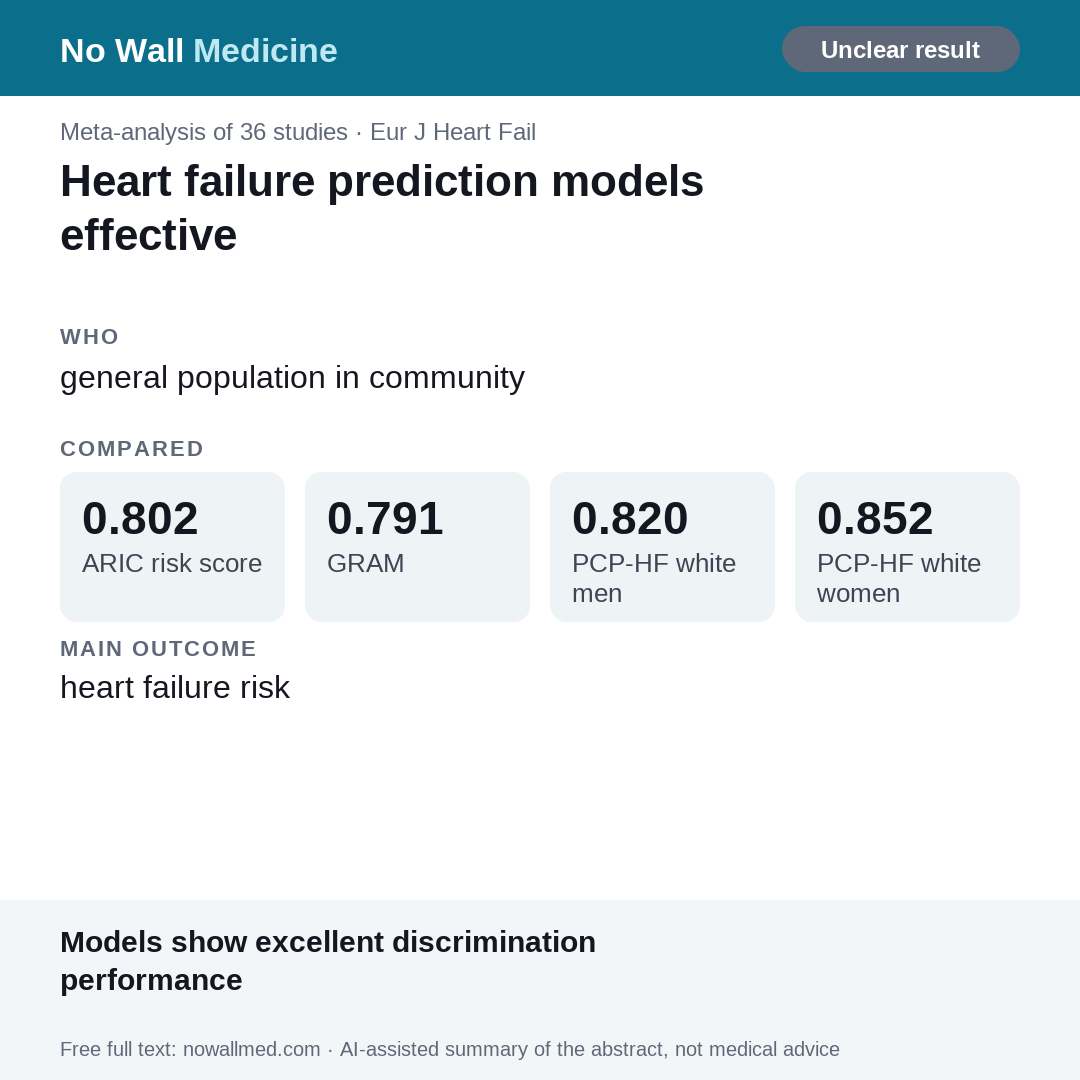
0.802ARIC risk score
0.791GRAM
0.820PCP-HF white men
0.852PCP-HF white women
Main outcome
heart failure risk
Bottom line: Models show excellent discrimination performance
Limitation: high risk of bias and low evidence certainty
Eur J Heart Fail · 2023-07-31Download image
Why it matters: It is unknown if existing mathematical models for predicting heart failure in the community are accurate or useful for clinical practice.
Key points
- Researchers analyzed 36 studies containing 59 prediction models designed to estimate the risk of new heart failure in general populations.
- The Pooled Cohort equations to Prevent Heart Failure for white women had a c-statistic of 0.852, while the REVERSE Time AttentIoN model had 0.839.
- 77% of the model results were at high risk of bias and no model had been studied for clinical impact.
Limitation the authors note: The certainty of evidence was low, 77% of model results were at high risk of bias, and no model had a clinical impact study.
Headline and key points written with AI from the paper’s abstract, with every number checked against it. Read the paper before relying on them.
Was this summary helpful?
Subject terms
Cite this article
Nadarajah R, Younsi T, Romer E, Raveendra K, Nakao YM, Nakao K. Prediction models for heart failure in the community: A systematic review and meta-analysis. Eur J Heart Fail. 2023. doi:10.1002/ejhf.2970
Spotted a mistake? Suggest a correction
Top studies every Monday
The week’s key trials and guidelines in your specialties, plus any topics you follow. By email, free.
Get the weekly digest