High risk of bias in mortality prediction models for older adults with cancer
Prediction models for overall survival and all-cause mortality risk in older adults with cancer: a systematic review
Systematic reviewHarm found
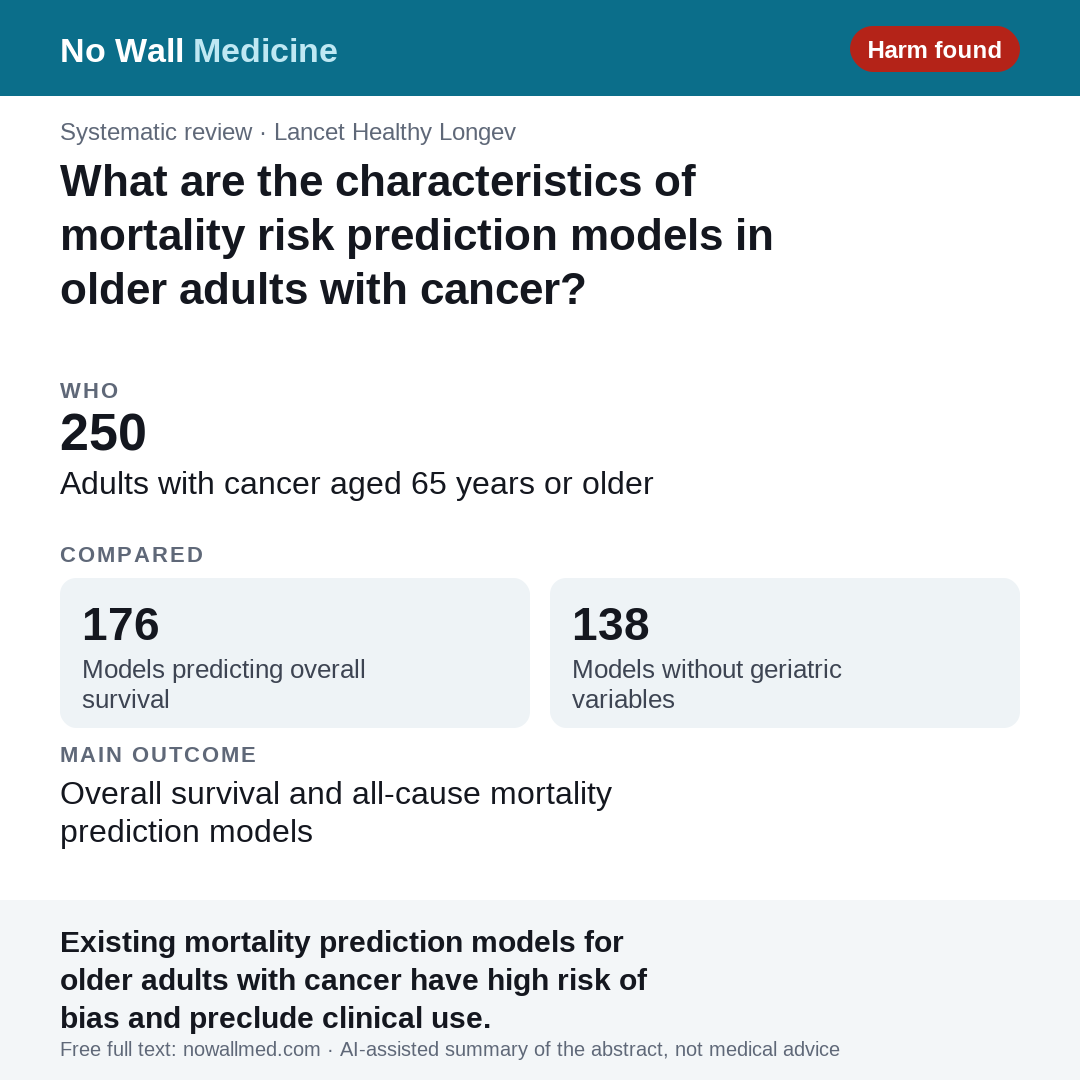
What are the characteristics of mortality risk prediction models in older adults with cancer?
Who
250
Adults with cancer aged 65 years or older
Compared
176Models predicting overall survival (70.4%)
138Models without geriatric variables (55.2%)
Main outcome
Overall survival and all-cause mortality prediction models
Bottom line: Existing mortality prediction models for older adults with cancer have high risk of bias and preclude clinical use.
Limitation: High risk of bias due to inappropriate handling of predictors and inadequate control for overfitting.
Lancet Healthy Longev · 2026-03-21Download image
Clinical question: What are the characteristics of mortality risk prediction models in older adults with cancer?
Why it matters: Existing mortality risk prediction models for older adults with cancer are associated with a high risk of bias.
Key points
- Researchers reviewed 250 studies containing models designed to predict overall survival and all-cause mortality in adults aged 65 years or older with cancer.
- Only 17.2% of the models were specifically developed for older adults, and 55.2% of models did not include geriatric factors like nutrition or cognition.
- All models showed a high risk of bias due to issues like inappropriate handling of continuous predictors and inadequate control for overfitting.
Limitation the authors note: The authors state that high risk of bias in all models precludes clinical use.
Headline and key points written with AI from the paper’s abstract, with every number checked against it. Read the paper before relying on them.
Topics
Cite this article
Duquenne P, Liposits G, Vonnes CO, Navarrete E, Serrano AG, Canoui-Poitrine F. Prediction models for overall survival and all-cause mortality risk in older adults with cancer: a systematic review. Lancet Healthy Longev. 2026. doi:10.1016/j.lanhl.2026.100829
Spotted a mistake? Suggest a correction