Systematic review finds most self-harm and suicide prediction models have high risk of bias
Prediction models for self-harm and suicide: a systematic review and critical appraisal
Systematic review and critical appraisalMixed results
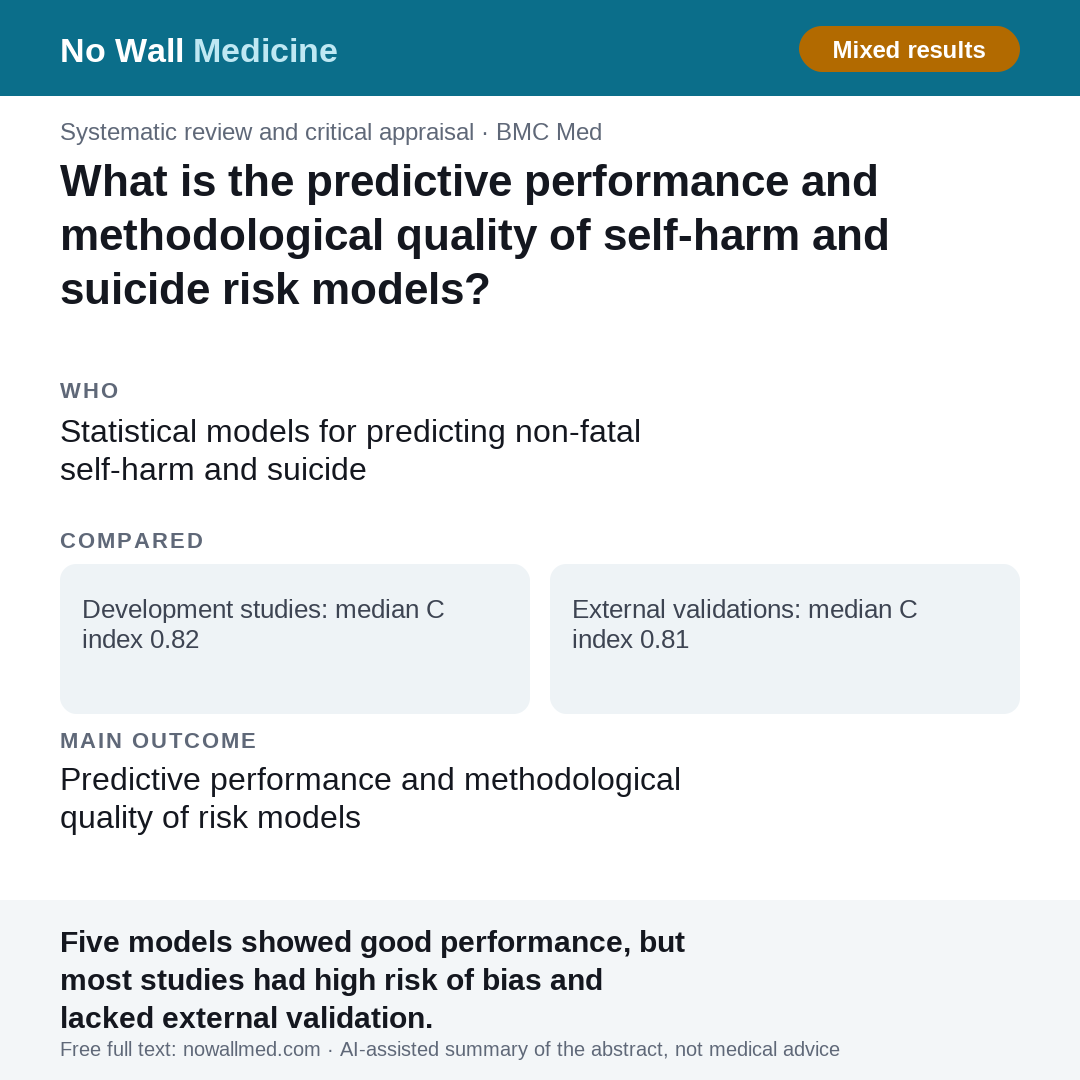
What is the predictive performance and methodological quality of self-harm and suicide risk models?
Who
Statistical models for predicting non-fatal self-harm and suicide
Compared
Development studies: median C index 0.82
External validations: median C index 0.81
Main outcome
Predictive performance and methodological quality of risk models
Result: C indices ranged from 0.61 to 0.97 (median 0.82) in development and 0.60 to 0.86 (median 0.81) in external validations
Bottom line: Five models showed good performance, but most studies had high risk of bias and lacked external validation.
Limitation: Most models were at high risk of bias due to inappropriate performance evaluation and insufficient sample sizes.
BMC Med · 2025-10-09Download image
Clinical question: What is the predictive performance and methodological quality of self-harm and suicide risk models?
Why it matters: The potential role of statistical models in improving the assessment of suicide risk is debated due to concerns regarding their accuracy and methodological quality.
Key points
- Researchers reviewed 91 articles containing 167 models and 29 external validations designed to predict self-harm or suicide risk.
- All model development studies and almost all external validations were at high risk of bias due to issues like insufficient sample sizes and incomplete performance evaluations.
- While median C indices, a measure of predictive accuracy, were 0.82 for development and 0.81 for external validations, only 8% of models were externally validated.
Limitation the authors note: The authors note that most studies suffered from high risk of bias due to inappropriate evaluation of performance, insufficient sample sizes, and improper handling of missing data.
Headline and key points written with AI from the paper’s abstract, with every number checked against it. Read the paper before relying on them.
Topics
Cite this article
Seyedsalehi A, Bailey J, Ogonah MGT, Fanshawe TR, Fazel S. Prediction models for self-harm and suicide: a systematic review and critical appraisal. BMC Med. 2025. doi:10.1186/s12916-025-04367-6
Spotted a mistake? Suggest a correction