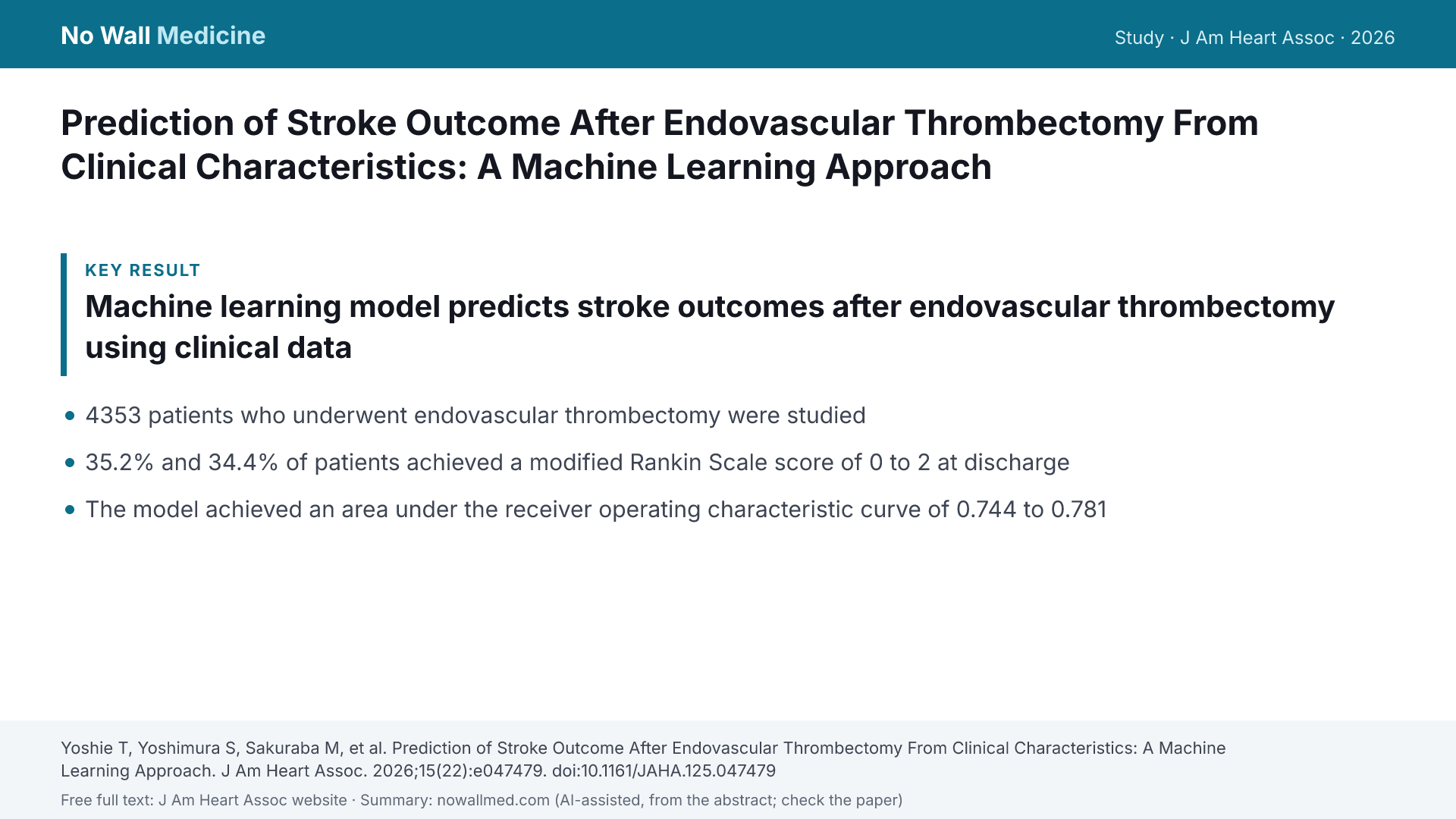
Machine learning model predicts stroke outcomes after endovascular thrombectomy using clinical data
Prediction of Stroke Outcome After Endovascular Thrombectomy From Clinical Characteristics: A Machine Learning Approach
Why it matters: Predicting outcomes after endovascular thrombectomy for acute ischemic stroke is challenging
Key points
- 4353 patients who underwent endovascular thrombectomy were studied.
- 35.2% and 34.4% of patients achieved a modified Rankin Scale score of 0 to 2 at discharge.
- The model achieved an area under the receiver operating characteristic curve of 0.744 to 0.781.
Study type: Observational study: it can show a link, but not prove that one thing causes another.
Headline and key points written with AI from the paper’s abstract, with every number checked against it. Read the paper before relying on them.
Was this summary helpful?
Subject terms
Headline, design, result, key points, caveat and citation as plain text.
Cite this article
Yoshie T, Yoshimura S, Sakuraba M, et al. Prediction of Stroke Outcome After Endovascular Thrombectomy From Clinical Characteristics: A Machine Learning Approach. J Am Heart Assoc. 2026;15(22):e047479. doi:10.1161/JAHA.125.047479
Spotted a mistake? Suggest a correction