Predictive model-based reminders and patient navigators were associated with fewer outpatient appointment no-shows
Predictive model-based interventions to reduce outpatient no-shows: a rapid systematic review
Rapid systematic reviewBenefit found
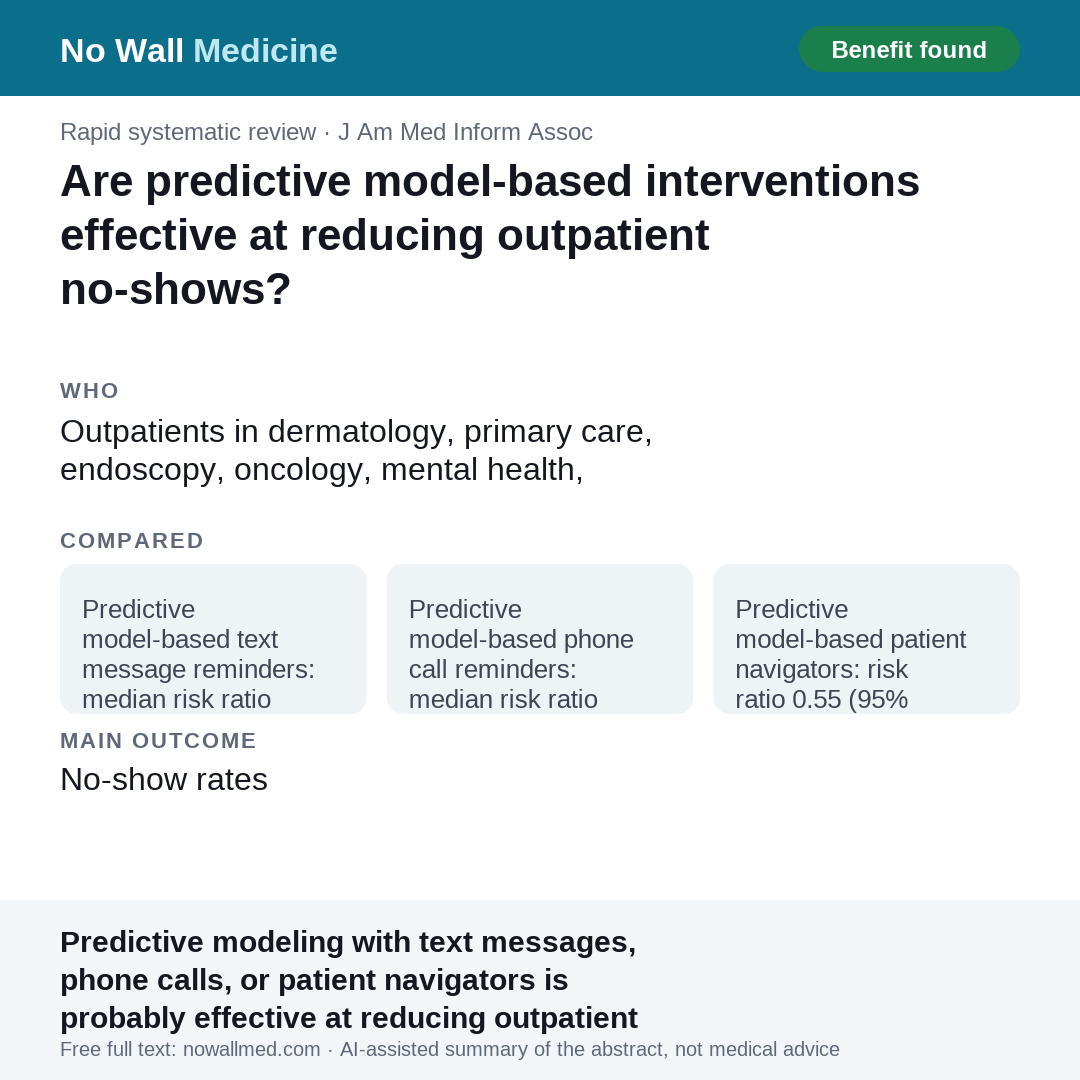
Are predictive model-based interventions effective at reducing outpatient no-shows?
Who
Outpatients in dermatology, primary care, endoscopy, oncology, mental health, pneumology, and imaging · Multiple clinical settings
Compared
Predictive model-based text message reminders: median risk ratio 0.91
Predictive model-based phone call reminders: median risk ratio 0.61
Predictive model-based patient navigators: risk ratio 0.55 (95% confidence interval 0.46, 0.67)
Main outcome
No-show rates
Bottom line: Predictive modeling with text messages, phone calls, or patient navigators is probably effective at reducing outpatient no-shows.
Limitation: Limited information was reported on cost-effectiveness, acceptability, and equity.
J Am Med Inform Assoc · 2022-12-13Download image
Clinical question: Are predictive model-based interventions effective at reducing outpatient no-shows?
Why it matters: It is unknown how effective interventions based on predictive models are at reducing outpatient no-shows, costs, acceptability, and equity.
Key points
- Researchers reviewed 7 randomized controlled trials and 1 non-randomized controlled trial across various medical specialties including dermatology, oncology, and mental health.
- Predictive model-based text message reminders had a median risk ratio of 0.91, while phone call reminders had a median risk ratio of 0.61 and patient navigators had a risk ratio of 0.55.
- The effectiveness of using predictive models to guide overbooking remained uncertain due to the available data.
Limitation the authors note: Limited information was reported on cost-effectiveness, acceptability, and equity.
Headline and key points written with AI from the paper’s abstract, with every number checked against it. Read the paper before relying on them.
Topics
Cite this article
Oikonomidi T, Norman G, McGarrigle L, Stokes J, van der Veer SN, Dowding D. Predictive model-based interventions to reduce outpatient no-shows: a rapid systematic review. J Am Med Inform Assoc. 2022. doi:10.1093/jamia/ocac242
Spotted a mistake? Suggest a correction
Top studies every Monday
The week’s key trials and guidelines in your specialties, plus any topics you follow. By email, free.
Get the weekly digest