Visual abstractsVisuals
Randomized trialCritical Care · Nov 11, 2026

Predictive performance of bedside physiological parameters for the failure of prophylactic non-invasive ventilation after extubation

Murgolo F, Grieco DL, Bertoni M, Cardu A, Pettenuzzo T, Maggiore SM, et al
Critical CareAdult
Post hoc analysisBenefit found
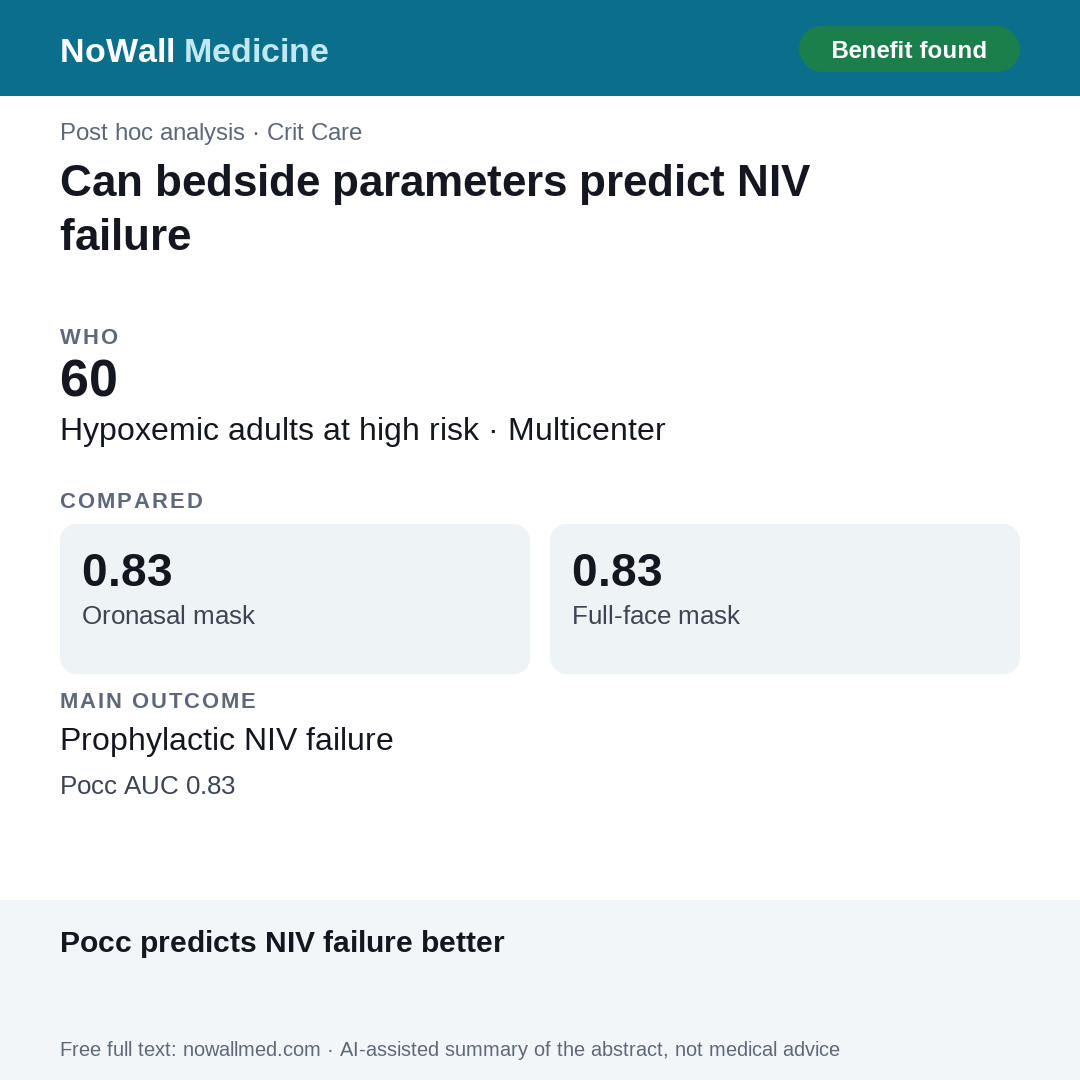
Can bedside parameters predict NIV failure
Who
60
Hypoxemic adults at high risk · Multicenter
Compared
0.83Oronasal mask (95% CI, 0.71-0.95)
0.83Full-face mask (95% CI, 0.72-0.95)
Main outcome
Prophylactic NIV failure
Result: Pocc AUC 0.83
Bottom line: Pocc predicts NIV failure better
Crit Care · 2026-11-11Download image
Read the full paper free at PubMed Central ↗

Abstract

Background Extubation failure is associated with increased mortality. Whether bedside physiological variables can identify patients at risk of reintubation during prophylactic NIV after extubation is unknown. Methods In this post hoc analysis of a multicenter physiological study, 60 hypoxemic adults at high risk of extubation failure underwent two 1-hour NIV sessions after planned extubation, with oronasal and full-face masks in randomized crossover order. We assessed the magnitude of airway occlusion pressure (Pocc), the esophageal pressure swing (ΔPes), SpO₂/FiO₂, respiratory rate, tidal volume, dynamic lung elastance (EL,dyn), ROX index [(SpO₂/FiO₂)/respiratory rate] and the pressure-oxygenation index (POX, SpO₂/FiO₂ divided by Pocc). Prophylactic NIV failure was reintubation for respiratory failure within 7 days. Discrimination was assessed by ROC analysis. Results Fourteen patients (23%) experienced NIV failure. Pocc yielded areas under the curve (AUCs) of 0.83 (95% CI, 0.71-0.95) with the oronasal mask and 0.83 (95% CI, 0.72-0.95) with the full-face mask, showing greater discriminative performance than tidal volume (AUCs, 0.55 and 0.53), respiratory rate (0.54 and 0.38), SpO₂/FiO₂ (0.51 and 0.50), and the ROX index (0.54 and 0.38; all p Conclusions During prophylactic NIV, Pocc discriminated NIV failure better than conventional bedside variables, with no detectable difference from directly measured inspiratory effort. External validation is required.
Topics

Humans; Noninvasive Ventilation; Female; Male; Aged; Airway Extubation; Middle Aged; Predictive Value of Tests; Cross-Over Studies; Treatment Failure; Respiratory Insufficiency; ROC Curve

DOI: 10.1186/s13054-026-06453-4 · PubMed: 43065113

Spotted a mistake? Suggest a correction

More in Critical Care

Meta-analysisCrit Care · Nov 19, 2026 · Critical Care

Corticosteroids in sepsis have conflicting mortality conclusions in reviews

Discordant evidence on corticosteroids in sepsis: a meta-research study

ResearchPediatricResuscitation · Nov 17, 2026 · Critical Care

Eighty-nine percent of infants survived 28 days after chest compressions at birth in 2024

Survival after neonatal chest compressions at birth: Temporal trends and prognostic factors in a population-based cohort, Queensland, Australia

ResearchResuscitation · Nov 17, 2026 · Critical Care

Bystanders attaching AEDs had highest 30-day survival rate of 28 percent

Survival after out of hospital cardiac arrest in relation to AED usage in a multi response system including AED equipped drones

ResearchResuscitation · Nov 17, 2026 · Critical Care

Foreign body airway obstruction caused 1.1% of out-of-hospital cardiac arrests

Out-of-hospital cardiac arrests due to foreign body airway obstruction: A CanROC registry, retrospective cohort study

ResearchResuscitation · Nov 17, 2026 · Critical Care

Commercially available multimodal LLMs for EEG-based prognostication after cardiac arrest