Blood tests for multiple cancers show high specificity and median sensitivity of 73%
Predictive Performance of Cell-Free Nucleic Acid-Based Multi-Cancer Early Detection Tests: A Systematic Review
Systematic reviewMixed results
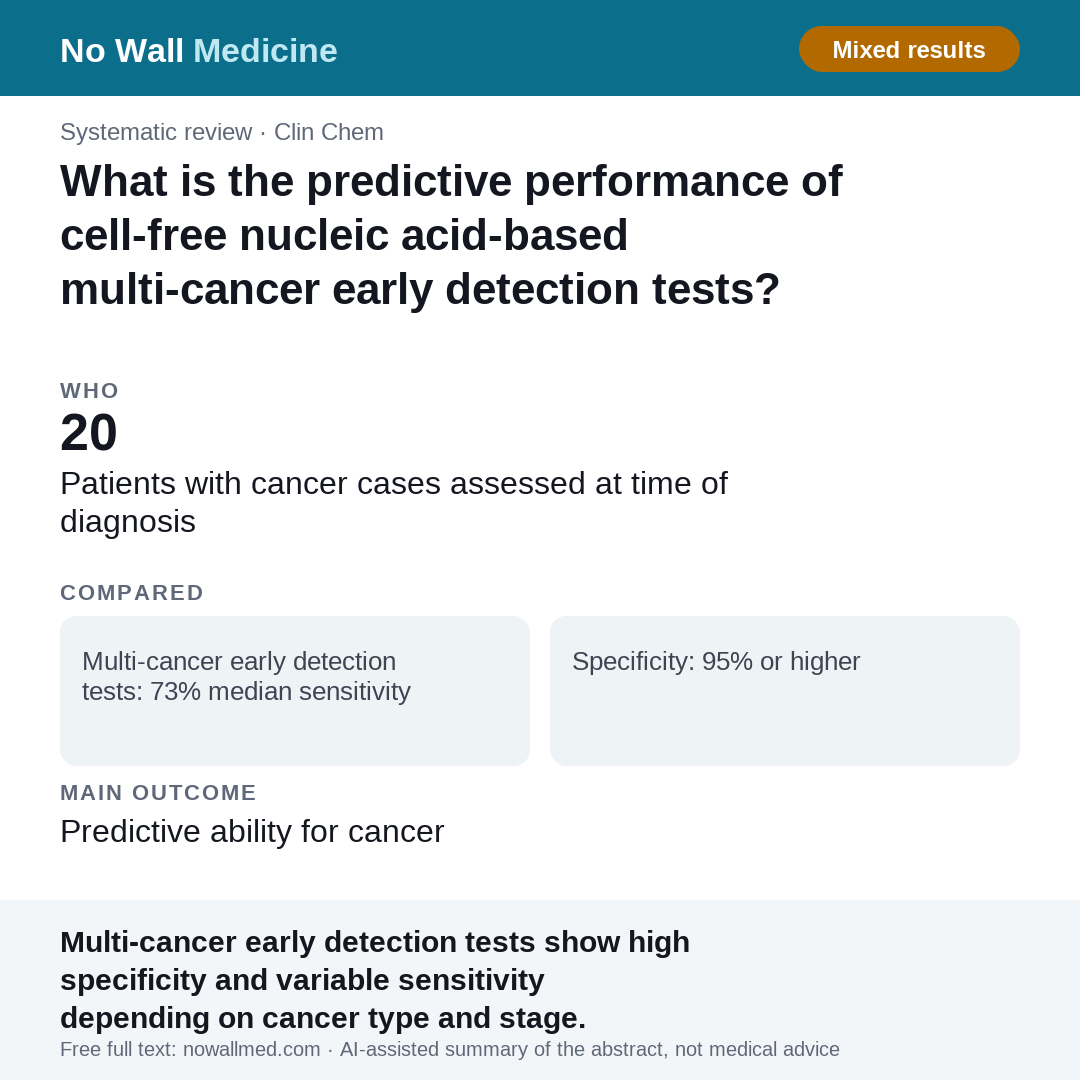
What is the predictive performance of cell-free nucleic acid-based multi-cancer early detection tests?
Who
20
Patients with cancer cases assessed at time of diagnosis
Compared
Multi-cancer early detection tests: 73% median sensitivity
Specificity: 95% or higher
Main outcome
Predictive ability for cancer
Bottom line: Multi-cancer early detection tests show high specificity and variable sensitivity depending on cancer type and stage.
Limitation: Most studies used cancer cases assessed at diagnosis rather than asymptomatic persons.
Clin Chem · 2023-10-04Download image
Clinical question: What is the predictive performance of cell-free nucleic acid-based multi-cancer early detection tests?
Why it matters: The clinical validity of multi-cancer early detection tests, specifically their ability to accurately predict cancer status, has not been established.
Key points
- Researchers reviewed 20 studies involving cell-free nucleic acid-based multi-cancer early detection tests that look for tumor DNA in the blood.
- The reviewed tests showed a median sensitivity of 73% and a specificity that was generally 95% or higher.
- Sensitivity for detecting cancer was generally linked to higher cancer stages and varied depending on the specific cancer type.
Headline and key points written with AI from the paper’s abstract, with every number checked against it. Read the paper before relying on them.
Was this summary helpful?
Subject terms
Cite this article
LeeVan E, Pinsky P. Predictive Performance of Cell-Free Nucleic Acid-Based Multi-Cancer Early Detection Tests: A Systematic Review. Clin Chem. 2023. doi:10.1093/clinchem/hvad134
Spotted a mistake? Suggest a correction
Top studies every Monday
The week’s key trials and guidelines in your specialties, plus any topics you follow. By email, free.
Get the weekly digest