Interferon-gamma release assays may predict tuberculosis better than skin tests in low incidence areas
Predictive performance of interferon-gamma release assays and the tuberculin skin test for incident tuberculosis: an individual participant data meta-analysis
Individual participant data meta-analysisMixed results
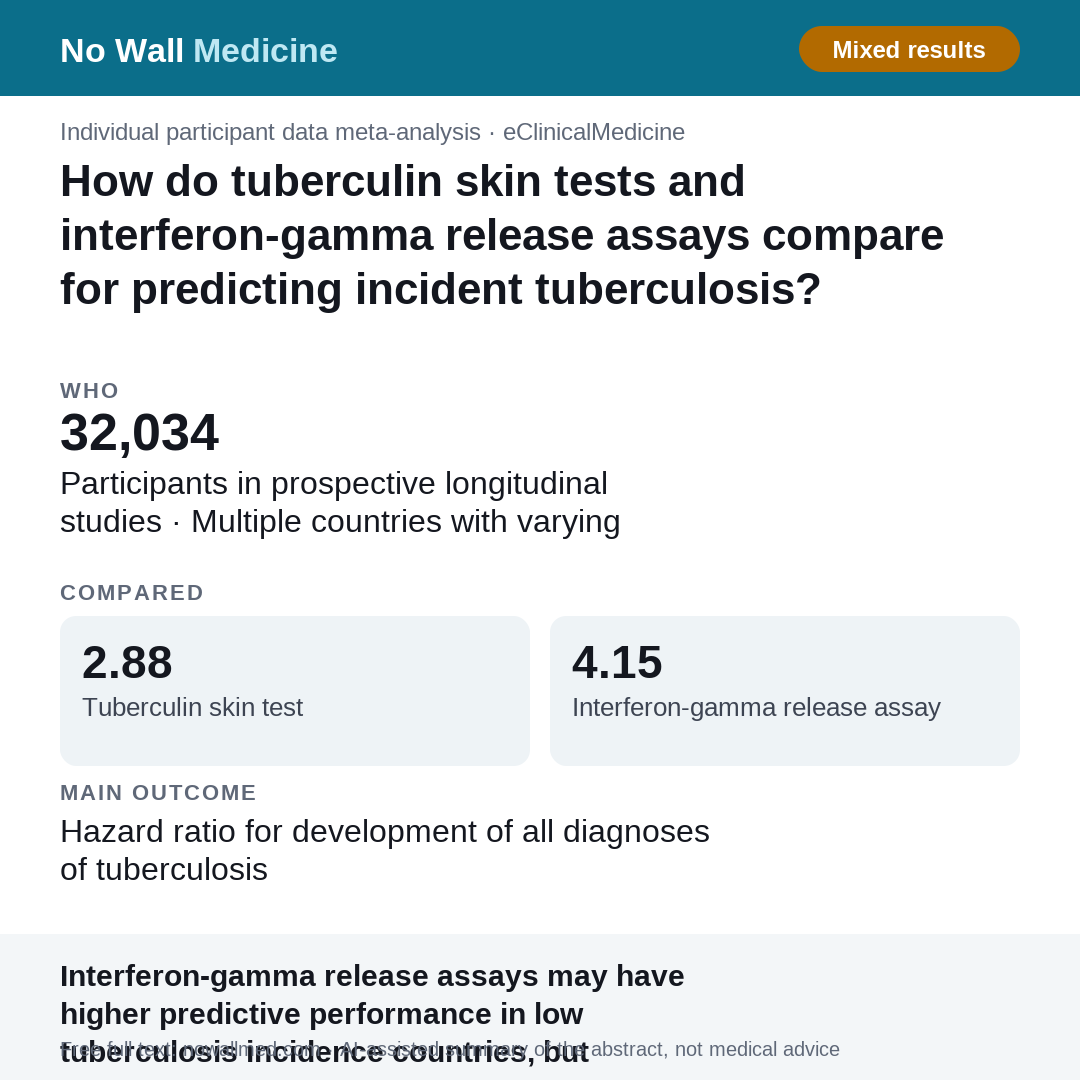
How do tuberculin skin tests and interferon-gamma release assays compare for predicting incident tuberculosis?
Who
32,034
Participants in prospective longitudinal studies · Multiple countries with varying tuberculosis incidence
Compared
2.88Tuberculin skin test (95% CI 1.69-4.90)
4.15Interferon-gamma release assay (95% CI 1.97-8.75)
Main outcome
Hazard ratio for development of all diagnoses of tuberculosis
Bottom line: Interferon-gamma release assays may have higher predictive performance in low tuberculosis incidence countries, but clinical advantages may be small.
Limitation: Much of the difference in low incidence countries was driven by a single study.
Funded by: National Institute for Health and Care Research; Medical Research Council
eClinicalMedicine · 2023-01-05Download image
Clinical question: How do tuberculin skin tests and interferon-gamma release assays compare for predicting incident tuberculosis?
Why it matters: Evidence remains conflicting regarding whether the tuberculin skin test or interferon-gamma release assays are better at predicting the development of active tuberculosis.
Key points
- Researchers analyzed 32,034 participants from 13 studies to compare the tuberculin skin test (TST) and interferon-gamma release assays (IGRA) for predicting active tuberculosis.
- In countries with tuberculosis incidence rates below 100 per 100,000 population, the hazard ratio for IGRA was 4.15 compared to 2.88 for the TST using specific thresholds.
- In low-incidence countries, the sensitivity for predicting tuberculosis was 63% for the skin test and 65% for the blood-based IGRA, both below the 75% target.
Headline and key points written with AI from the paper’s abstract, with every number checked against it. Read the paper before relying on them.
Was this summary helpful?
Cite this article
Hamada Y, Gupta RK, Quartagno M, Izzard A, Acuna-Villaorduna C, Altet N. Predictive performance of interferon-gamma release assays and the tuberculin skin test for incident tuberculosis: an individual participant data meta-analysis. eClinicalMedicine. 2023. doi:10.1016/j.eclinm.2022.101815
Spotted a mistake? Suggest a correction
Top studies every Monday
The week’s key trials and guidelines in your specialties, plus any topics you follow. By email, free.
Get the weekly digest