Machine learning models showed varying accuracy in predicting suicide-related behaviors among adolescents
Predictive Performance of Machine Learning for Suicide in Adolescents: Systematic Review and Meta-Analysis
Systematic review and meta-analysisBenefit found
How well do machine learning models predict suicide-related behaviors in adolescents?
Who
1408375
1,408,375 adolescents aged 11 to 20 years
Compared
0.79Nonsuicidal self-injury (95% CI 0.72-0.86)
0.77Suicidal ideation (95% CI 0.71-0.83)
0.84Suicide attempts (95% CI 0.83-0.86)
0.82Suicide attempts and suicidal ideation (95% CI 0.79-0.84)
Main outcome
Area under the receiver operating characteristic curve
Bottom line: Machine learning models show promising predictive performance for forecasting suicide risk in adolescents, especially for suicide attempts.
Limitation: Predominance of internal validation methods with few studies employing external validation may limit generalizability.
J Med Internet Res · 2025-06-16Download image
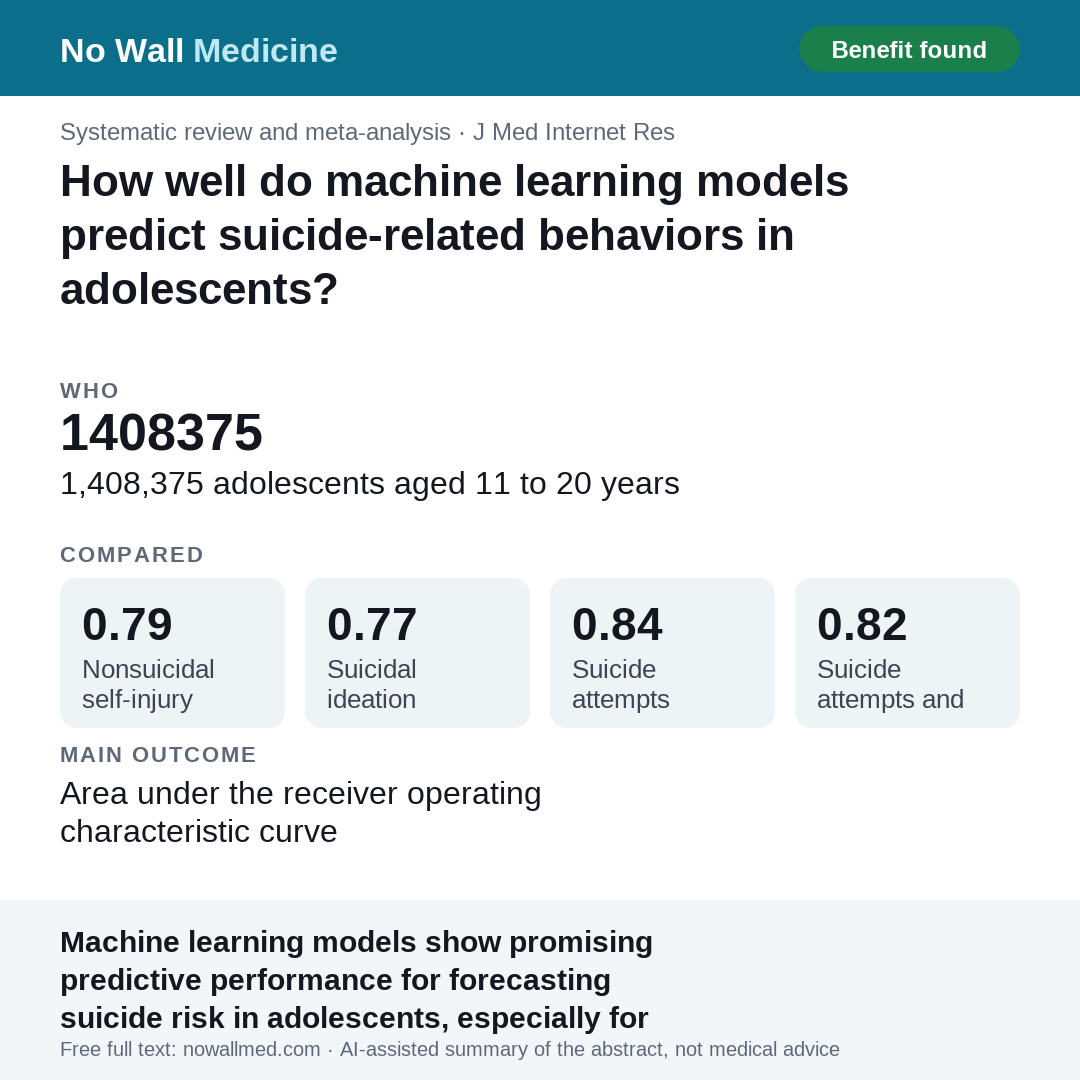
Clinical question: How well do machine learning models predict suicide-related behaviors in adolescents?
Why it matters: Traditional assessment tools demonstrate limited predictive accuracy for identifying suicide risk in adolescents, creating a need for more effective identification methods.
Key points
- Researchers analyzed 42 studies involving 1,408,375 adolescents aged 11 to 20 years to evaluate machine learning models for predicting suicide-related behaviors.
- The combined area under the receiver operating characteristic curve, a measure of accuracy, was 0.84 for suicide attempts and 0.77 for suicidal ideation.
- Machine learning models showed a combined sensitivity of 0.80 for suicide attempt prediction and a combined specificity of 0.96 for nonsuicidal self-injury prediction.
Limitation the authors note: The authors state that the predominance of internal validation methods and few studies employing external validation may limit the generalizability of the results.
Headline and key points written with AI from the paper’s abstract, with every number checked against it. Read the paper before relying on them.
Topics
Cite this article
Liu L, Li Z, Hu Y, Li C, He S, Zhang S. Predictive Performance of Machine Learning for Suicide in Adolescents: Systematic Review and Meta-Analysis. J Med Internet Res. 2025. doi:10.2196/73052
Spotted a mistake? Suggest a correction
Top studies every Monday
The week’s key trials and guidelines in your specialties, by email. Free.
Get the weekly digest