Microsatellite instability status predicts response to PD-1 blockade in advanced gastric cancer patients
Predictive role of microsatellite instability for PD-1 blockade in patients with advanced gastric cancer: a meta-analysis of randomized clinical trials
Meta-analysis of randomized clinical trialsBenefit found
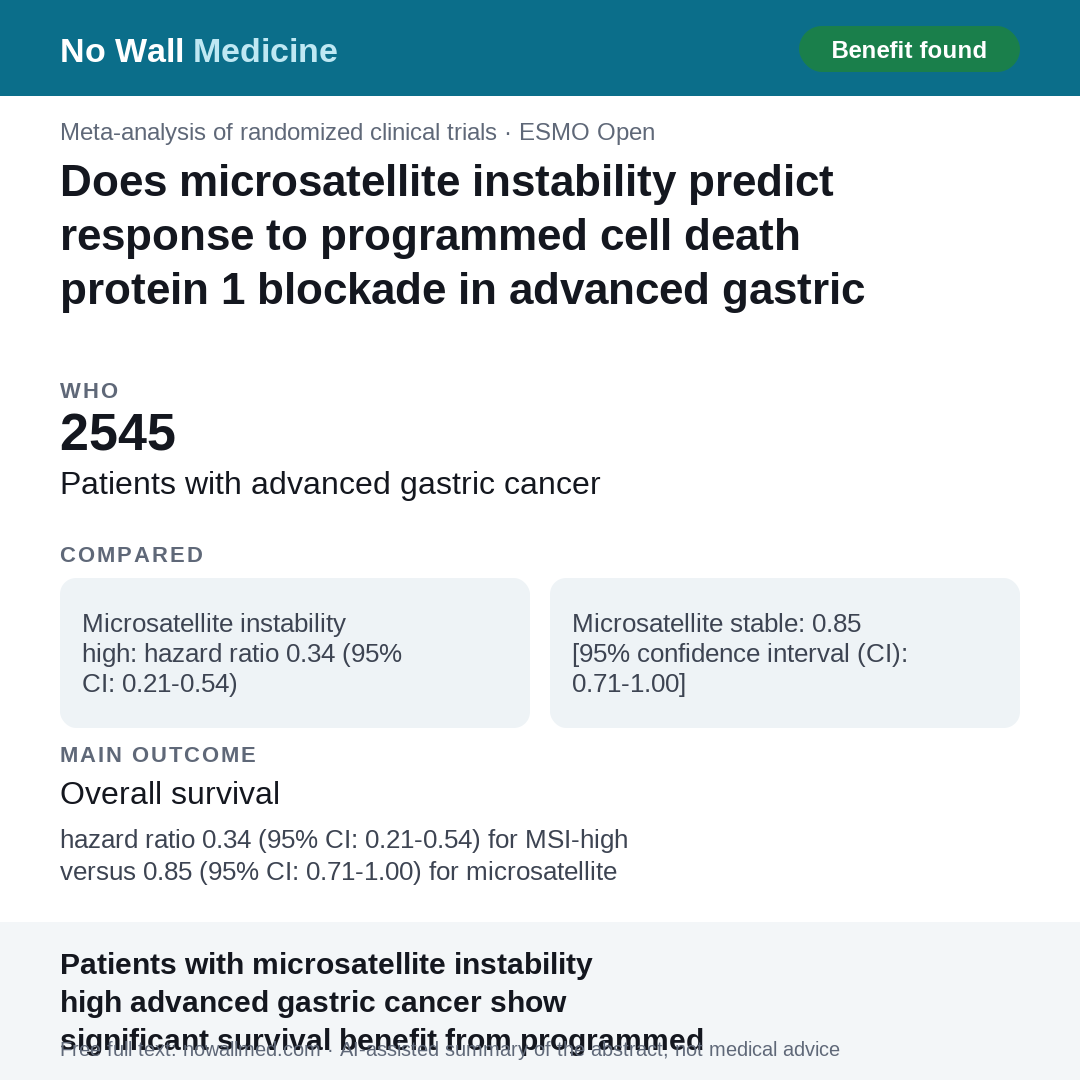
Does microsatellite instability predict response to programmed cell death protein 1 blockade in advanced gastric cancer?
Who
2545
Patients with advanced gastric cancer
Compared
Microsatellite instability high: hazard ratio 0.34 (95% CI: 0.21-0.54)
Microsatellite stable: 0.85 [95% confidence interval (CI): 0.71-1.00]
Main outcome
Overall survival
Result: hazard ratio 0.34 (95% CI: 0.21-0.54) for MSI-high versus 0.85 (95% CI: 0.71-1.00) for microsatellite stable
Bottom line: Patients with microsatellite instability high advanced gastric cancer show significant survival benefit from programmed cell death protein 1 blockade.
ESMO Open · 2021-01-15Download image
Clinical question: Does microsatellite instability predict response to programmed cell death protein 1 blockade in advanced gastric cancer?
Why it matters: Individual analyses of randomized trials have had low statistical power to determine if microsatellite instability is a positive predictive factor for immunotherapy in advanced gastric cancer.
Key points
- Researchers analyzed 2545 patients from four randomized clinical trials, including 123 (4.8%) with microsatellite instability-high cancers.
- In patients with microsatellite instability-high cancers, the hazard ratio for overall survival with anti-PD-1 therapy was 0.34 compared to 0.85 for microsatellite stable patients.
- The microsatellite instability-high group showed a hazard ratio for progression-free survival of 0.57 and an odds ratio for tumor response of 1.76.
Headline and key points written with AI from the paper’s abstract, with every number checked against it. Read the paper before relying on them.
Was this summary helpful?
Subject terms
Cite this article
Pietrantonio F, Randon G, Di Bartolomeo M, Luciani A, Chao J, Smyth EC. Predictive role of microsatellite instability for PD-1 blockade in patients with advanced gastric cancer: a meta-analysis of randomized clinical trials. ESMO Open. 2021. doi:10.1016/j.esmoop.2020.100036
Spotted a mistake? Suggest a correction
Top studies every Monday
The week’s key trials and guidelines in your specialties, plus any topics you follow. By email, free.
Get the weekly digest