Preclinical mouse models failed to predict clinical outcomes for chimeric antigen receptor T cell therapies
Predictive value of preclinical models for CAR-T cell therapy clinical trials: a systematic review and meta-analysis
Systematic review and meta-analysisMixed results
How well do preclinical models predict clinical outcomes for CAR-T cell therapy?
Who
Chimeric antigen receptor T cell monotherapy clinical and preclinical studies
Compared
Clinical outcomes predicted by clinical/preclinical features: Macro F1 and area under the curve >0.8
Preclinical outcomes predicted by preclinical features: Macro F1 <0.5, area under the curve <0.6
Main outcome
Predictive accuracy of preclinical models for clinical outcomes
Bottom line: Models accurately predict clinical outcomes from clinical features but fail to predict preclinical outcomes from preclinical features.
J Immunother Cancer · 2025-06-12Download image
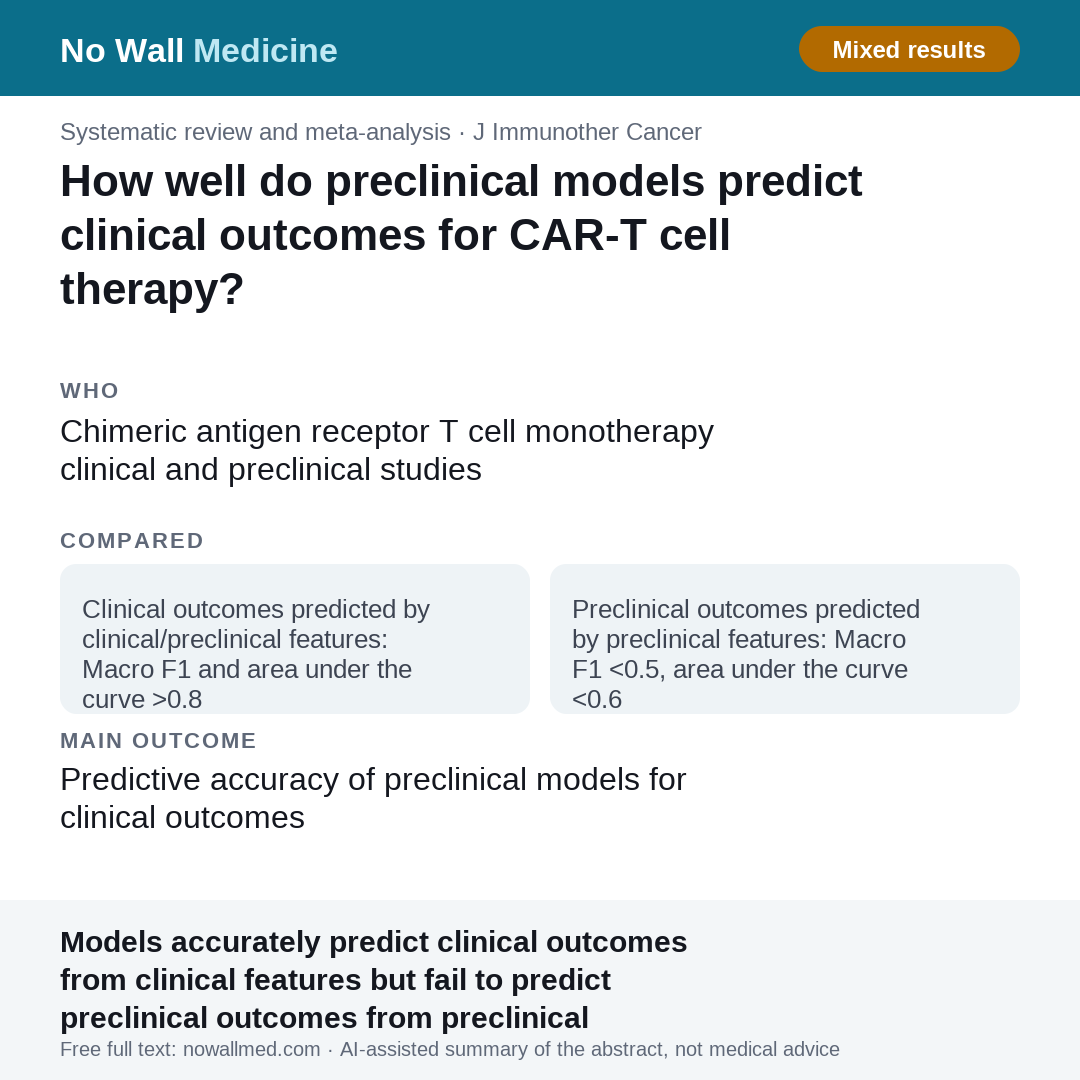
Clinical question: How well do preclinical models predict clinical outcomes for CAR-T cell therapy?
Why it matters: The predictive capacity of experimental mouse models for clinical outcomes in chimeric antigen receptor T cell therapy remains largely unknown.
Key points
- Researchers analyzed 105 clinical trials and 180 preclinical studies involving 44 and 131 distinct chimeric antigen receptor T cell constructs.
- While a model accurately predicted clinical outcomes using clinical features, it failed to predict clinical outcomes from preclinical features with a Macro F1 < 0.5 and AUC < 0.6.
- Only 4% (n=12) of the mouse studies included in the analysis used syngeneic models, which are models where the immune system of the mouse is compatible with the tumor.
Headline and key points written with AI from the paper’s abstract, with every number checked against it. Read the paper before relying on them.
Was this summary helpful?
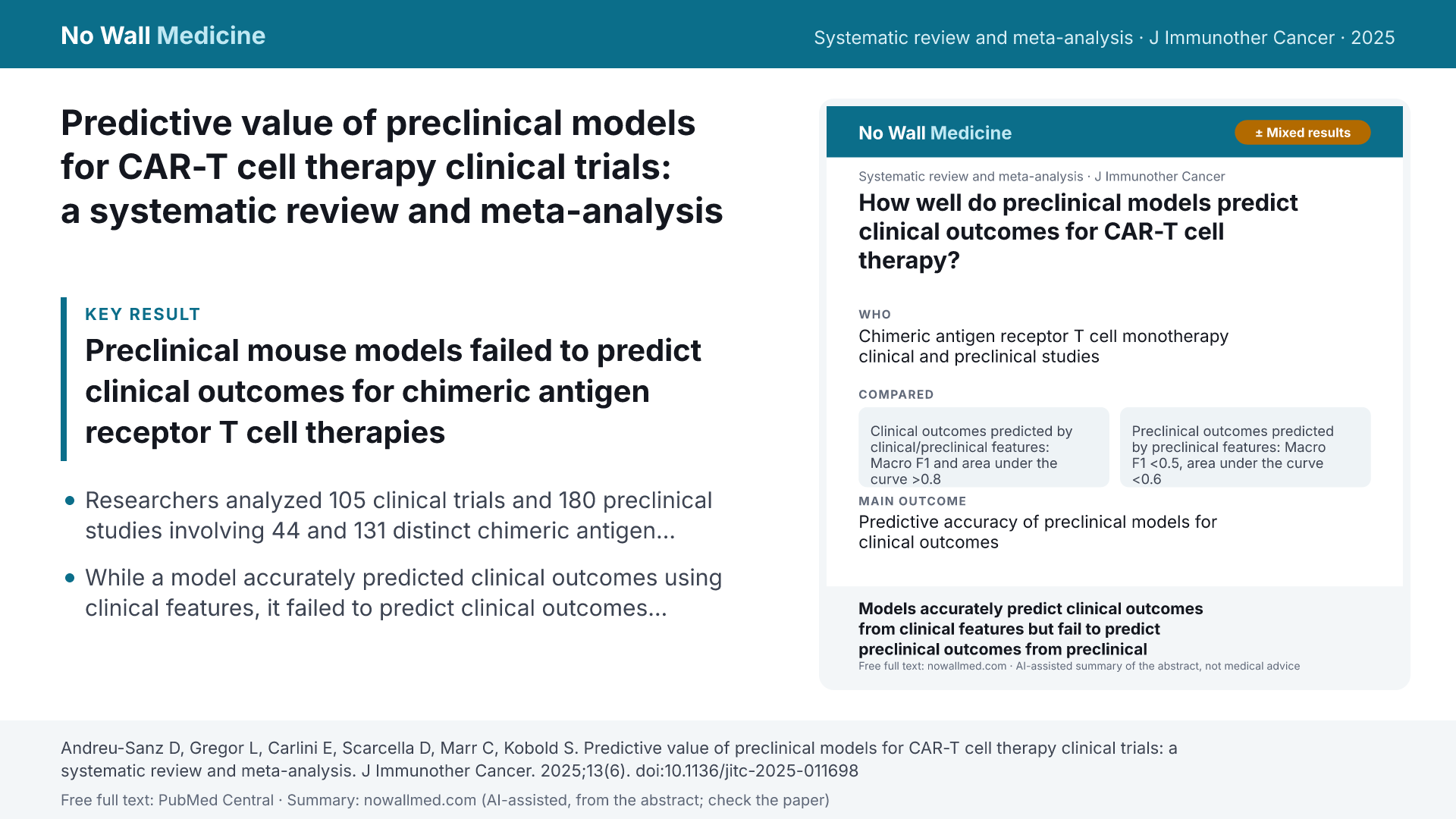
Abstract
Background Experimental mouse models are indispensable for the preclinical development of cancer immunotherapies, whereby complex interactions in the tumor microenvironment can be somewhat replicated. Despite the availability of diverse models, their predictive capacity for clinical outcomes remains largely unknown, posing a hurdle in the translation from preclinical to clinical success. Methods This study systematically reviews and meta-analyzes clinical trials of chimeric antigen receptor (CAR)-T cell monotherapies with their corresponding preclinical studies. Adhering to Preferred Reporting Items for Systematic Reviews and Meta-Analyses guidelines, a comprehensive search of PubMed and ClinicalTrials.gov was conducted, identifying 422 clinical trials and 3,157 preclinical studies. From these, 105 clinical trials and 180 preclinical studies, accounting for 44 and 131 distinct CAR constructs, respectively, were included. Results Patients' responses varied based on the target antigen, expectedly with higher efficacy and toxicity rates in hematological cancers. Preclinical data analysis revealed homogeneous and antigen-independent efficacy rates. Our analysis revealed that only 4% (n=12) of mouse studies used syngeneic models, highlighting their scarcity in research. Three logistic regression models were trained on CAR structures, tumor entities, and experimental settings to predict treatment outcomes. While the logistic regression model accurately predicted clinical outcomes based on clinical or preclinical features (Macro F1 and area under the curve (AUC)>0.8), it failed in predicting preclinical outcomes from preclinical features (Macro F1<0.5, AUC<0.6), indicating that preclinical studies may be influenced by experimental factors not accounted for in the model. Conclusion These findings underscore the need to better understand the experimental factors enhancing the predictive accuracy of mouse models in preclinical settings.
Abstract reproduced under the article’s CC BY NC licence.
Subject terms
Cite this article
Andreu-Sanz D, Gregor L, Carlini E, Scarcella D, Marr C, Kobold S. Predictive value of preclinical models for CAR-T cell therapy clinical trials: a systematic review and meta-analysis. J Immunother Cancer. 2025. doi:10.1136/jitc-2025-011698
Spotted a mistake? Suggest a correction
Top studies every Monday
The week’s key trials and guidelines in your specialties, plus any topics you follow. By email, free.
Get the weekly digest