Predictive Value of Serum N-Terminal pro-B-Type Natriuretic Peptide and Troponin T for Incident Heart Failure: A Meta-Analysis of 9 International Cohorts
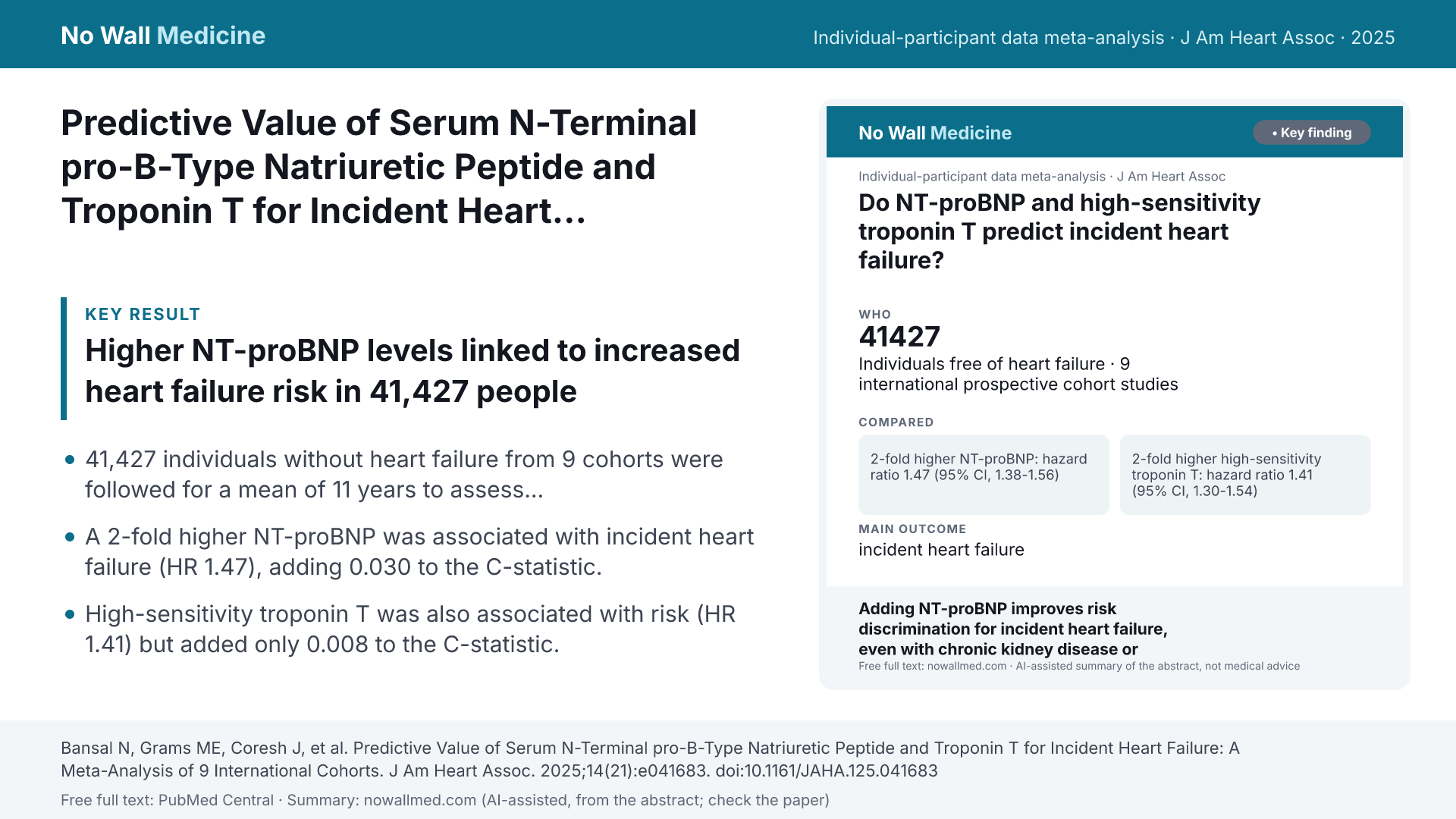
Key result: Higher NT-proBNP levels linked to increased heart failure risk in 41,427 people
Individual-participant data meta-analysisKey finding
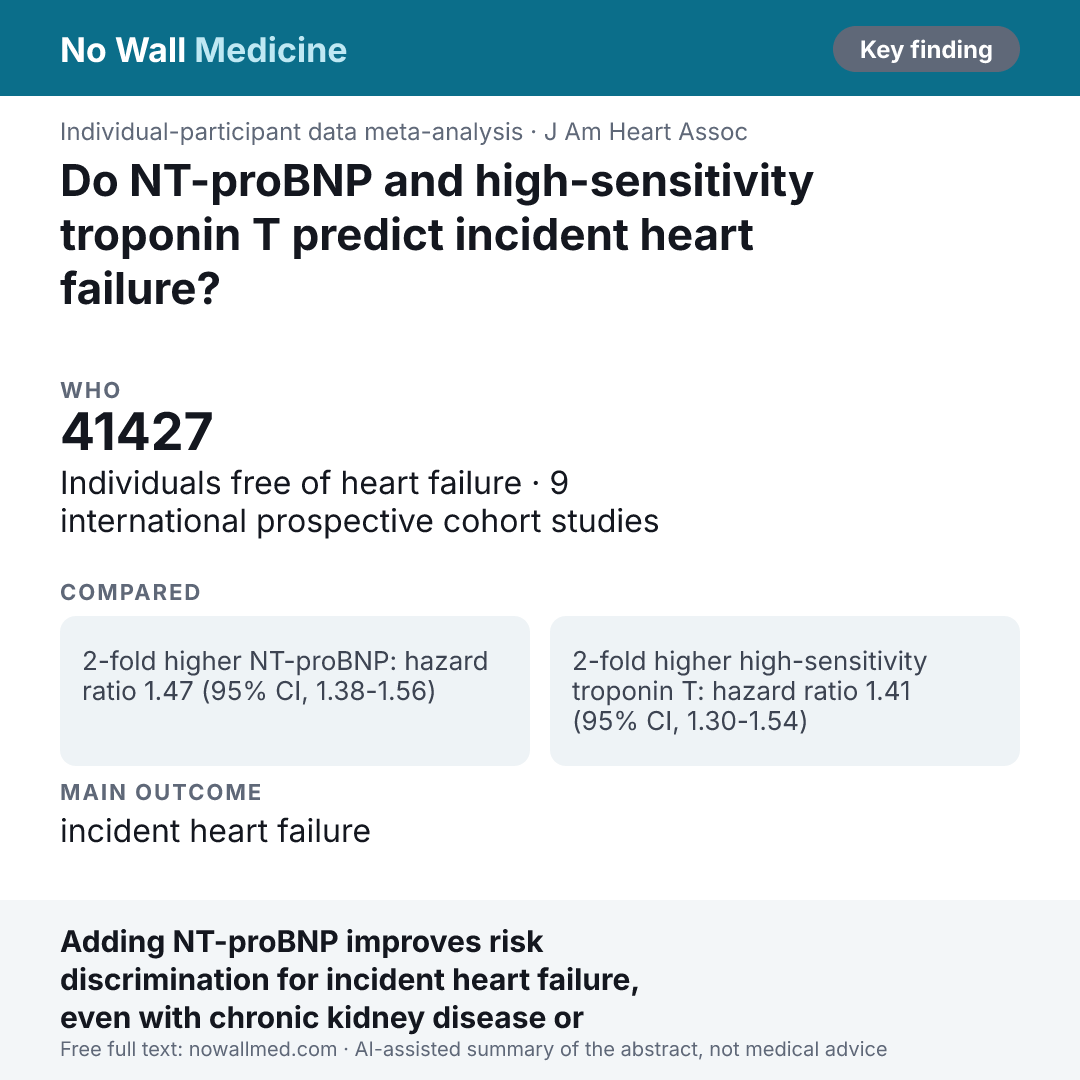
Do NT-proBNP and high-sensitivity troponin T predict incident heart failure?
Who
41427
Individuals free of heart failure · 9 international prospective cohort studies
Compared
2-fold higher NT-proBNP: hazard ratio 1.47 (95% CI, 1.38-1.56)
2-fold higher high-sensitivity troponin T: hazard ratio 1.41 (95% CI, 1.30-1.54)
Main outcome
incident heart failure
Result: C-statistic increase 0.030 (95% CI, 0.021-0.040) for NT-proBNP
Bottom line: Adding NT-proBNP improves risk discrimination for incident heart failure, even with chronic kidney disease or atherosclerotic cardiovascular disease.
J Am Heart Assoc · 2025-10-30 · Save PNG
Key points
- 41,427 individuals without heart failure from 9 cohorts were followed for a mean of 11 years to assess biomarker associations.
- A 2-fold higher NT-proBNP was associated with incident heart failure (HR 1.47), adding 0.030 to the C-statistic.
- High-sensitivity troponin T was also associated with risk (HR 1.41) but added only 0.008 to the C-statistic.
Why it matters: Prior prediction equations for heart failure omitted cardiac biomarkers and used select populations, limiting their broad applicability.
Discussion prompts
- Would these patients look like yours? Who was left out?
- Is the main outcome one that matters to patients?
- Is the difference large enough to change what you do?
Cite: Bansal N, Grams ME, Coresh J, et al. Predictive Value of Serum N-Terminal pro-B-Type Natriuretic Peptide and Troponin T for Incident Heart Failure: A Meta-Analysis of 9 International Cohorts. J Am Heart Assoc. 2025;14(21):e041683. doi:10.1161/JAHA.125.041683
Free full text: PubMed Central · Summary and visual abstract: nowallmed.com/a/predictive-value-of-serum-n-terminal-pro-b-type-natriuretic-peptide-a8ktgw/ (AI-assisted from the abstract; check the paper before relying on it).