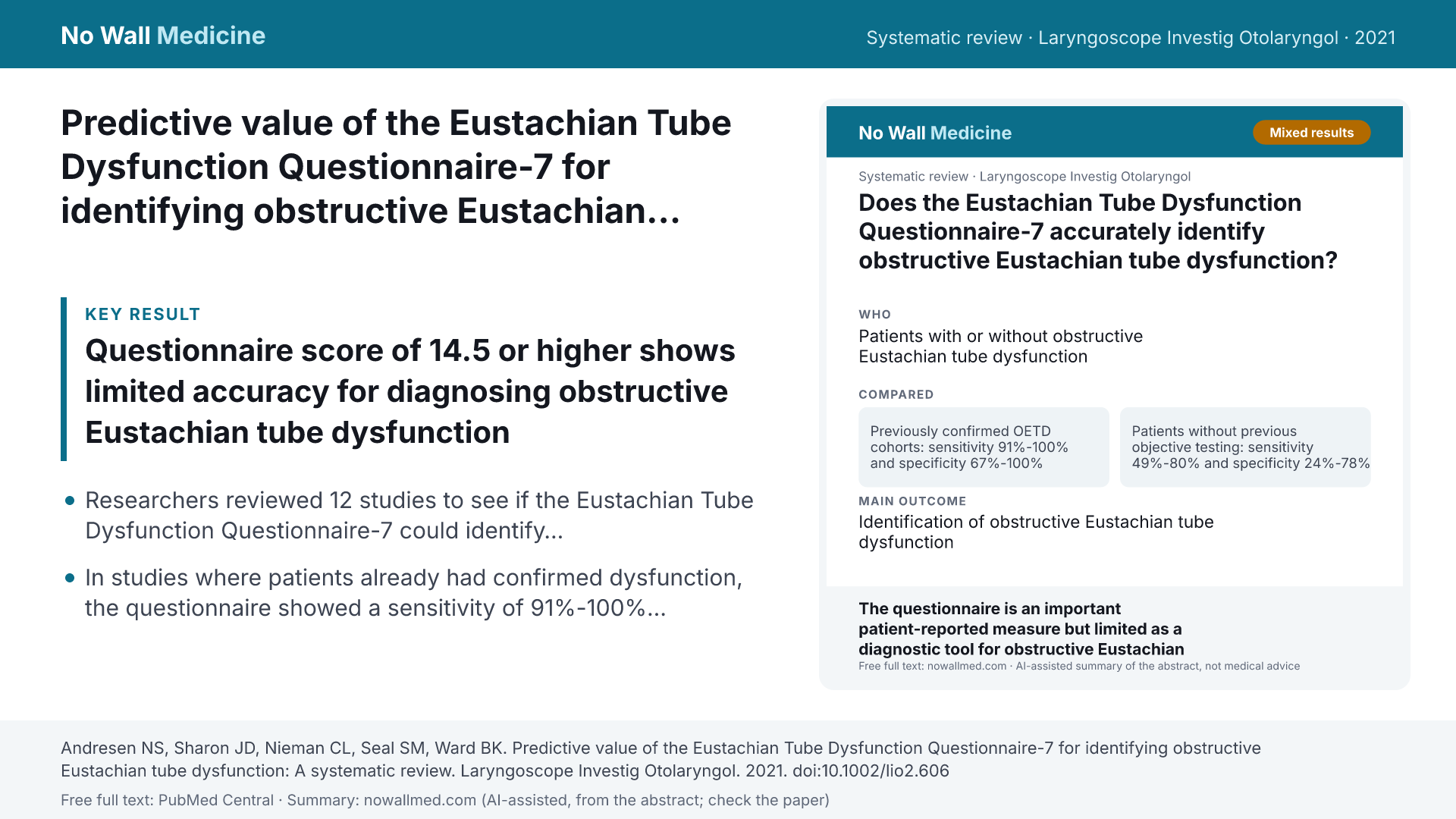
Questionnaire score of 14.5 or higher shows limited accuracy for diagnosing obstructive Eustachian tube dysfunction
Predictive value of the Eustachian Tube Dysfunction Questionnaire-7 for identifying obstructive Eustachian tube dysfunction: A systematic review
Systematic reviewMixed results
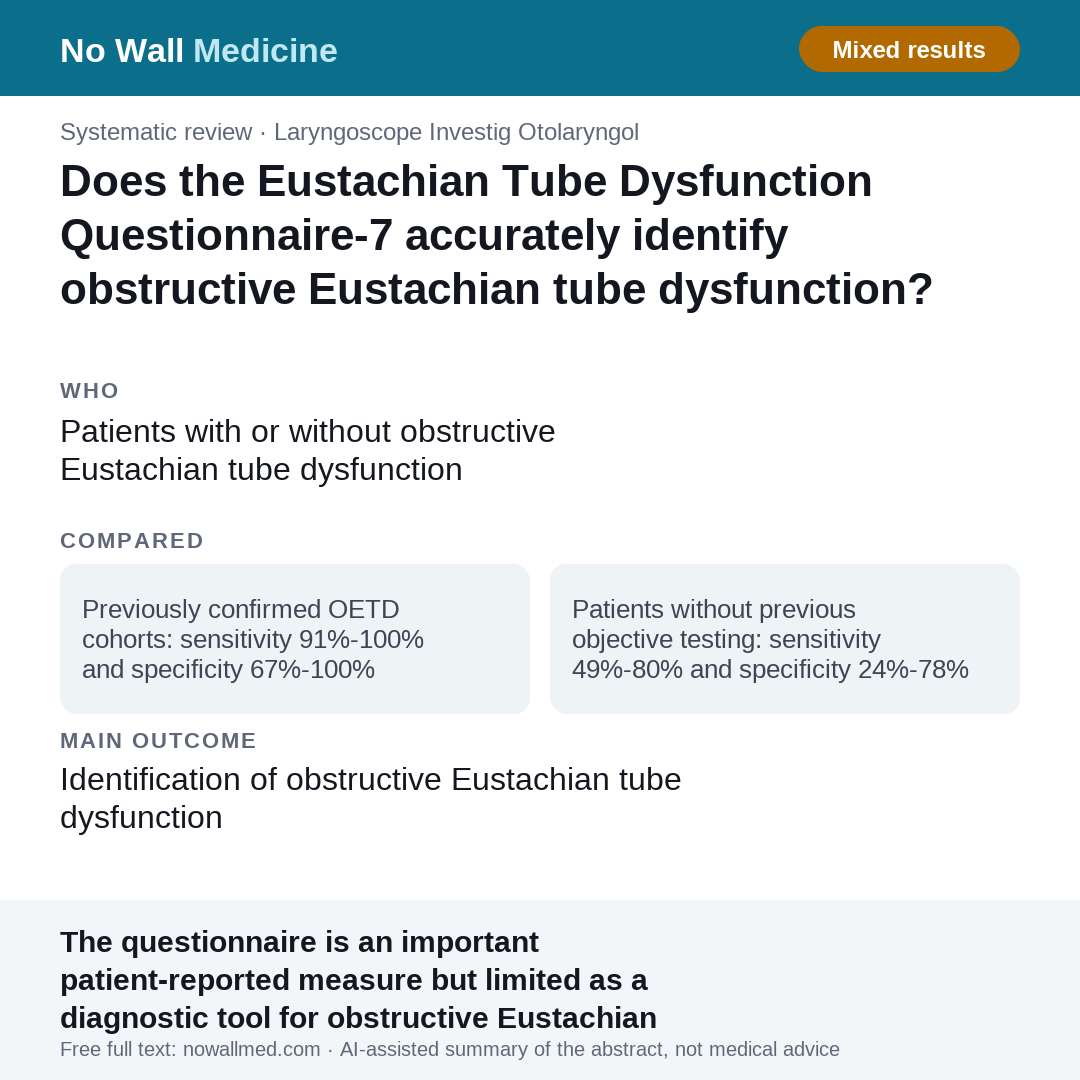
Does the Eustachian Tube Dysfunction Questionnaire-7 accurately identify obstructive Eustachian tube dysfunction?
Who
Patients with or without obstructive Eustachian tube dysfunction
Compared
Previously confirmed OETD cohorts: sensitivity 91%-100% and specificity 67%-100%
Patients without previous objective testing: sensitivity 49%-80% and specificity 24%-78%
Main outcome
Identification of obstructive Eustachian tube dysfunction
Bottom line: The questionnaire is an important patient-reported measure but limited as a diagnostic tool for obstructive Eustachian tube dysfunction.
Limitation: Eight of the twelve included studies had patient cohort selection bias.
Laryngoscope Investig Otolaryngol · 2021-06-24Download image
Clinical question: Does the Eustachian Tube Dysfunction Questionnaire-7 accurately identify obstructive Eustachian tube dysfunction?
Key points
- Researchers reviewed 12 studies to see if the Eustachian Tube Dysfunction Questionnaire-7 could identify obstructive Eustachian tube dysfunction using objective measures like middle ear pressure tests.
- In studies where patients already had confirmed dysfunction, the questionnaire showed a sensitivity of 91%-100% and specificity of 67%-100%.
- In studies where patients had not undergone objective testing, the questionnaire showed a sensitivity of 49%-80% and specificity of 24%-78%.
Limitation the authors note: Eight of the 12 included studies had patient cohort selection bias.
Headline and key points written with AI from the paper’s abstract, with every number checked against it. Read the paper before relying on them.
Was this summary helpful?
Headline, design, result, key points, caveat and citation as plain text.
Cite this article
Andresen NS, Sharon JD, Nieman CL, Seal SM, Ward BK. Predictive value of the Eustachian Tube Dysfunction Questionnaire-7 for identifying obstructive Eustachian tube dysfunction: A systematic review. Laryngoscope Investig Otolaryngol. 2021. doi:10.1002/lio2.606
Spotted a mistake? Suggest a correction