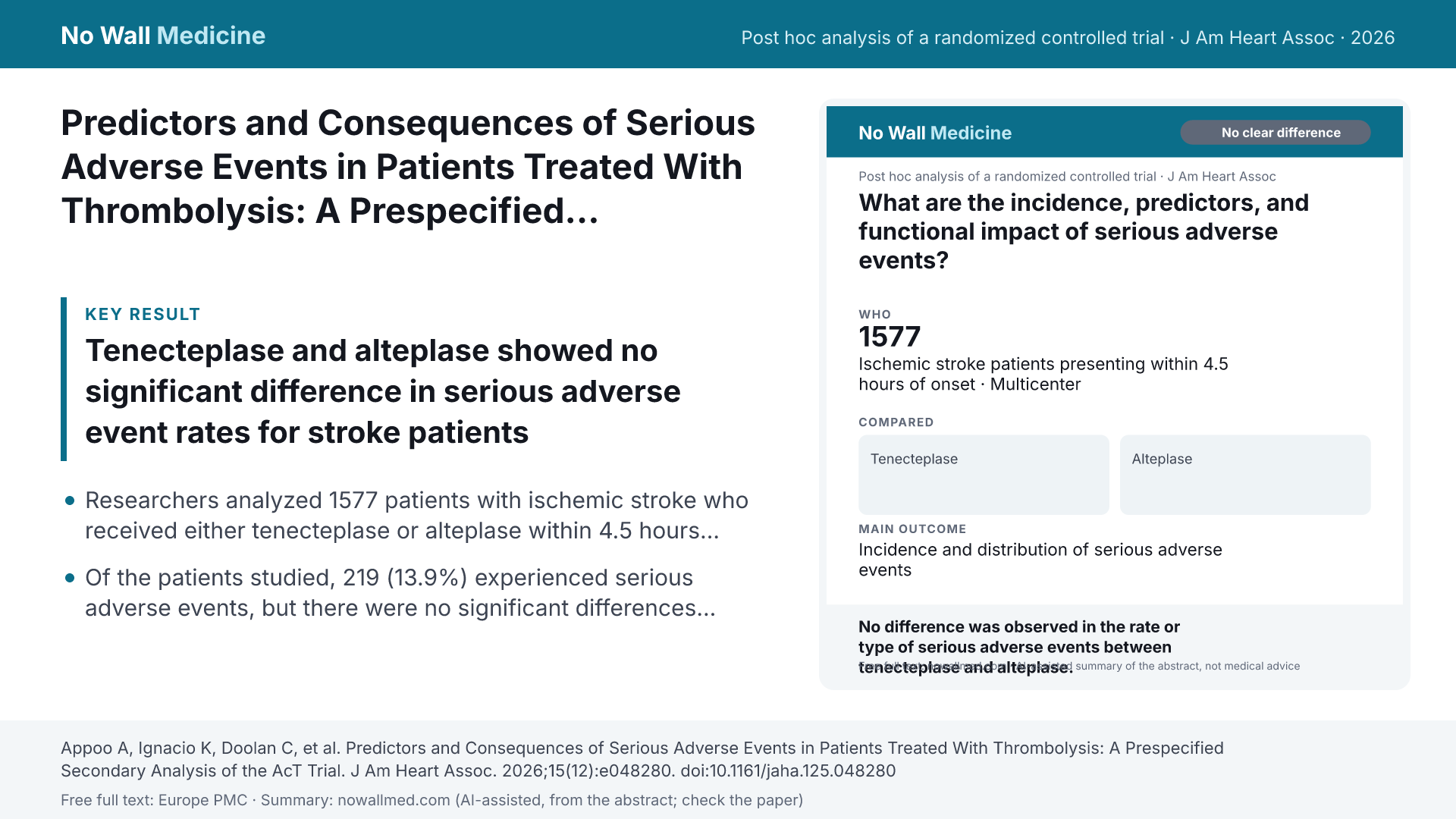
Tenecteplase and alteplase showed no significant difference in serious adverse event rates for stroke patients
Predictors and Consequences of Serious Adverse Events in Patients Treated With Thrombolysis: A Prespecified Secondary Analysis of the AcT Trial
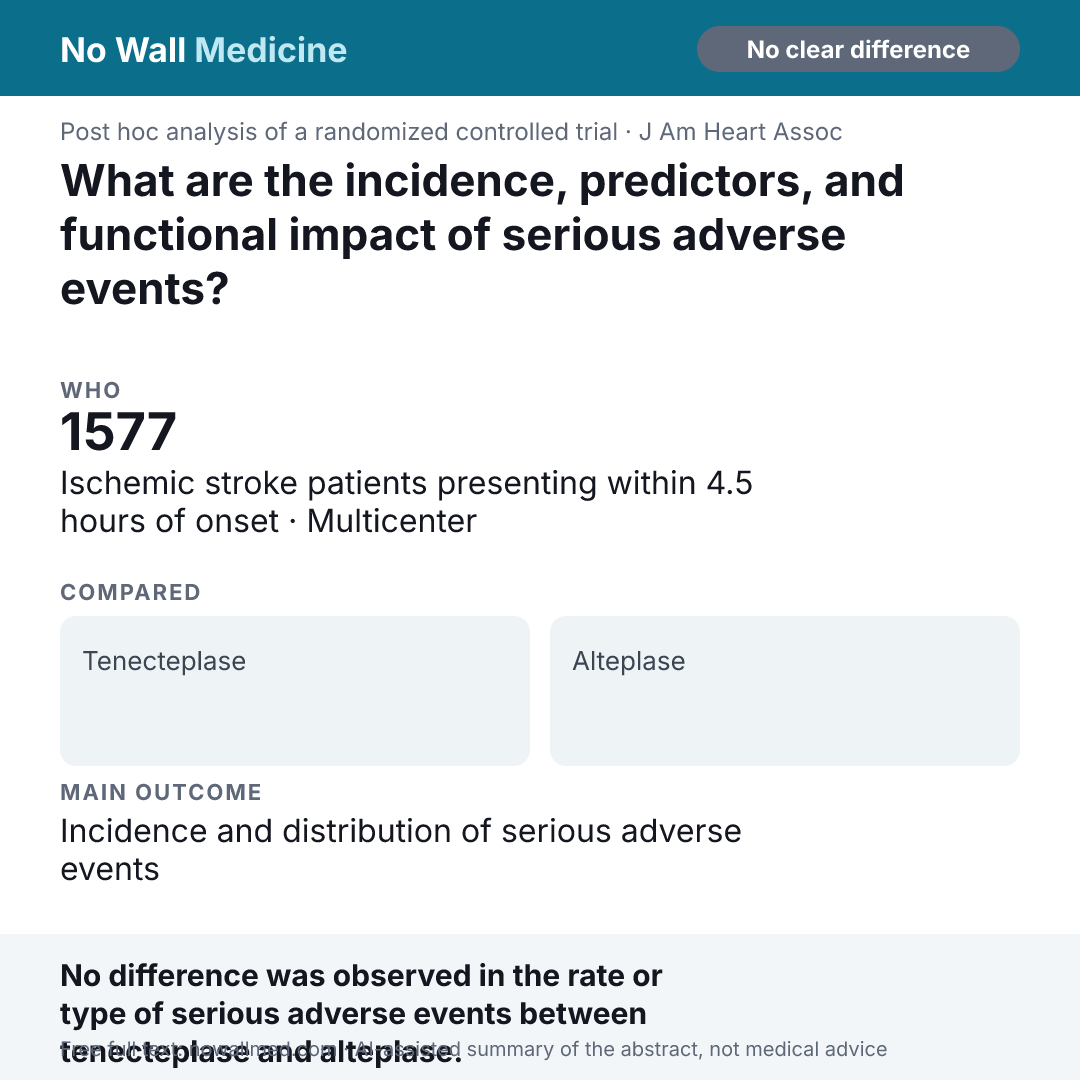
Post hoc analysis of a randomized controlled trialNo clear difference
What are the incidence, predictors, and functional impact of serious adverse events?
Who
1577
Ischemic stroke patients presenting within 4.5 hours of onset · Multicenter
Compared
Tenecteplase
Alteplase
Main outcome
Incidence and distribution of serious adverse events
Bottom line: No difference was observed in the rate or type of serious adverse events between tenecteplase and alteplase.
J Am Heart Assoc · 2026-06-09 · Save PNG
Same trial (NCT03889249)
Papers we list that report this registered trial, oldest first. Read a secondary analysis alongside the main results.
- Main results No clear difference
Tenecteplase and alteplase treatments showed no significant difference in patient quality of life after stroke Stroke 2024-01 - Secondary analysis No clear difference
This paper J Am Heart Assoc 2026-06
Clinical question: What are the incidence, predictors, and functional impact of serious adverse events?
Why it matters: It is important to understand the safety, predictors, and functional impact of serious adverse events when comparing tenecteplase to alteplase in stroke patients.
Key points
- Researchers analyzed 1577 patients with ischemic stroke who received either tenecteplase or alteplase within 4.5 hours of symptom onset.
- Of the patients studied, 219 (13.9%) experienced serious adverse events, but there were no significant differences in the distribution of these events between the two drugs.
- Patients experiencing serious adverse events had higher 90-day modified Rankin Scale scores, which is a measure of disability, with a median of 4 versus 2.
Headline and key points written with AI from the paper’s abstract, with every number checked against it. Read the paper before relying on them.
Was this summary helpful?
Abstract
Background
With the increasing use of tenecteplase, it is important to understand its safety compared with alteplase. We aimed to determine the incidence, predictors, and functional impact of serious adverse events (SAEs) in patients treated with alteplase versus tenecteplase. Methods
This is a post hoc analysis of the AcT (Alteplase Compared to Tenecteplase) trial, a phase 3 multicenter randomized controlled trial that randomized 1577 ischemic patients with stroke (2019-2022) into tenecteplase versus alteplase presenting <4.5 hours of onset. SAEs were recorded within 24 hours of treatment and classified by organ system using the Medical Dictionary for Regulatory Activities. Mixed-effects logistic regression evaluated predictors of SAEs and their impact on 90-day modified Rankin Scale. Results
Of the 1577 enrolled, 219 (13.9%) patients had SAEs. Patients with SAEs had higher National Institutes of Health Stroke Scale (median, 11 versus 9; P=0.002) and higher endovascular treatment rates (50.2% versus 29.2%; P<0.001) than those without SAEs. Nervous system disorders were the most common SAE (58.2%), including stroke worsening (26.7%) and intracranial hemorrhage (25%). No significant differences were observed in SAE distribution by thrombolytic. Patients with SAEs had higher 90-day modified Rankin Scale scores (median, 4 versus 2; odds ratio [OR], 3.93 [95% CI, 2.78-5.56]). Independent predictors of SAEs included baseline National Institutes of Health Stroke Scale (per SD increase: OR, 1.2 [95% CI, 1.0-1.5]), large-vessel occlusion (OR, 1.6 [95% CI, 1.1-2.5]), Alberta Stroke Program Early Computed Tomography Score (per point increase: OR, 0.9 [95% CI, 0.8-1.0]), and cerebral atrophy (per point increase: OR, 1.5 [95% CI, 1.1-1.9]). Conclusions
Our study found no difference between rate or type of SAEs by thrombolytic type, supporting the safety of tenecteplase. Registration
URL: https://www.clinicaltrials.gov; Unique Identifier: NCT03889249.
Abstract reproduced under the article’s CC BY-NC-ND licence.
Subject terms
Headline, design, result, key points, caveat and citation as plain text.
Cite this article
Appoo A, Ignacio K, Doolan C, et al. Predictors and Consequences of Serious Adverse Events in Patients Treated With Thrombolysis: A Prespecified Secondary Analysis of the AcT Trial. J Am Heart Assoc. 2026;15(12):e048280. doi:10.1161/jaha.125.048280
Spotted a mistake? Suggest a correction