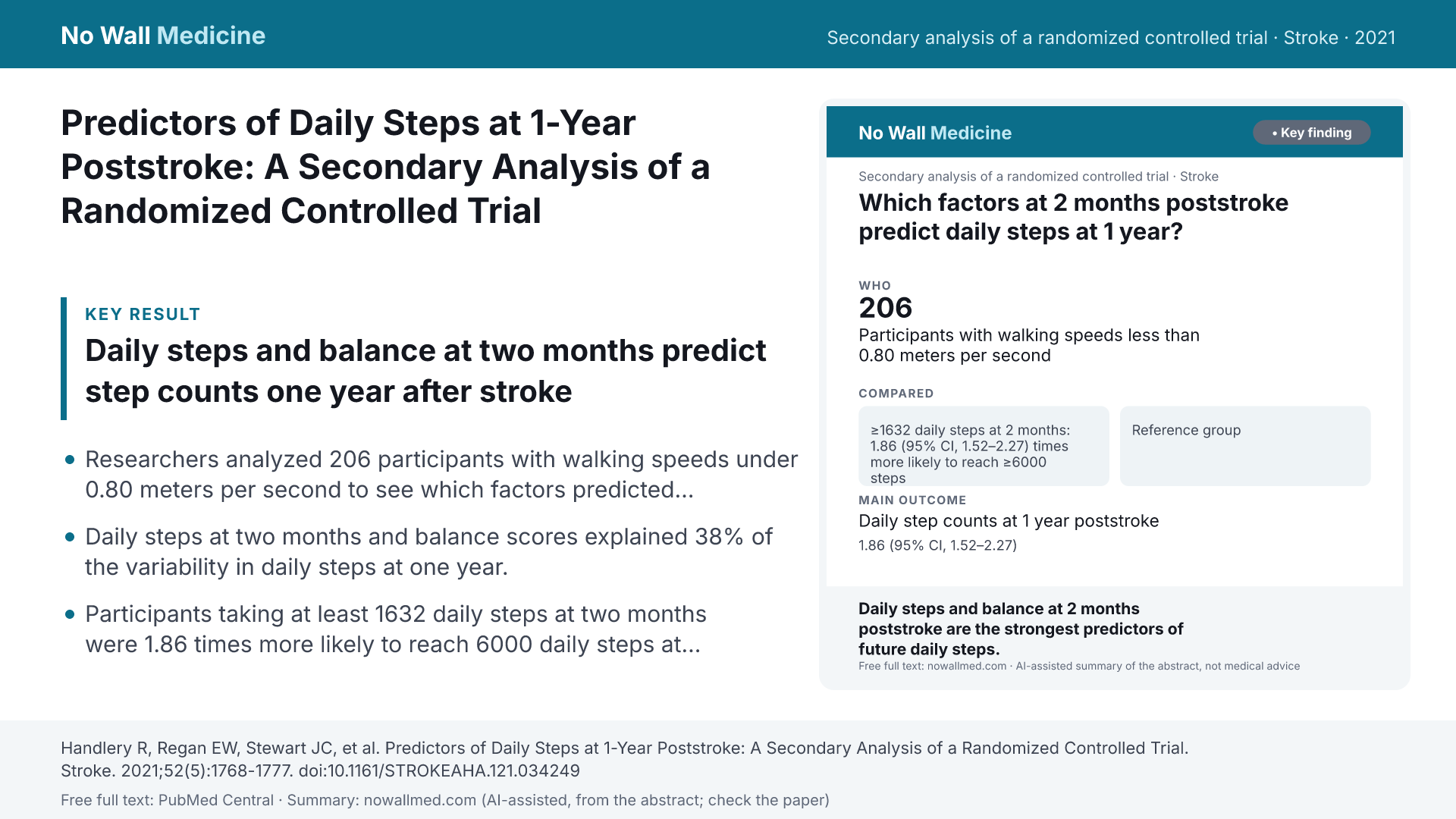
Daily steps and balance at two months predict step counts one year after stroke
Predictors of Daily Steps at 1-Year Poststroke: A Secondary Analysis of a Randomized Controlled Trial
Secondary analysis of a randomized controlled trialKey finding
Which factors at 2 months poststroke predict daily steps at 1 year?
Who
206
Participants with walking speeds less than 0.80 meters per second
Compared
≥1632 daily steps at 2 months: 1.86 (95% CI, 1.52–2.27) times more likely to reach ≥6000 steps
Reference group
Main outcome
Daily step counts at 1 year poststroke
Result: 1.86 (95% CI, 1.52–2.27)
Bottom line: Daily steps and balance at 2 months poststroke are the strongest predictors of future daily steps.
Stroke · 2021-03-11 · Save PNG
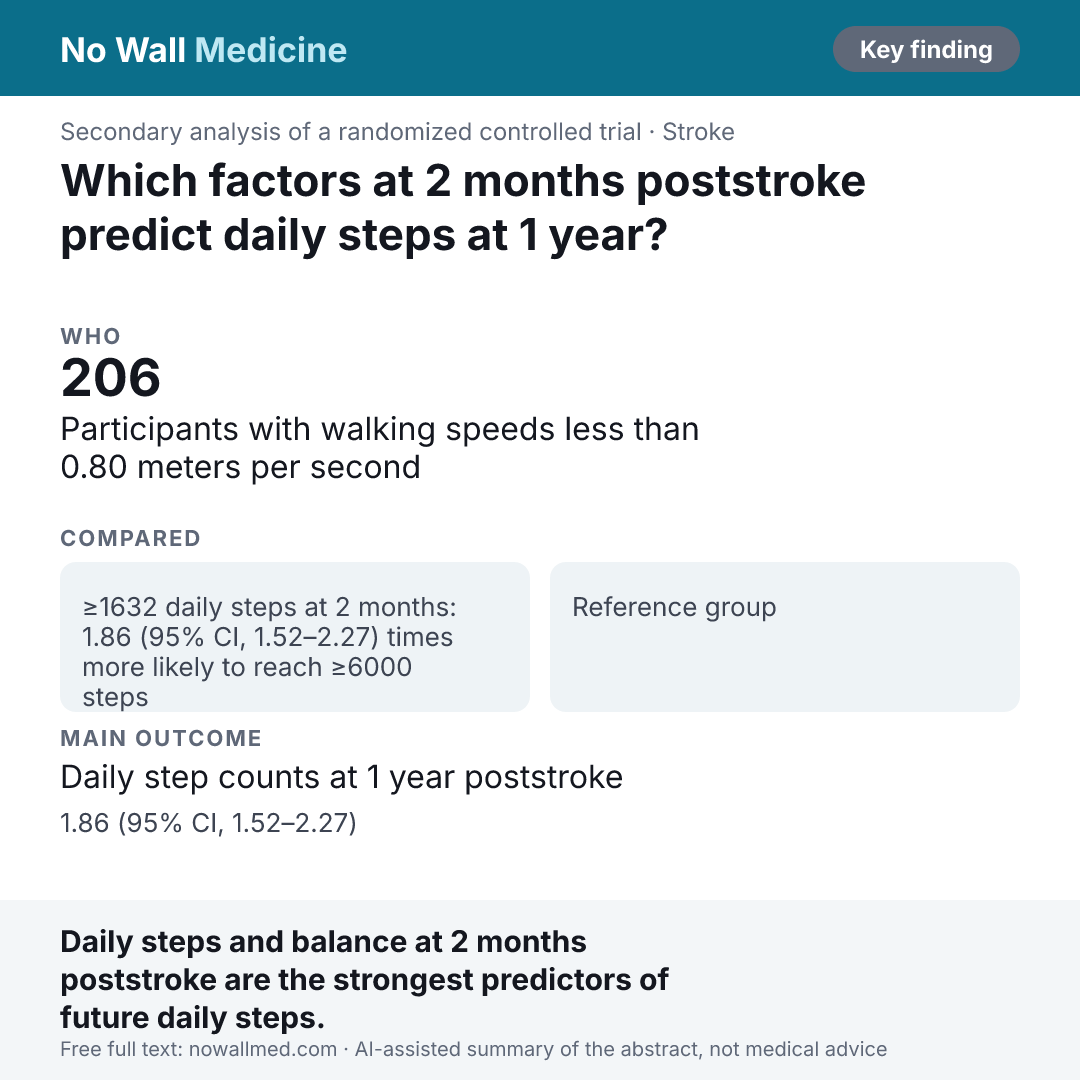
Clinical question: Which factors at 2 months poststroke predict daily steps at 1 year?
Key points
- Researchers analyzed 206 participants with walking speeds under 0.80 meters per second to see which factors predicted daily steps at one year.
- Daily steps at two months and balance scores explained 38% of the variability in daily steps at one year.
- Participants taking at least 1632 daily steps at two months were 1.86 times more likely to reach 6000 daily steps at one year.
Headline and key points written with AI from the paper’s abstract, with every number checked against it. Read the paper before relying on them.
Was this summary helpful?
Subject terms
Headline, design, result, key points, caveat and citation as plain text.
Cite this article
Handlery R, Regan EW, Stewart JC, et al. Predictors of Daily Steps at 1-Year Poststroke: A Secondary Analysis of a Randomized Controlled Trial. Stroke. 2021;52(5):1768-1777. doi:10.1161/STROKEAHA.121.034249
Spotted a mistake? Suggest a correction