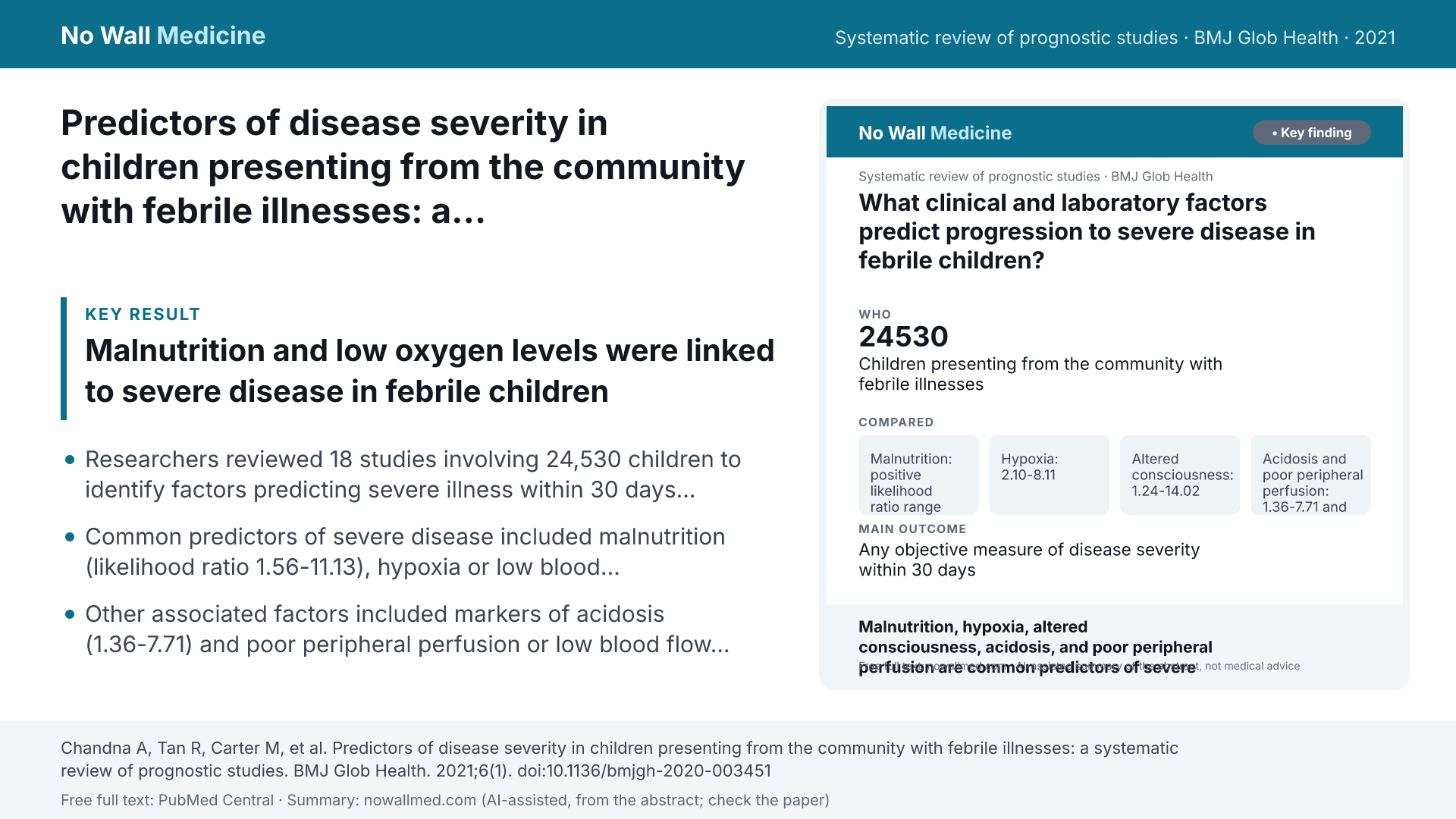
Malnutrition and low oxygen levels were linked to severe disease in febrile children
Predictors of disease severity in children presenting from the community with febrile illnesses: a systematic review of prognostic studies
Systematic review of prognostic studiesBenefit found
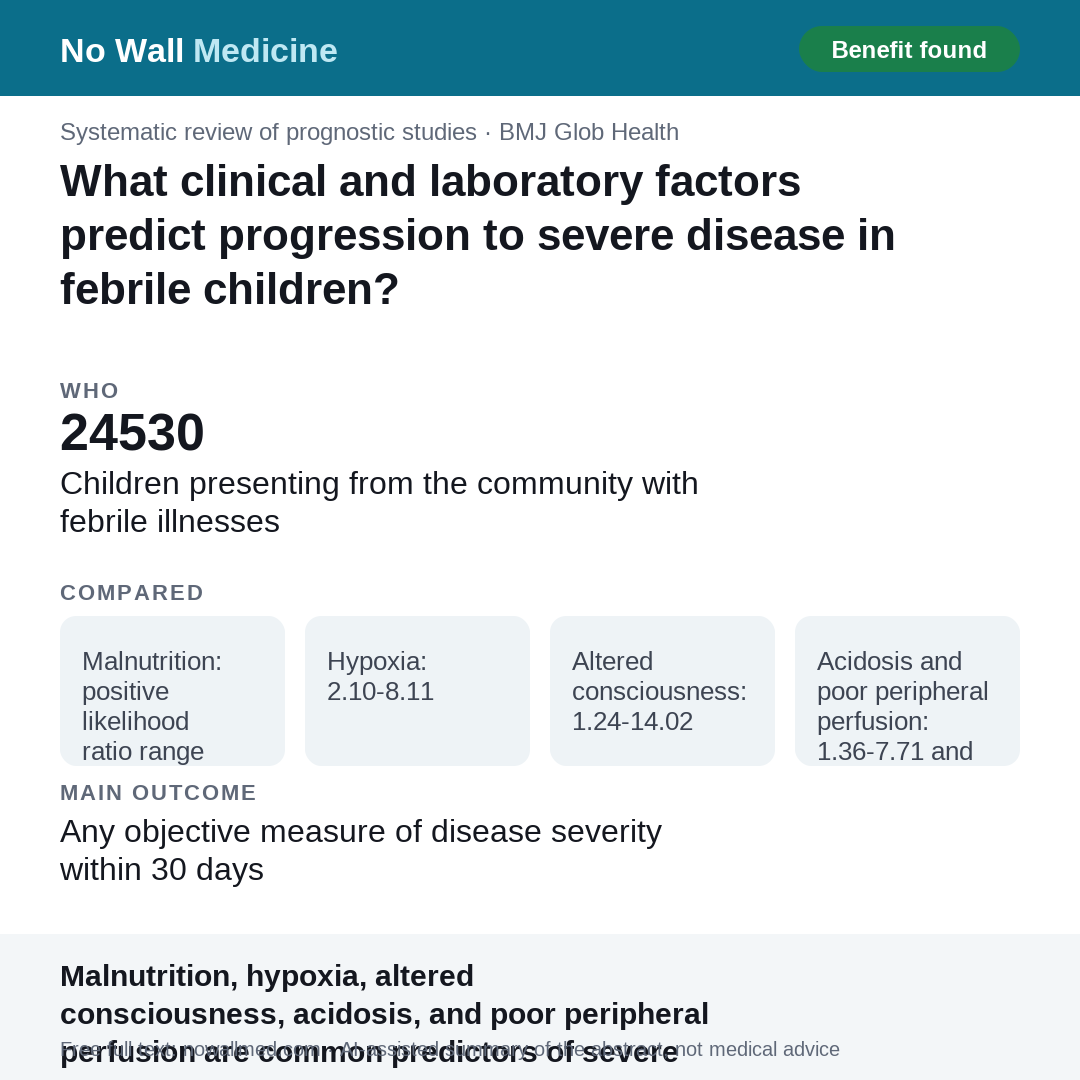
What clinical and laboratory factors predict progression to severe disease in febrile children?
Who
24530
Children presenting from the community with febrile illnesses
Compared
Malnutrition: positive likelihood ratio range 1.56-11.13
Hypoxia: 2.10-8.11
Altered consciousness: 1.24-14.02
Acidosis and poor peripheral perfusion: 1.36-7.71 and 1.78-17.38
Main outcome
Any objective measure of disease severity within 30 days
Bottom line: Malnutrition, hypoxia, altered consciousness, acidosis, and poor peripheral perfusion are common predictors of severe disease in febrile children.
Limitation: Most studies were at high risk of bias and had applicability concerns.
BMJ Glob Health · 2021-01-21Download image
Clinical question: What clinical and laboratory factors predict progression to severe disease in febrile children?
Why it matters: Clinicians need to identify which children with fever are at risk of progressing to severe disease to optimize referral and treatment decisions.
Key points
- Researchers reviewed 18 studies involving 24,530 children to identify factors predicting severe illness within 30 days of enrollment.
- Common predictors of severe disease included malnutrition (likelihood ratio 1.56-11.13), hypoxia or low blood oxygen (2.10-8.11), and altered consciousness (1.24-14.02).
- Other associated factors included markers of acidosis (1.36-7.71) and poor peripheral perfusion or low blood flow to the skin (1.78-17.38).
Limitation the authors note: Most studies were at high risk of bias and there was significant heterogeneity between studies.
Headline and key points written with AI from the paper’s abstract, with every number checked against it. Read the paper before relying on them.
Was this summary helpful?
Abstract
Introduction
Early identification of children at risk of severe febrile illness can optimise referral, admission and treatment decisions, particularly in resource-limited settings. We aimed to identify prognostic clinical and laboratory factors that predict progression to severe disease in febrile children presenting from the community. Methods
We systematically reviewed publications retrieved from MEDLINE, Web of Science and Embase between 31 May 1999 and 30 April 2020, supplemented by hand search of reference lists and consultation with an expert Technical Advisory Panel. Studies evaluating prognostic factors or clinical prediction models in children presenting from the community with febrile illnesses were eligible. The primary outcome was any objective measure of disease severity ascertained within 30 days of enrolment. We calculated unadjusted likelihood ratios (LRs) for comparison of prognostic factors, and compared clinical prediction models using the area under the receiver operating characteristic curves (AUROCs). Risk of bias and applicability of studies were assessed using the Prediction Model Risk of Bias Assessment Tool and the Quality In Prognosis Studies tool. Results
Of 5949 articles identified, 18 studies evaluating 200 prognostic factors and 25 clinical prediction models in 24 530 children were included. Heterogeneity between studies precluded formal meta-analysis. Malnutrition (positive LR range 1.56-11.13), hypoxia (2.10-8.11), altered consciousness (1.24-14.02), and markers of acidosis (1.36-7.71) and poor peripheral perfusion (1.78-17.38) were the most common predictors of severe disease. Clinical prediction model performance varied widely (AUROC range 0.49-0.97). Concerns regarding applicability were identified and most studies were at high risk of bias. Conclusions
Few studies address this important public health question. We identified prognostic factors from a wide range of geographic contexts that can help clinicians assess febrile children at risk of progressing to severe disease. Multicentre studies that include outpatients are required to explore generalisability and develop data-driven tools to support patient prioritisation and triage at the community level. Prospero registration number
CRD42019140542.
Abstract reproduced under the article’s CC BY licence.
Subject terms
Cite this article
Chandna A, Tan R, Carter M, et al. Predictors of disease severity in children presenting from the community with febrile illnesses: a systematic review of prognostic studies. BMJ Glob Health. 2021. doi:10.1136/bmjgh-2020-003451
Spotted a mistake? Suggest a correction