Academic and nonacademic factors predict success in matching into plastic surgery residency programs
Predictors of Matching into Plastic Surgery Residency Integrated and Independent Tracks: A Systematic Review
Systematic reviewMixed results
What are the predictors of matching into plastic surgery residency integrated and independent tracks?
Who
Applicants to plastic surgery residency programs · United States
Compared
Integrated track
Independent track
Main outcome
Successful match outcomes in plastic surgery residency programs
Bottom line: Academic metrics and nonacademic qualities predict match success, with different emphasis between integrated and independent tracks.
Plast Reconstr Surg Glob Open · 2026-06-23Download image
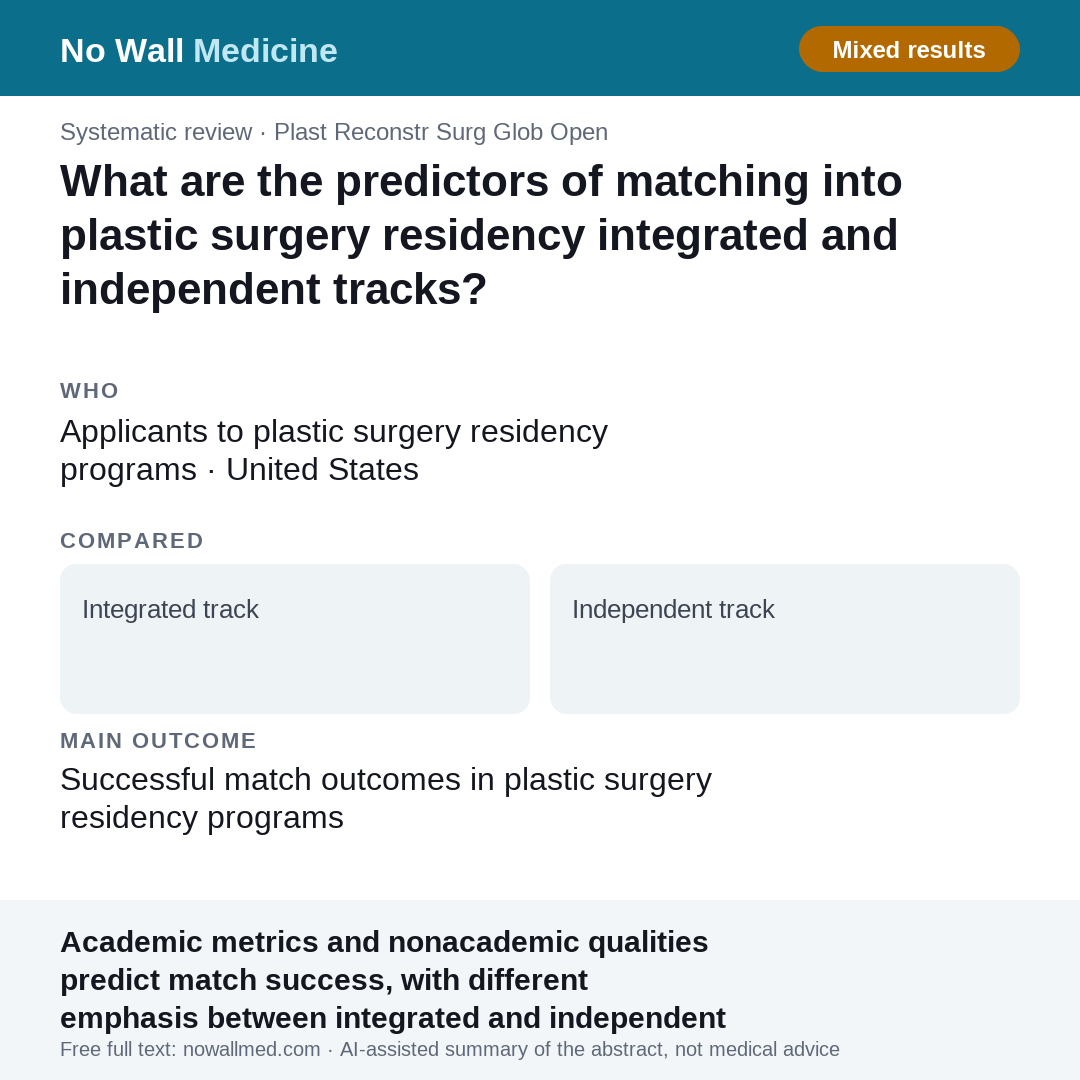
Clinical question: What are the predictors of matching into plastic surgery residency integrated and independent tracks?
Why it matters: Competition for plastic surgery residency positions remains intense as national match rates have steadily declined in recent years.
Key points
- Researchers conducted a systematic review of existing studies to identify predictors of success for both integrated and independent plastic surgery residency tracks.
- High United States Medical Licensing Examination scores, research publications, and Alpha Omega Alpha membership were consistently linked to successful matching outcomes.
- The independent track placed more emphasis on the number of interviews and the institutional pedigree of prerequisite surgical training compared to the integrated track.
Headline and key points written with AI from the paper’s abstract, with every number checked against it. Read the paper before relying on them.
Abstract
Background
Plastic surgery residency training in the United States consists of 2 main pathways: the integrated and independent tracks. As more programs continue to transition to only offering the integrated model, competition for both tracks remains intense, with national match rates steadily declining in recent years. This systematic review synthesizes current evidence on predictors of successful match outcomes in both integrated and independent plastic surgery residency programs. Methods
A comprehensive literature search was conducted to identify studies examining predictors of match success in plastic surgery residency programs. We analyzed academic metrics, including United States Medical Licensing Examination scores, Alpha Omega Alpha membership, and research productivity, as well as nonacademic factors such as letters of recommendation, leadership experience, extracurricular involvement, and interview performance. Results
Strong academic performance was consistently associated with match success for both tracks, including high United States Medical Licensing Examination scores, significant research output with a high number of publications and first-author studies, and Alpha Omega Alpha membership. Nonacademic qualities, such as impactful letters of recommendation, leadership roles, and excellent interview skills, also significantly contributed to favorable outcomes. Between the independent and integrated pathways, there was a difference in levels of importance among these predictors, as institutional pedigree of prerequisite surgical training and number of interviews were all more emphasized in the independent track. Conclusions
By identifying and evaluating predictive factors for matching into integrated and independent plastic surgery programs, this review offers updated, evidence-based insights to help applicants optimize their residency applications and assists programs in refining selection criteria for this highly competitive specialty.
Abstract reproduced under the article’s CC BY-NC-ND licence.
Cite this article
Eckert J, Elemosho A, Mangum K, Alser O, Janis JE. Predictors of Matching into Plastic Surgery Residency Integrated and Independent Tracks: A Systematic Review. Plast Reconstr Surg Glob Open. 2026. doi:10.1097/gox.0000000000007833
Spotted a mistake? Suggest a correction