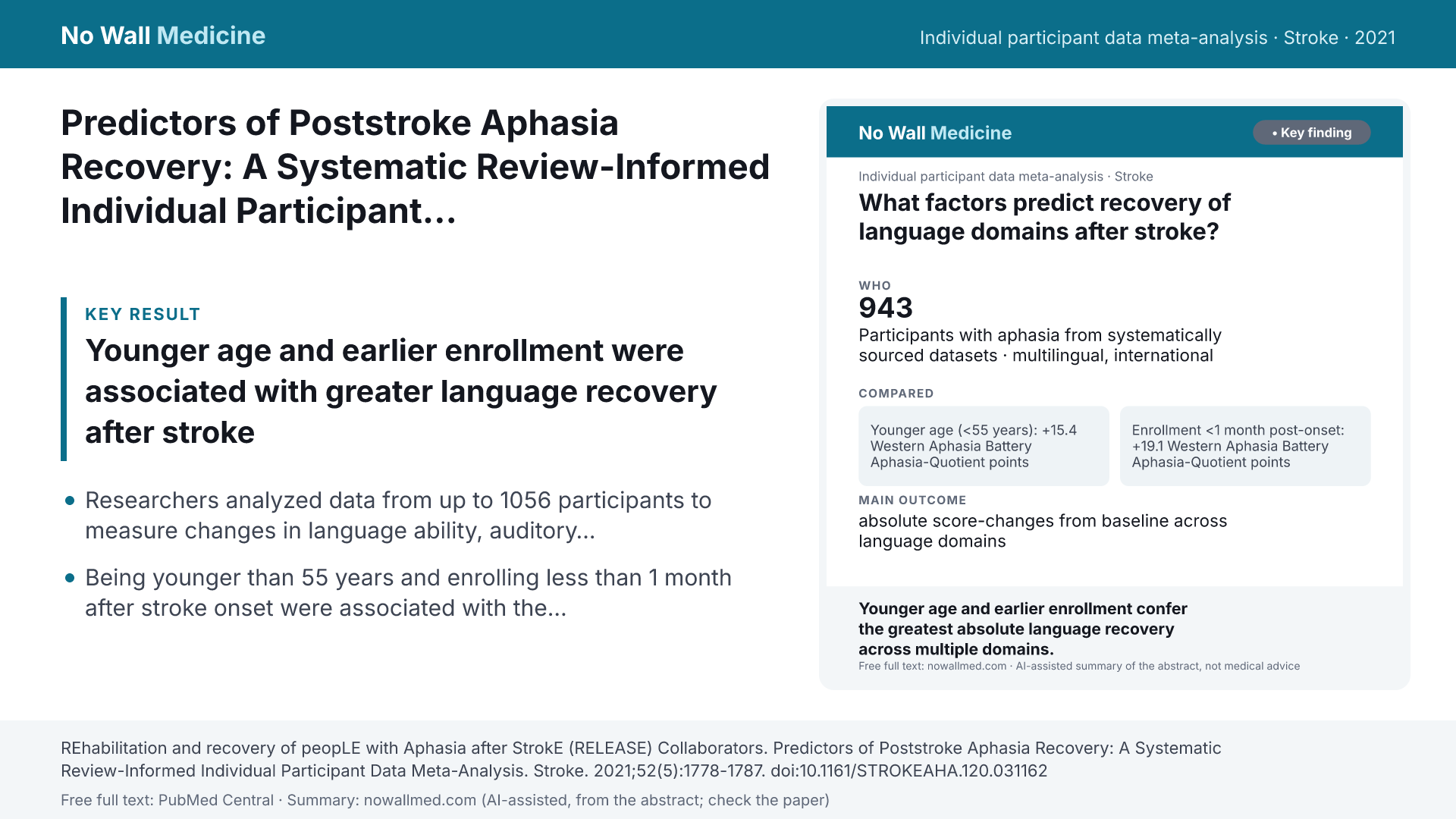
Younger age and earlier enrollment were associated with greater language recovery after stroke
Predictors of Poststroke Aphasia Recovery: A Systematic Review-Informed Individual Participant Data Meta-Analysis
Individual participant data meta-analysisKey finding
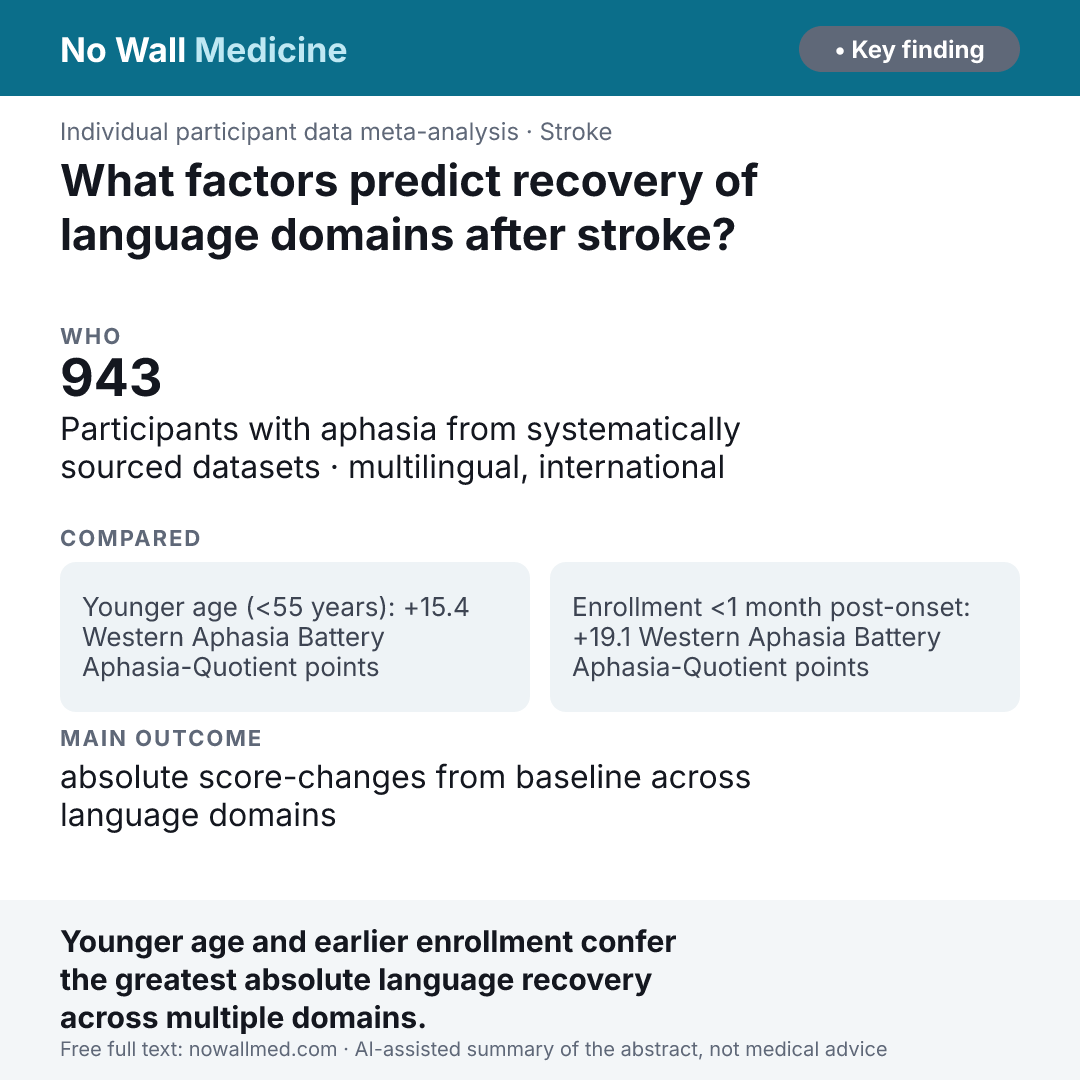
What factors predict recovery of language domains after stroke?
Who
943
Participants with aphasia from systematically sourced datasets · multilingual, international
Compared
Younger age (<55 years): +15.4 Western Aphasia Battery Aphasia-Quotient points
Enrollment <1 month post-onset: +19.1 Western Aphasia Battery Aphasia-Quotient points
Main outcome
absolute score-changes from baseline across language domains
Bottom line: Younger age and earlier enrollment confer the greatest absolute language recovery across multiple domains.
Stroke · 2021-03-15 · Save PNG
Clinical question: What factors predict recovery of language domains after stroke?
Key points
- Researchers analyzed data from up to 1056 participants to measure changes in language ability, auditory comprehension, naming, and functional communication.
- Being younger than 55 years and enrolling less than 1 month after stroke onset were associated with the largest improvements across all language domains.
- Language score improvements were associated with lower age and lower aphasia chronicity, which refers to the time elapsed since the stroke.
Headline and key points written with AI from the paper’s abstract, with every number checked against it. Read the paper before relying on them.
Was this summary helpful?
Subject terms
Headline, design, result, key points, caveat and citation as plain text.
Cite this article
REhabilitation and recovery of peopLE with Aphasia after StrokE (RELEASE) Collaborators. Predictors of Poststroke Aphasia Recovery: A Systematic Review-Informed Individual Participant Data Meta-Analysis. Stroke. 2021;52(5):1778-1787. doi:10.1161/STROKEAHA.120.031162
Spotted a mistake? Suggest a correction