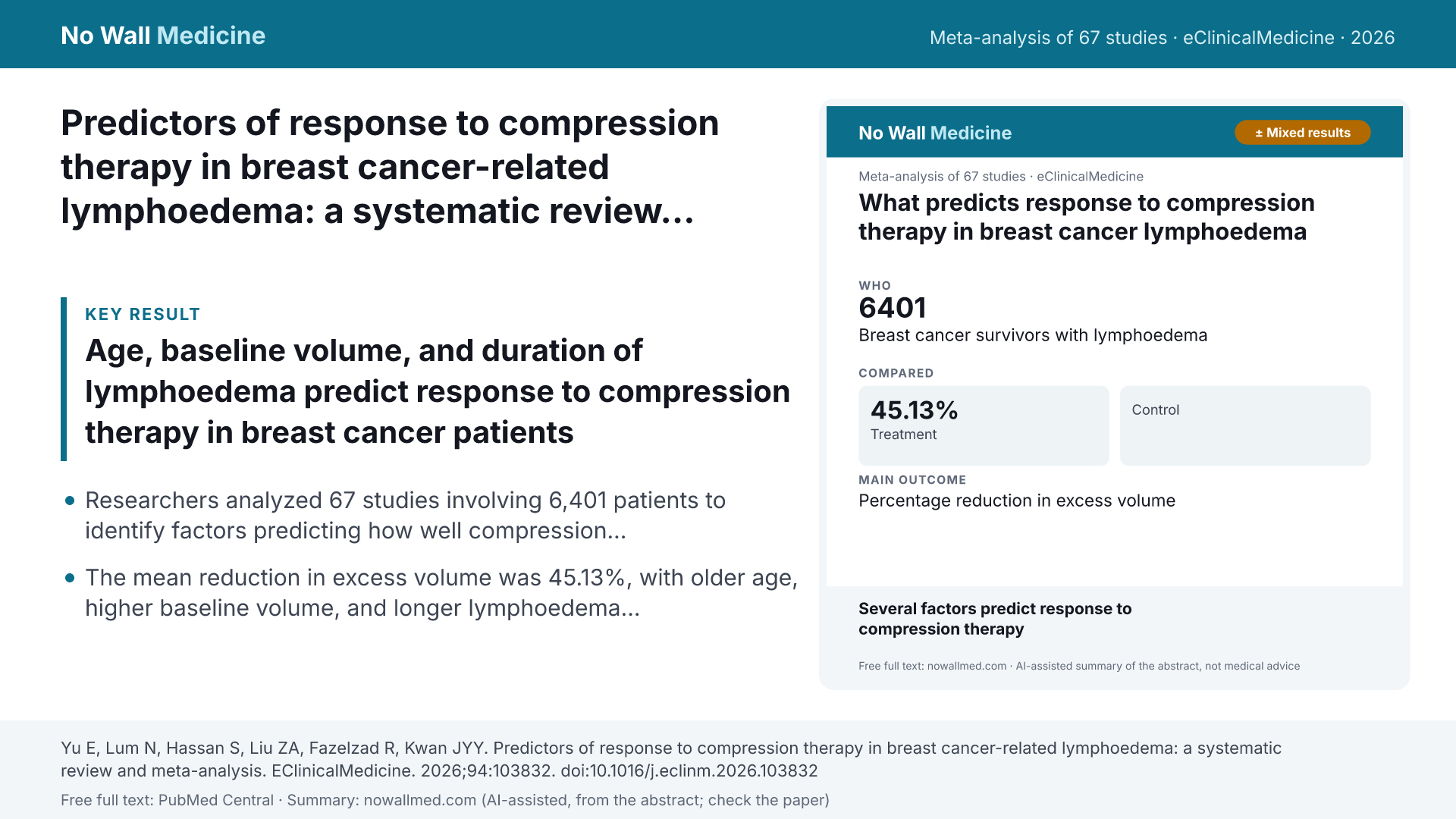
Age, baseline volume, and duration of lymphoedema predict response to compression therapy in breast cancer patients
Predictors of response to compression therapy in breast cancer-related lymphoedema: a systematic review and meta-analysis
Meta-analysis of 67 studiesMixed results
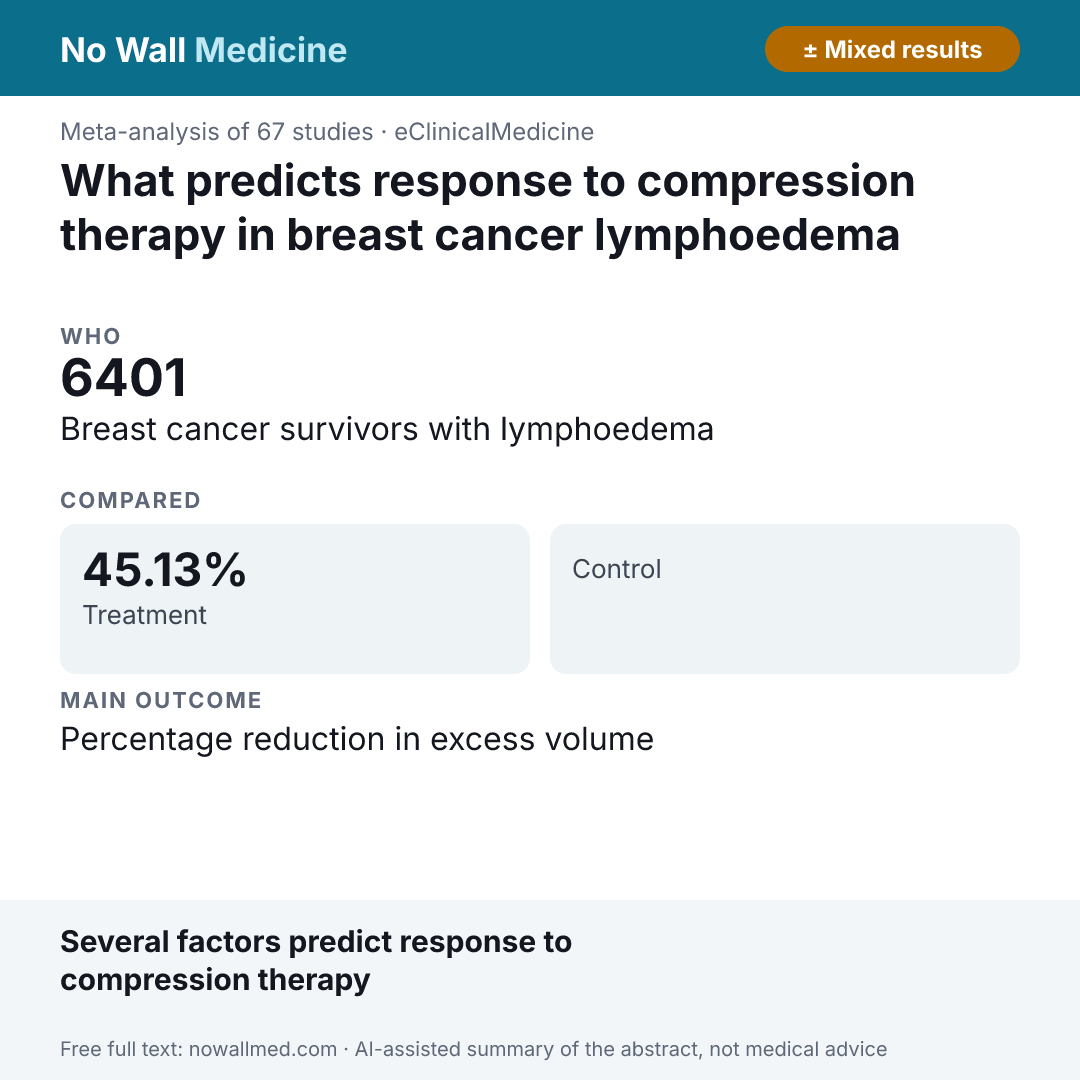
What predicts response to compression therapy in breast cancer lymphoedema
Who
6401
Breast cancer survivors with lymphoedema
Compared
45.13%Treatment (mean PREV)
Control
Main outcome
Percentage reduction in excess volume
Bottom line: Several factors predict response to compression therapy
Limitation: Variability in study characteristics and analysis
eClinicalMedicine · 2026-03-20 · Save PNG
Why it matters: Predictors of how patients respond to compression therapy for breast cancer-related lymphoedema are not well-characterized and often conflict across studies.
Key points
- Researchers analyzed 67 studies involving 6,401 patients to identify factors predicting how well compression therapy reduces swelling in breast cancer-related lymphoedema.
- The mean reduction in excess volume was 45.13%, with older age, higher baseline volume, and longer lymphoedema duration significantly associated with lower reductions.
- Increased treatment compliance and lymphoscintigraphic uptake, a measure of lymphatic function, were associated with higher percentage reductions in excess volume.
Limitation the authors note: Variability in study characteristics and analysis methodologies constrained comparability across predictors, limiting precision for certain factors.
Headline and key points written with AI from the paper’s abstract, with every number checked against it. Read the paper before relying on them.
Was this summary helpful?
Headline, design, result, key points, caveat and citation as plain text.
Cite this article
Yu E, Lum N, Hassan S, Liu ZA, Fazelzad R, Kwan JYY. Predictors of response to compression therapy in breast cancer-related lymphoedema: a systematic review and meta-analysis. EClinicalMedicine. 2026;94:103832. doi:10.1016/j.eclinm.2026.103832
Spotted a mistake? Suggest a correction