Transcranial pulse stimulation reduced depression scores more than a sham treatment in a clinical trial
Prefrontal Transcranial Pulse Stimulation for Major Depressive Disorder: A Randomized Clinical Trial
Double-blind, sham-controlled randomized clinical trialBenefit found
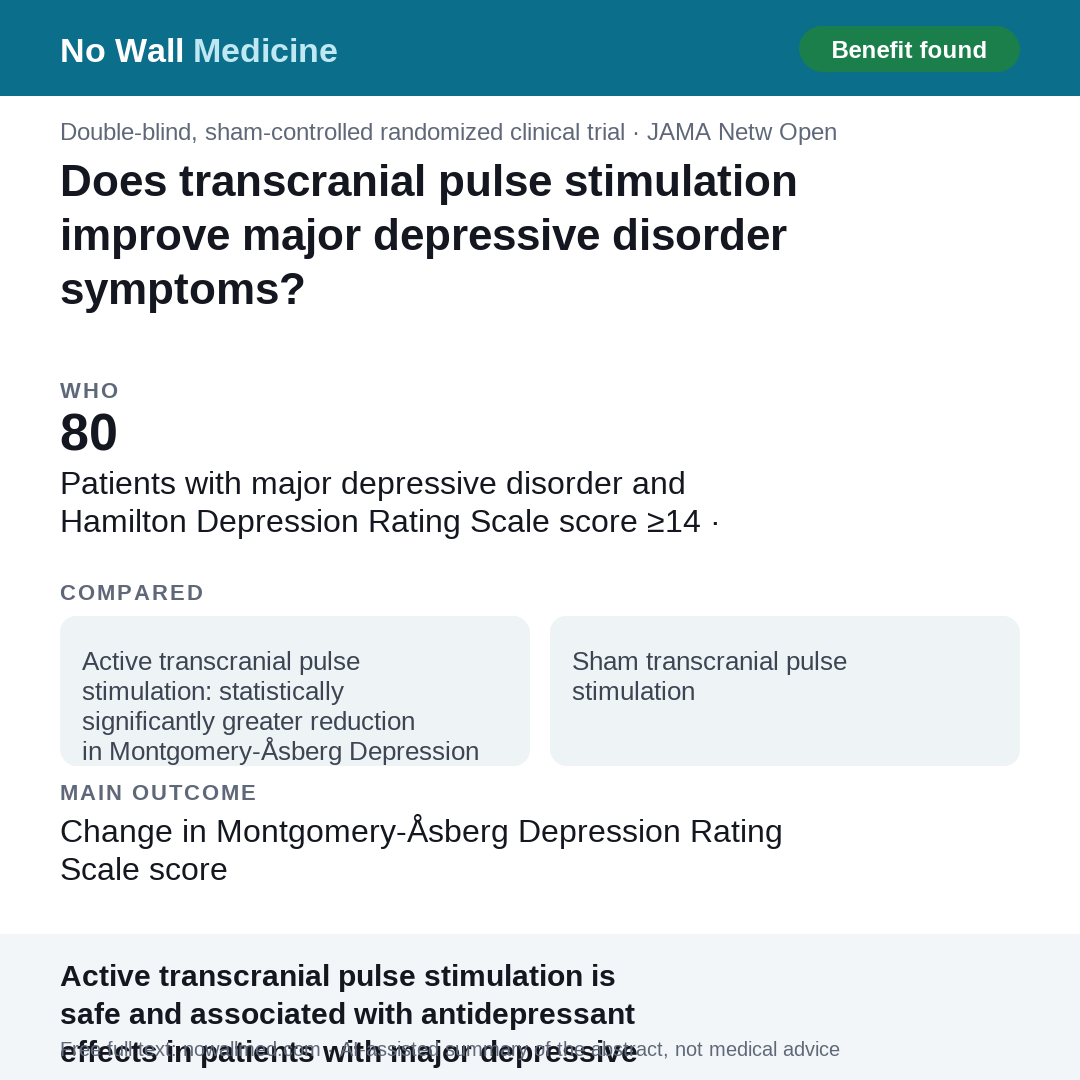
Does transcranial pulse stimulation improve major depressive disorder symptoms?
Who
80
Patients with major depressive disorder and Hamilton Depression Rating Scale score ≥14 · Hong Kong Polytechnic University
Compared
Active transcranial pulse stimulation: statistically significantly greater reduction in Montgomery-Åsberg Depression Rating Scale scores
Sham transcranial pulse stimulation
Main outcome
Change in Montgomery-Åsberg Depression Rating Scale score
Result: mean difference, -4.19; 95% CI, -8.33 to -0.04
Bottom line: Active transcranial pulse stimulation is safe and associated with antidepressant effects in patients with major depressive disorder.
Limitation: Future studies are needed to optimize therapeutic efficacy by increasing treatment sessions and refining targeting strategies.
JAMA Netw Open · 2026-07-01Download image
Clinical question: Does transcranial pulse stimulation improve major depressive disorder symptoms?
Why it matters: The efficacy of transcranial pulse stimulation, a noninvasive brain stimulation technique, had not been tested in a double-blind, sham-controlled randomized clinical trial.
Key points
- Researchers studied 80 participants with major depressive disorder, comparing 12 sessions of active or sham transcranial pulse stimulation to the left dorsolateral prefrontal cortex.
- The active group showed a statistically significantly greater reduction in Montgomery-Åsberg Depression Rating Scale scores than the sham group with a mean difference of -4.19.
- Brain imaging showed that active stimulation enhanced functional connectivity within the left dorsolateral prefrontal cortex and between that area and several other brain regions.
Headline and key points written with AI from the paper’s abstract, with every number checked against it. Read the paper before relying on them.
Topics
Spotted a mistake? Suggest a correction
More in Psychiatry & Mental Health
Depressive symptoms linked to stronger defensive response in panic disorder patients
Defensive reactivity to interoceptive perturbation in panic disorder: Depressive symptom burden and panic severity dimensions
Genes linked to mitochondria implicated in psychiatric disorders
Brain-derived multi-omics prioritization of mitochondria-related genes in schizophrenia, bipolar disorder, and major depressive disorder
Brain structure variations linked to alcohol use severity in large studies
A reproducible structural brain axis of alcohol use severity
Most animal psychedelic studies use stress-inducing methods and brief testing
Animal models in psychedelic research - Tripping over translation