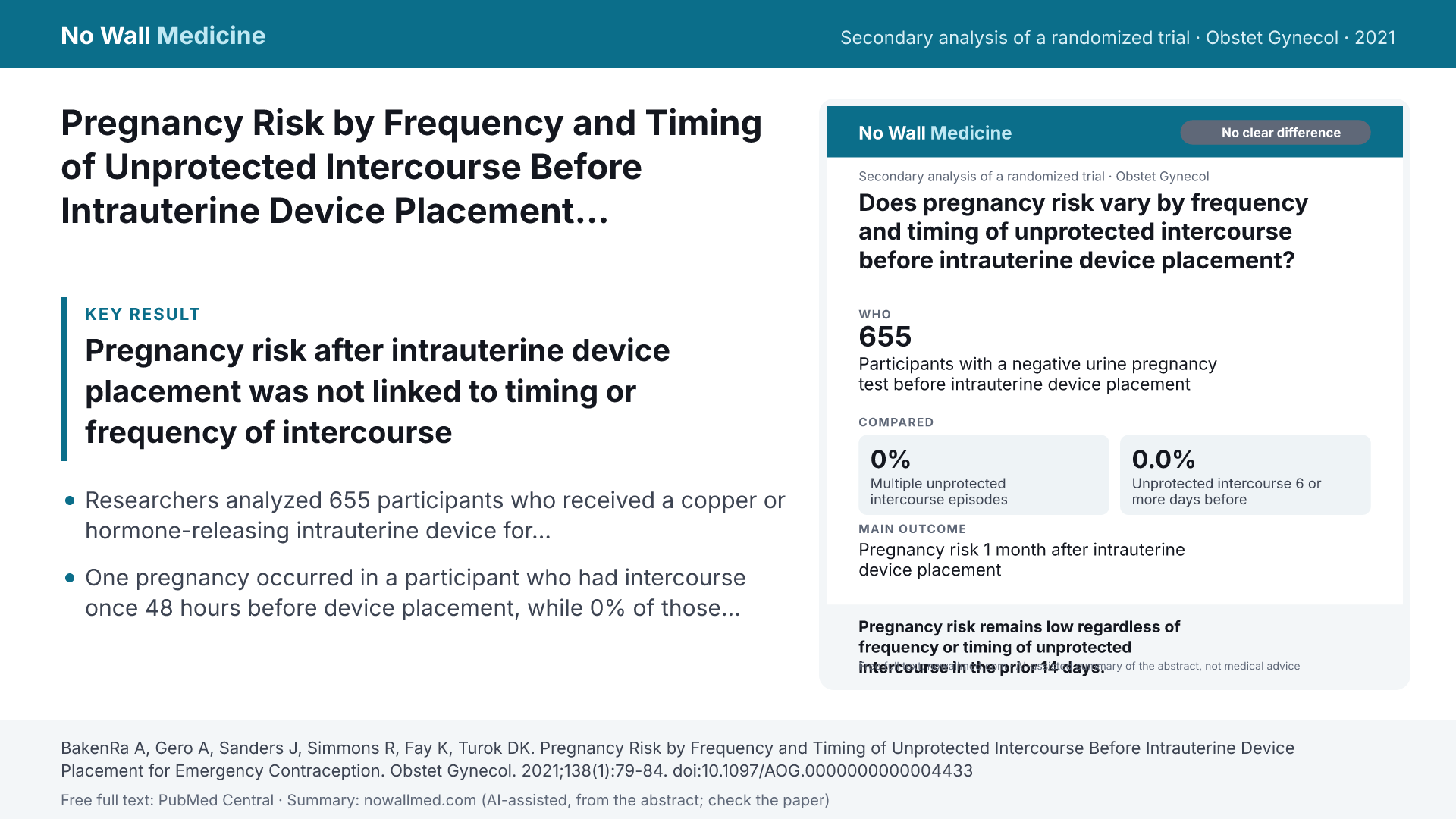
Pregnancy Risk by Frequency and Timing of Unprotected Intercourse Before Intrauterine Device Placement for Emergency Contraception
Key result: Pregnancy risk after intrauterine device placement was not linked to timing or frequency of intercourse
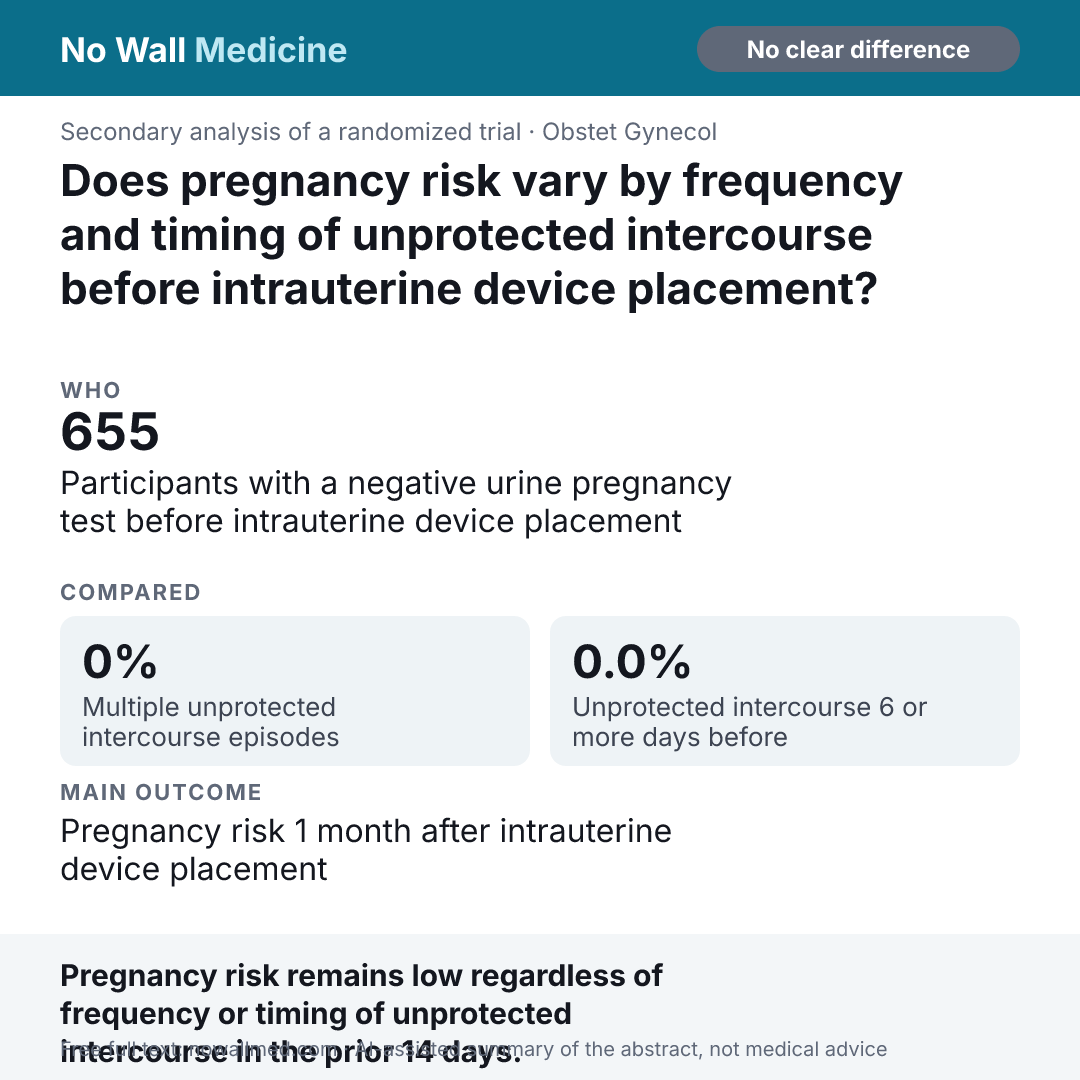
Secondary analysis of a randomized trialNo clear difference
Does pregnancy risk vary by frequency and timing of unprotected intercourse before intrauterine device placement?
Who
655
Participants with a negative urine pregnancy test before intrauterine device placement
Compared
0%Multiple unprotected intercourse episodes (97.5% CI 0-1.3%)
0.0%Unprotected intercourse 6 or more days before (97.5% CI 0.0-3.8%)
Main outcome
Pregnancy risk 1 month after intrauterine device placement
Bottom line: Pregnancy risk remains low regardless of frequency or timing of unprotected intercourse in the prior 14 days.
Obstet Gynecol · 2021-07-14 · Save PNG
Key points
- Researchers analyzed 655 participants who received a copper or hormone-releasing intrauterine device for emergency contraception after a negative pregnancy test.
- One pregnancy occurred in a participant who had intercourse once 48 hours before device placement, while 0% of those with multiple intercourse episodes became pregnant.
- Pregnancy risk did not significantly differ between single and multiple intercourse episodes or between intercourse occurring 5 or fewer days versus 6 or more days before placement.
Discussion prompts
- Would these patients look like yours? Who was left out?
- Is the main outcome one that matters to patients?
- Is the difference large enough to change what you do?
Cite: BakenRa A, Gero A, Sanders J, Simmons R, Fay K, Turok DK. Pregnancy Risk by Frequency and Timing of Unprotected Intercourse Before Intrauterine Device Placement for Emergency Contraception. Obstet Gynecol. 2021;138(1):79-84. doi:10.1097/AOG.0000000000004433
Free full text: PubMed Central · Summary and visual abstract: nowallmed.com/a/pregnancy-risk-by-frequency-and-timing-of-unprotected-intercourse-1wbg40r/ (AI-assisted from the abstract; check the paper before relying on it).