Ketamine alters brain connectivity in specific subregions of the anterior cingulate cortex
Preliminary evidence that ketamine alters anterior cingulate resting-state functional connectivity in depressed individuals
Double-blind randomized placebo-controlled crossover trialMixed results
Does ketamine alter anterior cingulate resting-state functional connectivity in depressed individuals?
Who
Patients with treatment resistant depression and healthy volunteers
Compared
Ketamine
Placebo
Main outcome
Resting-state functional connectivity in anterior cingulate cortex subregions
Bottom line: Ketamine differentially modulates anterior cingulate connectivity, with subgenual changes correlating with improved anhedonia symptoms.
Transl Psychiatry · 2023-12-01Download image
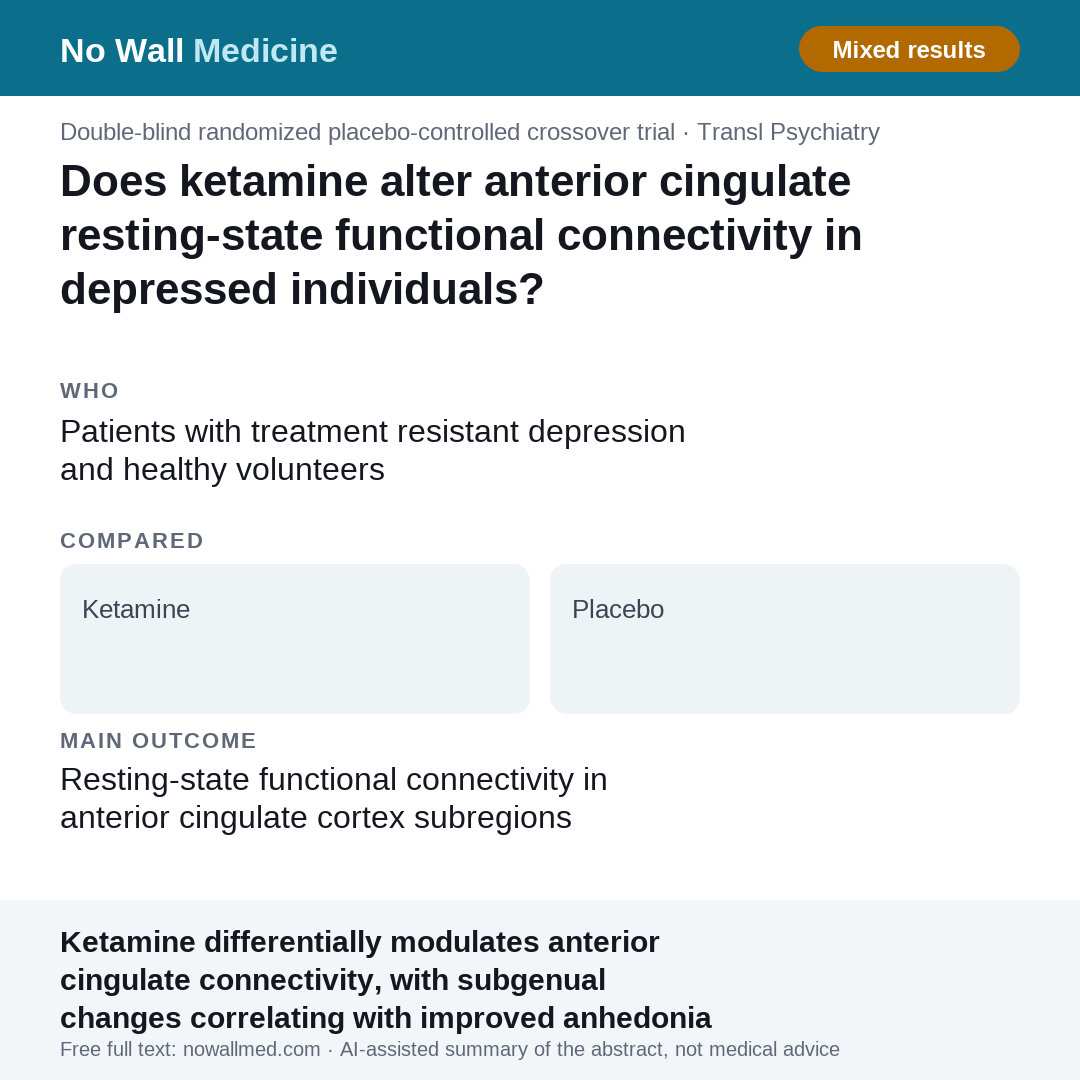
Clinical question: Does ketamine alter anterior cingulate resting-state functional connectivity in depressed individuals?
Why it matters: It is unknown if ketamine's effects on the anterior cingulate cortex are specific to certain subregions rather than affecting the entire area uniformly.
Key points
- Researchers conducted a double-blind randomized placebo-controlled crossover trial comparing intravenous ketamine to placebo in patients with treatment resistant depression and healthy volunteers.
- Ketamine differentially modulated resting-state functional connectivity, which is the spontaneous communication between brain regions, in the subgenual, perigenual, and dorsal anterior cingulate cortex.
- Changes in connectivity between the perigenual anterior cingulate cortex and the insula correlated with improvements in depression scores.
Headline and key points written with AI from the paper’s abstract, with every number checked against it. Read the paper before relying on them.
Was this summary helpful?
Subject terms
Cite this article
Alexander L, Hawkins PCT, Evans JW, Mehta MA, Zarate CA. Preliminary evidence that ketamine alters anterior cingulate resting-state functional connectivity in depressed individuals. Transl Psychiatry. 2023. doi:10.1038/s41398-023-02674-1
Spotted a mistake? Suggest a correction
Top studies every Monday
The week’s key trials and guidelines in your specialties, plus any topics you follow. By email, free.
Get the weekly digest