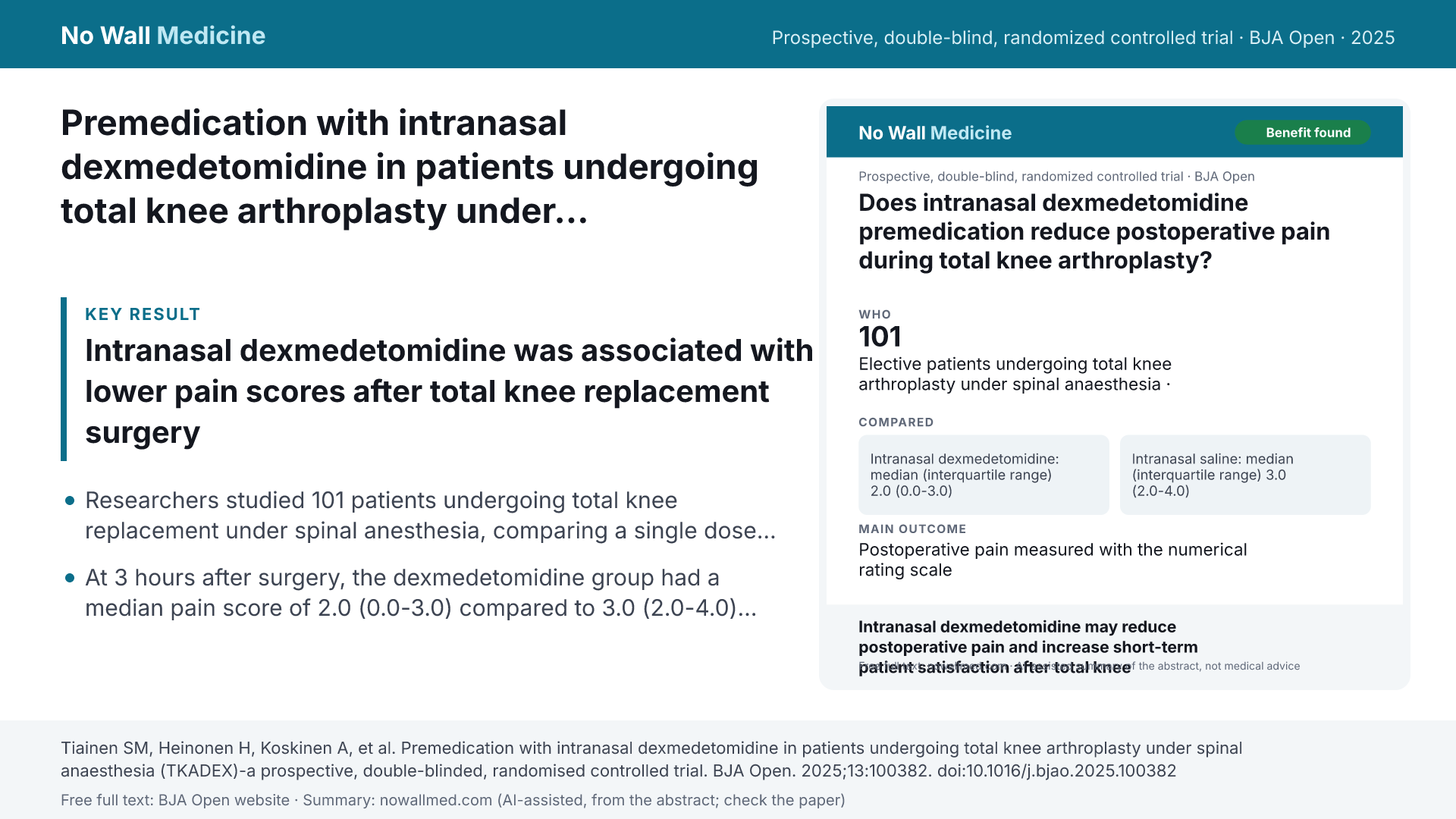
Intranasal dexmedetomidine was associated with lower pain scores after total knee replacement surgery
Premedication with intranasal dexmedetomidine in patients undergoing total knee arthroplasty under spinal anaesthesia (TKADEX)-a prospective, double-blinded, randomised controlled trial
Prospective, double-blind, randomized controlled trialBenefit found
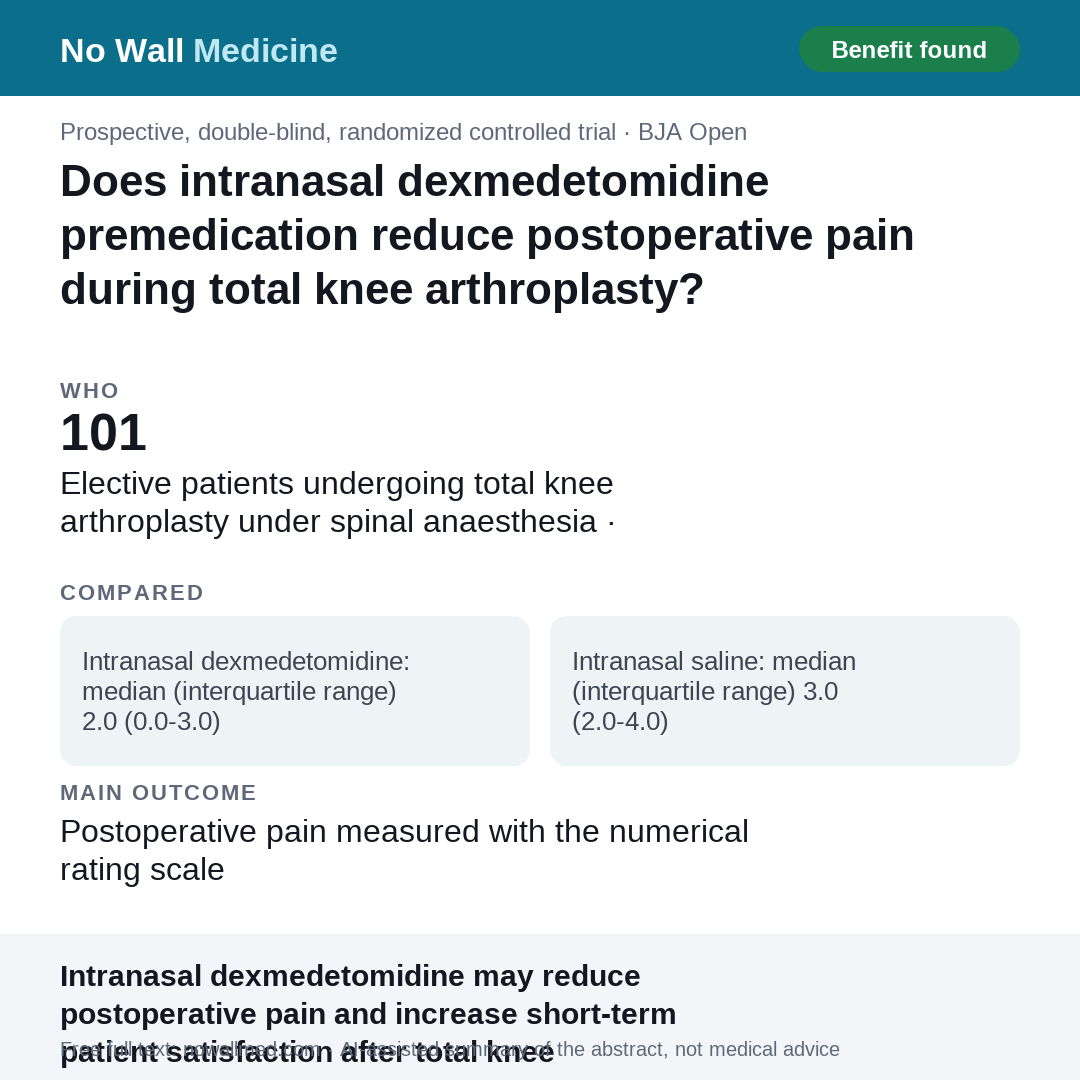
Does intranasal dexmedetomidine premedication reduce postoperative pain during total knee arthroplasty?
Who
101
Elective patients undergoing total knee arthroplasty under spinal anaesthesia · Single-centre
Compared
Intranasal dexmedetomidine: median (interquartile range) 2.0 (0.0-3.0)
Intranasal saline: median (interquartile range) 3.0 (2.0-4.0)
Main outcome
Postoperative pain measured with the numerical rating scale
Bottom line: Intranasal dexmedetomidine may reduce postoperative pain and increase short-term patient satisfaction after total knee arthroplasty.
BJA Open · 2025-03-03Download image
Clinical question: Does intranasal dexmedetomidine premedication reduce postoperative pain during total knee arthroplasty?
Why it matters: The optimal dosing for using dexmedetomidine, an alpha-2 agonist, to manage pain after surgery is currently unknown.
Key points
- Researchers studied 101 patients undergoing total knee replacement under spinal anesthesia, comparing a single dose of intranasal dexmedetomidine to an intranasal saline placebo.
- At 3 hours after surgery, the dexmedetomidine group had a median pain score of 2.0 (0.0-3.0) compared to 3.0 (2.0-4.0) in the control group.
- There was no significant difference in cumulative 24 h opioid requirements between the dexmedetomidine group [45 mg (30-68 mg)] and the control group [53 mg (38-88 mg)].
Limitation the authors note: This was a single-centre study.
Headline and key points written with AI from the paper’s abstract, with every number checked against it. Read the paper before relying on them.
Was this summary helpful?
Abstract
Background
Previous studies have shown that perioperative use of adjuvants, such as the alpha-2 agonist dexmedetomidine, may reduce postoperative pain and opioid requirements. However, information about optimal dosing is lacking. We investigated if premedication with intranasal dexmedetomidine compared with placebo reduces postoperative pain in patients undergoing total knee arthroplasty under spinal anaesthesia.Methods
This single-centre, double-blind, two-arm study compared premedication with intranasal dexmedetomidine (single 1 μg kg-1 dose) to intranasal saline in 101 consecutive elective patients undergoing total knee arthroplasty under spinal anaesthesia. The primary outcome was postoperative pain measured with the numerical rating scale during the first 24 h. Secondary outcomes were postoperative opioid requirement, perioperative haemodynamic variables, requirement of additional intraoperative sedation, incidence of postoperative nausea and vomiting, and patient satisfaction at 30 days after surgery.Results
Patients in the dexmedetomidine group had lower numerical rating scale scores [median (interquartile range) 2.0 (0.0-3.0)] at 3 h when compared with the control group [3.0 (2.0-4.0)] (P=0.037). Cumulative 24 h opioid requirements (in morphine equivalents) did not differ between dexmedetomidine [45 mg (30-68 mg)] and control groups [53 mg (38-88 mg)] (P=0.334). More patients in the dexmedetomidine group were satisfied with pain management in the ward (P=0.0013). The groups did not differ in the incidence of postoperative nausea and vomiting (P=0.310) or haemodynamic adverse events (P>0.27 for all).Conclusions
Our results indicate that intranasal dexmedetomidine may reduce postoperative pain and the requirement for additional sedation and increase short-term patient satisfaction in patients undergoing total knee arthroplasty.Clinical trial registration
ClinicalTrials.gov (NCT04859283).
Abstract reproduced under the article’s CC BY-NC-ND licence.
Cite this article
Tiainen SM, Heinonen H, Koskinen A, Mäkelä S, Laitio R, Löyttyniemi E. Premedication with intranasal dexmedetomidine in patients undergoing total knee arthroplasty under spinal anaesthesia (TKADEX)-a prospective, double-blinded, randomised controlled trial. BJA Open. 2025. doi:10.1016/j.bjao.2025.100382
Spotted a mistake? Suggest a correction