Cannabis exposure at delivery was associated with higher attention problems and developmental issues in children
Prenatal Exposure to Delta 9-Tetrahydrocannabinol and Child Neurodevelopment: A Critical Windows Analysis
Key points
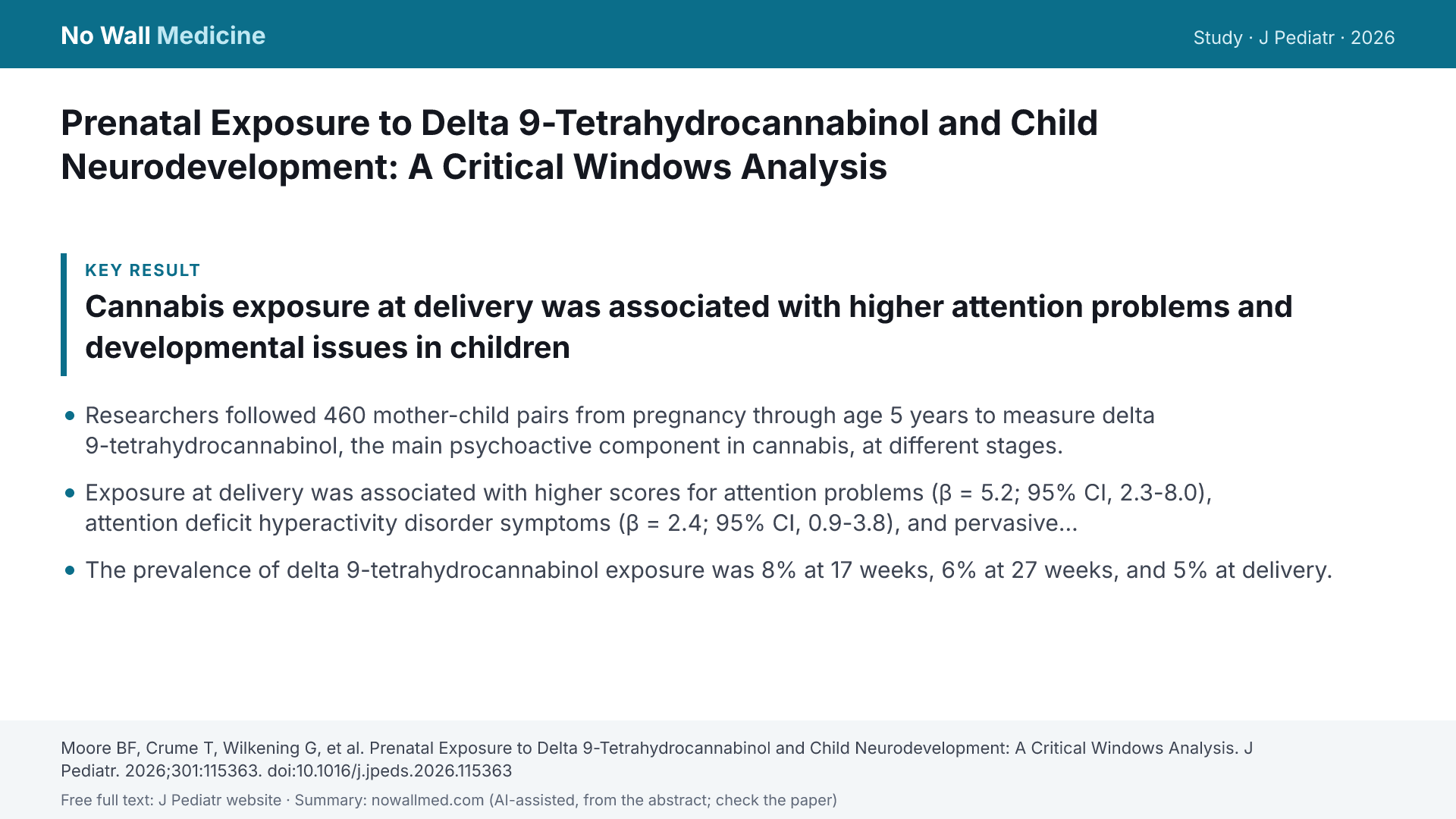
- Researchers followed 460 mother-child pairs from pregnancy through age 5 years to measure delta 9-tetrahydrocannabinol, the main psychoactive component in cannabis, at different stages.
- Exposure at delivery was associated with higher scores for attention problems (β = 5.2; 95% CI, 2.3-8.0), attention deficit hyperactivity disorder symptoms (β = 2.4; 95% CI, 0.9-3.8), and pervasive developmental problems (β = 3.9; 95% CI, 0.8-7.1).
- The prevalence of delta 9-tetrahydrocannabinol exposure was 8% at 17 weeks, 6% at 27 weeks, and 5% at delivery.
Study type: Observational study: it can show a link, but not prove that one thing causes another.
Headline and key points written with AI from the paper’s abstract, with every number checked against it. Read the paper before relying on them.
Was this summary helpful?
Headline, design, result, key points, caveat and citation as plain text.
Cite this article
Moore BF, Crume T, Wilkening G, et al. Prenatal Exposure to Delta 9-Tetrahydrocannabinol and Child Neurodevelopment: A Critical Windows Analysis. J Pediatr. 2026;301:115363. doi:10.1016/j.jpeds.2026.115363
Spotted a mistake? Suggest a correction