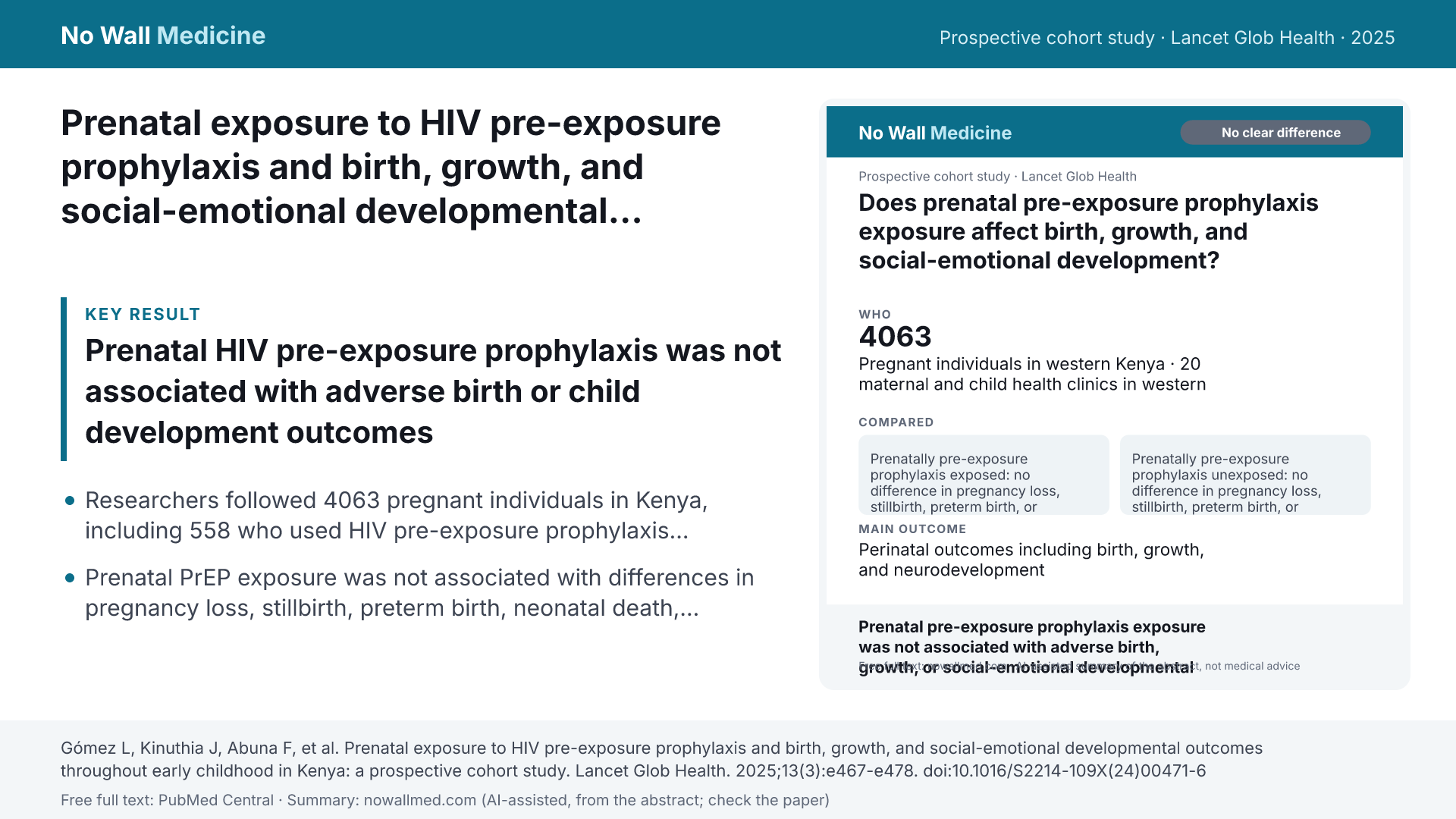
Prenatal HIV pre-exposure prophylaxis was not associated with adverse birth or child development outcomes
Prenatal exposure to HIV pre-exposure prophylaxis and birth, growth, and social-emotional developmental outcomes throughout early childhood in Kenya: a prospective cohort study
Prospective cohort studyNo clear difference
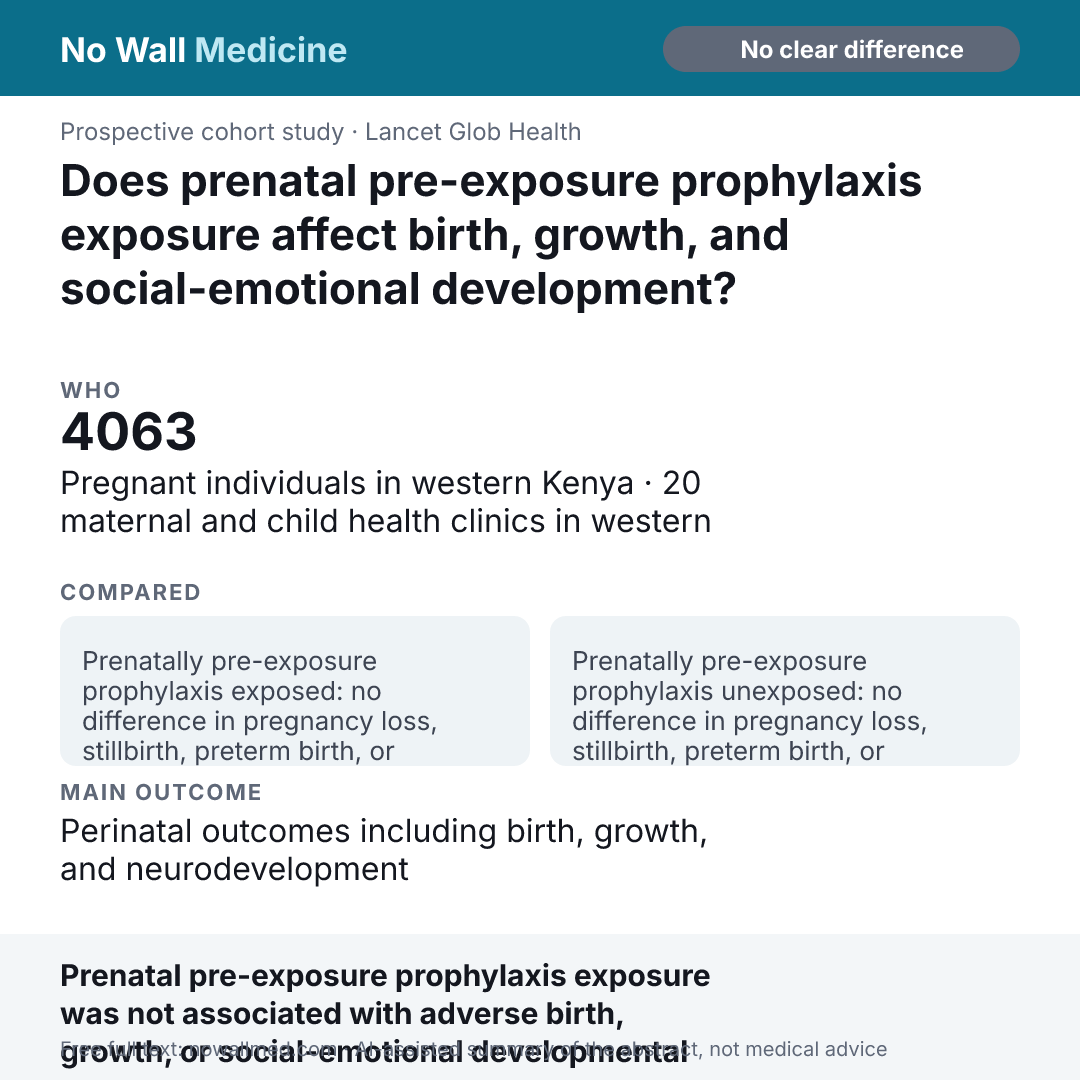
Does prenatal pre-exposure prophylaxis exposure affect birth, growth, and social-emotional development?
Who
4063
Pregnant individuals in western Kenya · 20 maternal and child health clinics in western Kenya
Compared
Prenatally pre-exposure prophylaxis exposed: no difference in pregnancy loss, stillbirth, preterm birth, or neonatal death
Prenatally pre-exposure prophylaxis unexposed: no difference in pregnancy loss, stillbirth, preterm birth, or neonatal death
Main outcome
Perinatal outcomes including birth, growth, and neurodevelopment
Bottom line: Prenatal pre-exposure prophylaxis exposure was not associated with adverse birth, growth, or social-emotional developmental outcomes through 36 months.
Funded by: National Institutes of Health and several other organizations
Lancet Glob Health · 2025-03-01 · Save PNG
Clinical question: Does prenatal pre-exposure prophylaxis exposure affect birth, growth, and social-emotional development?
Why it matters: Safety data regarding the relationship between prenatal HIV pre-exposure prophylaxis exposure and birth, growth, and social-emotional development in children remains important as implementation scales up.
Key points
- Researchers followed 4063 pregnant individuals in Kenya, including 558 who used HIV pre-exposure prophylaxis (PrEP) during pregnancy.
- Prenatal PrEP exposure was not associated with differences in pregnancy loss, stillbirth, preterm birth, neonatal death, or infant growth metrics.
- No differences were found in social-emotional development scores at 24, 30, or 36 months postpartum between exposed and unexposed groups.
Headline and key points written with AI from the paper’s abstract, with every number checked against it. Read the paper before relying on them.
Was this summary helpful?
Abstract
Background
As pre-exposure prophylaxis (PrEP) implementation continues to scale up among pregnant people, accruing safety data following prenatal PrEP exposure remains important. In this study, we aimed to evaluate the relationship between prenatal PrEP exposure and birth and infant or child outcomes. Methods
This prospective cohort study analysed data from the PrEP Implementation for Mothers in Antenatal Care study (NCT03070600). Participants were eligible for inclusion if they were currently pregnant, not currently using PrEP, were aged 15 years or older, planned to remain in the study area, were not enrolled in other studies, and did not have HIV or tuberculosis. Participants enrolled during pregnancy at 20 maternal and child health clinics in western Kenya and were followed up until 9 months postpartum. Those who reported taking PrEP at any antenatal visits were identified as prenatally PrEP exposed. In an extension cohort, participants and their children were followed up until 36 months postpartum. Infant anthropometry and social-emotional development using the Ages and Stages Questionnaire (ASQ-SE), second edition were assessed by trained study nurses. Among a subset of participants, we confirmed prenatal PrEP exposure using tenofovir diphosphate concentrations in dried blood spots. Perinatal outcomes (birth, growth, and neurodevelopment) were the primary outcomes assessed. Findings
Between Jan 15, 2018, and Jul 31, 2019, 4063 female individuals were enrolled and included in the analysis, of whom 558 (13·7%) used PrEP during pregnancy, initiating at a median of 26 weeks' gestation (IQR 22-31) for a median duration of 9·6 weeks in pregnancy (5·7-15·0). Compared with PrEP-unexposed pregnancies, there was no difference in pregnancy loss (ie, miscarriage), stillbirth, preterm birth, or neonatal death among PrEP exposed pregnancies (all p>0·05). There were no differences in infant length or weight at 6 weeks, 6 months, and 9 months (all p>0·05) between children with and without prenatal PrEP exposure, including underweight, stunting, and wasting. Results were similar when analysed separately by trimester of PrEP initiation and duration on PrEP, and in a subset at 24 months, 30 months, and 36 months. Prenatal PrEP exposure was not associated with ASQ-SE scores at 24-months (p=0·12), 30-months (p=0·75), or 36-months (p=0·81). No differences in adverse perinatal and infant outcomes were found among Kenyan individuals with quantifiable prenatal tenofovir diphosphate exposure. Interpretation
We found no significant differences in adverse birth or infant or child outcomes for 3 years of follow-up by prenatal PrEP exposure status. These data support findings from previous studies that demonstrate the safety of oral PrEP use during pregnancy. Funding
The National Institutes of Health, National Institute of Allergy and Infectious Disease; Eunice Kennedy Shriver National Institute of Child Health and Human Development; the National Institute of Nursing Research; the University of Washington's Center for AIDS Research Behavioral Sciences Core and Biometrics Core; and the Global Center for the Integrated Health of Women, Adolescents, and Children. Translation
For the Swahili translation of the abstract see Supplementary Materials section.
Abstract reproduced under the article’s CC BY licence.
Subject terms
Headline, design, result, key points, caveat and citation as plain text.
Cite this article
Gómez L, Kinuthia J, Abuna F, et al. Prenatal exposure to HIV pre-exposure prophylaxis and birth, growth, and social-emotional developmental outcomes throughout early childhood in Kenya: a prospective cohort study. Lancet Glob Health. 2025;13(3):e467-e478. doi:10.1016/S2214-109X(24)00471-6
Spotted a mistake? Suggest a correction