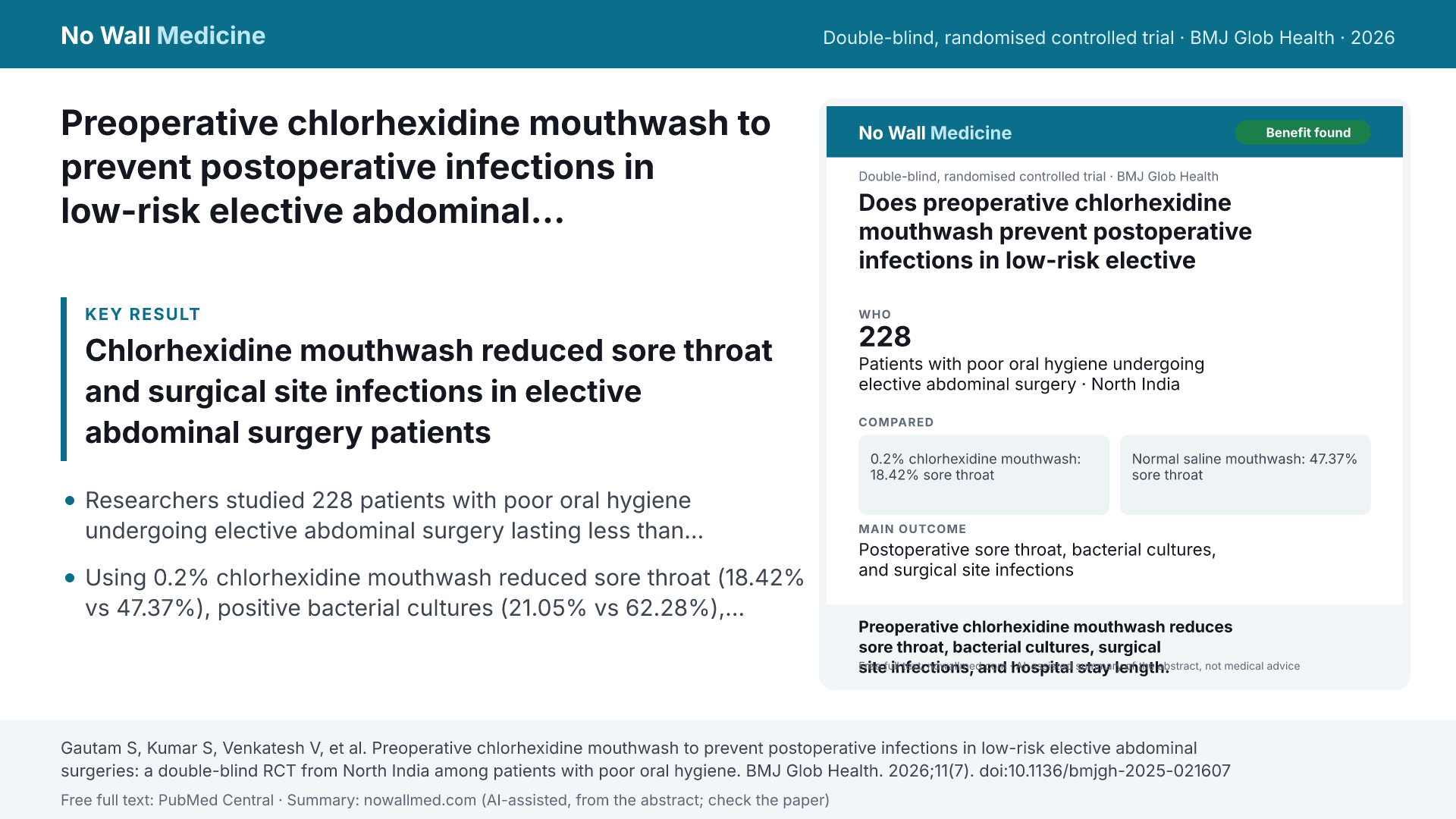
Chlorhexidine mouthwash reduced sore throat and surgical site infections in elective abdominal surgery patients
Preoperative chlorhexidine mouthwash to prevent postoperative infections in low-risk elective abdominal surgeries: a double-blind RCT from North India among patients with poor oral hygiene
Double-blind, randomised controlled trialBenefit found
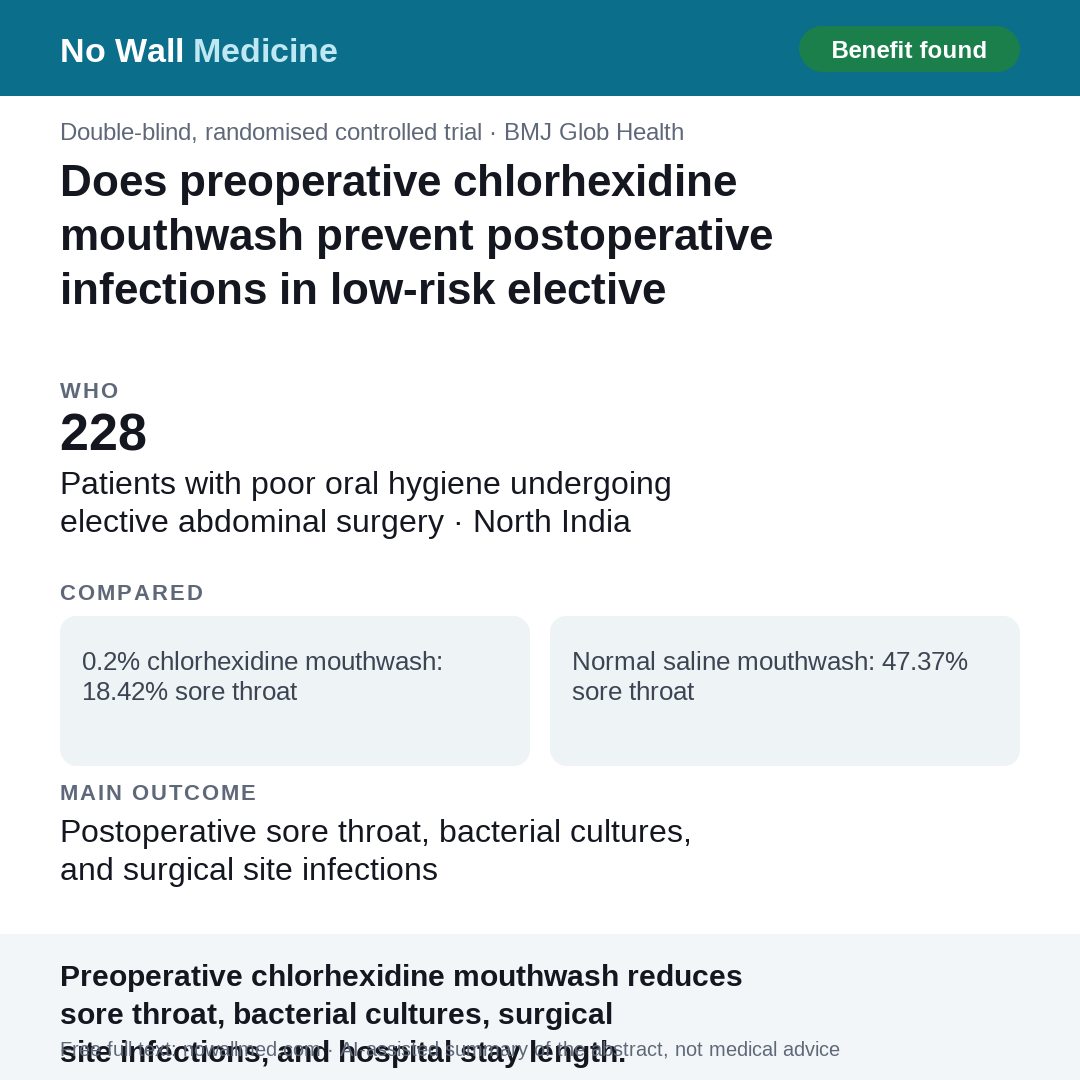
Does preoperative chlorhexidine mouthwash prevent postoperative infections in low-risk elective abdominal surgeries?
Who
228
Patients with poor oral hygiene undergoing elective abdominal surgery · North India
Compared
0.2% chlorhexidine mouthwash: 18.42% sore throat
Normal saline mouthwash: 47.37% sore throat
Main outcome
Postoperative sore throat, bacterial cultures, and surgical site infections
Bottom line: Preoperative chlorhexidine mouthwash reduces sore throat, bacterial cultures, surgical site infections, and hospital stay length.
BMJ Glob Health · 2026-07-29Download image
Clinical question: Does preoperative chlorhexidine mouthwash prevent postoperative infections in low-risk elective abdominal surgeries?
Why it matters: The role of chlorhexidine mouthwash in short-duration elective abdominal surgeries remains unexplored, particularly for patients with poor oral hygiene in low-resource settings.
Key points
- Researchers studied 228 patients with poor oral hygiene undergoing elective abdominal surgery lasting less than 4 hours.
- Using 0.2% chlorhexidine mouthwash reduced sore throat (18.42% vs 47.37%), positive bacterial cultures (21.05% vs 62.28%), and surgical site infections (4.39% vs 21.93%).
- The chlorhexidine group also experienced a shorter length of hospital stay, while pneumonia rates were low and comparable between groups.
Headline and key points written with AI from the paper’s abstract, with every number checked against it. Read the paper before relying on them.
Was this summary helpful?
Abstract
Introduction
Postoperative respiratory complications, particularly in patients with poor oral hygiene, contribute significantly to morbidity and healthcare burden. The oral cavity serves as a reservoir of pathogenic micro-organisms that, when aspirated during or after surgery, can lead to respiratory infections. While chlorhexidine mouthwash has shown promise in high-risk surgeries, its role in short-duration elective abdominal surgeries remains unexplored, especially in low-resource settings. Methods
This double-blind, randomised controlledrial included 228 patients (American Society of Anaesthesiologists I/II, aged 18-65 years, Oral Hygiene Index (OHI) >6) undergoing elective abdominal surgery under general anaesthesia lasting <4 hours. Patients were randomised to receive either 0.2% chlorhexidine (group A) or normal saline (group B) mouthwash two times before surgery. Outcomes measured included postoperative sore throat, fever, pneumonia, surgical site infections (SSI) and length of hospital stay. Microbiological cultures, complete blood count, C-reactive protein (CRP) and chest X-rays were evaluated on postoperative days 1, 3 and 7. Results
Chlorhexidine significantly reduced sore throat (18.42% vs 47.37%, p<0.001), positive bacterial cultures (21.05% vs 62.28%, p<0.001), CRP elevation and SSI (4.39% vs 21.93%, p<0.001). Length of hospital stay was also shorter in the chlorhexidine group (p<0.001). Pneumonia rates were low and comparable. Conclusion
This double-blind randomised controlled trial demonstrates that preoperative use of chlorhexidine mouthwash significantly reduces postoperative sore throat, bacterial colonisation, SSI and length of hospital stay in patients with poor oral hygiene undergoing short-duration elective abdominal surgeries. These findings highlight the utility of a simple, low-cost oral hygiene intervention in improving surgical outcomes, particularly in low-resource settings and support its incorporation into standard perioperative protocols, even for lower risk procedures. Trial registration number
CTRI/2024/06/069511).
Abstract reproduced under the article’s CC BY NC licence.
Subject terms
Cite this article
Gautam S, Kumar S, Venkatesh V, et al. Preoperative chlorhexidine mouthwash to prevent postoperative infections in low-risk elective abdominal surgeries: a double-blind RCT from North India among patients with poor oral hygiene. BMJ Glob Health. 2026. doi:10.1136/bmjgh-2025-021607
Spotted a mistake? Suggest a correction