Preoperative smoking cessation interventions: a systematic review and meta-analysis
Systematic review and meta-analysisMixed results
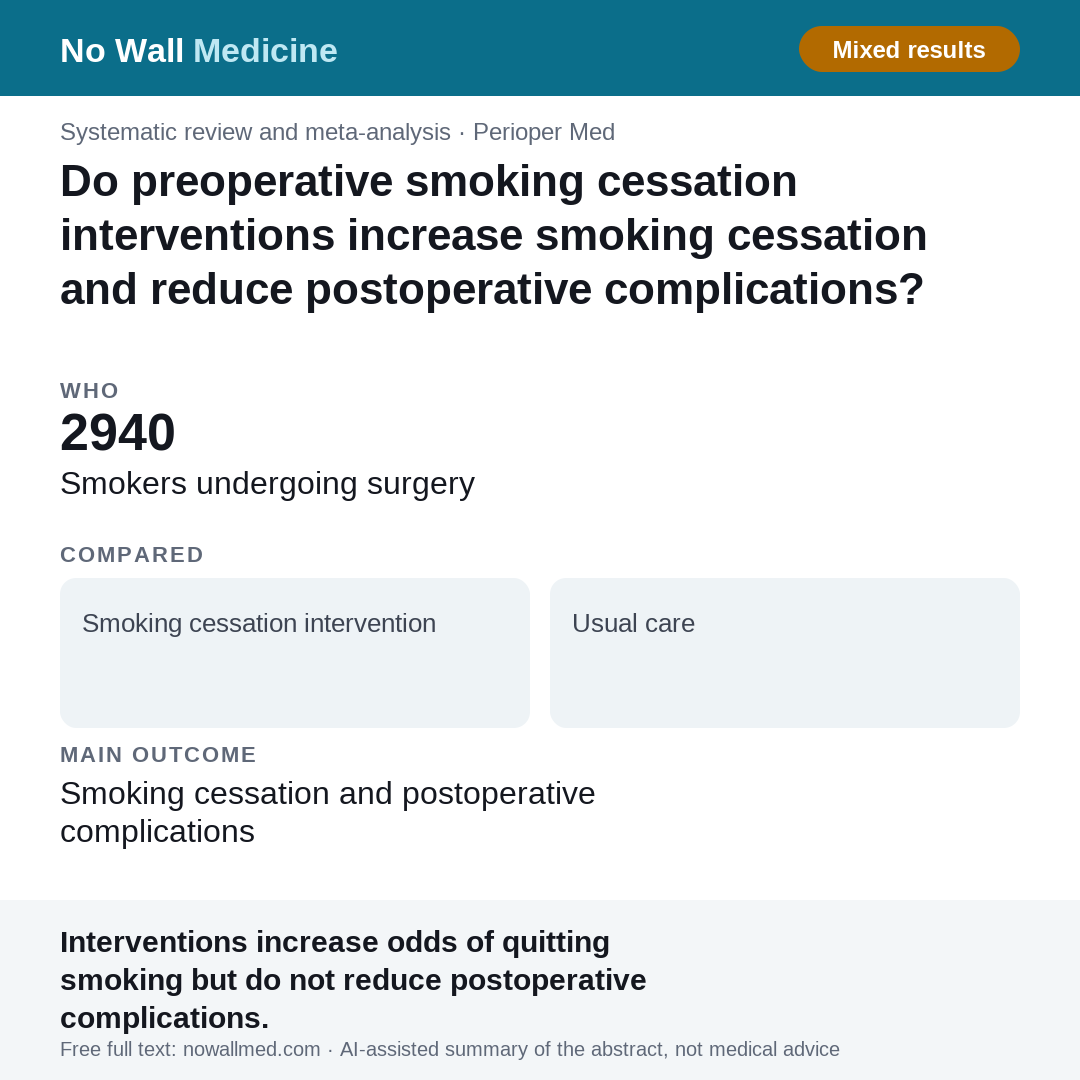
Do preoperative smoking cessation interventions increase smoking cessation and reduce postoperative complications?
Who
2940
Smokers undergoing surgery
Compared
Smoking cessation intervention
Usual care
Main outcome
Smoking cessation and postoperative complications
Result: relative risk 1.64 (95% CI 1.30-2.07) for smoking cessation
Bottom line: Interventions increase odds of quitting smoking but do not reduce postoperative complications.
Limitation: High risk of bias and heterogeneity in the included studies.
Perioper Med · 2025-01-10Download image
Clinical question: Do preoperative smoking cessation interventions increase smoking cessation and reduce postoperative complications?
Abstract
Background
Smoking is the leading single cause of preventable death in England and also increases the risk of postoperative complications. The preoperative period is a potential opportunity to introduce smoking cessation interventions to smokers to reduce the risk of postoperative complications. A systematic search was conducted to find all studies that investigated the effectiveness of preoperative smoking cessation interventions. The primary outcome was smoking cessation at surgical time to the last follow-up, and the secondary outcome was postoperative complications that required treatment or ICU admission. A random-effects meta-analysis was used to synthesize the outcomes. Sixteen studies were included in the review (3505 participants), and 14 studies were included in the meta-analysis (2940 randomized participants). The quality of evidence was moderate due to the high risk of bias and heterogeneity. We found that patients who were provided with a smoking cessation intervention had significantly increased odds of quitting smoking by the time of surgery compared with usual care, with a reported relative risk (95% CI) 1.64 (1.30-2.07) and at the longest follow-ups with RR (95% CI) 1.38 (1.12-1.70). Moreover, there was no difference found in the rate of postoperative complications between intervention and control conditions with RR (95% CI) 0.81 (0.62-1.06). The use of standardized outcome measurements is recommended to reduce heterogeneity for future studies, and further investigation focusing on patient perspectives is needed. Trial registration
PROSPERO CRD42023423202.
Cite this article
Alsanad M, Aljanoubi M, Alenezi FK, Farley A, Naidu B, Yeung J. Preoperative smoking cessation interventions: a systematic review and meta-analysis. Perioper Med. 2025. doi:10.1186/s13741-024-00479-4
Spotted a mistake? Suggest a correction
Top studies every Monday
The week’s key trials and guidelines in your specialties, plus any topics you follow. By email, free.
Get the weekly digest