Three-dimensional simulation of breast appearance does not create unrealistic expectations after breast-conserving surgery
Preoperative three-dimensional simulation of the breast appearance after wide local excision or level one oncoplastic techniques for breast-conserving treatment does not set unrealistic expectations for aesthetic outcome: One-year follow-up of a randomised controlled trial
Prospective 3-arm randomized controlled trialNo clear difference
Does preoperative three-dimensional simulation set unrealistic expectations for aesthetic outcomes?
Who
117
Women undergoing wide local excision or level one oncoplastic breast-conserving treatment
Compared
Three-dimensional surface imaging simulation
Viewing post-operative 2D photographs
Standard care
Main outcome
Perception of aesthetic outcome and BREAST-Q scores
Bottom line: Three-dimensional simulation does not set unrealistic aesthetic expectations compared to standard care or viewing photographs.
J Plast Reconstr Aesthet Surg · 2024-07-15Download image
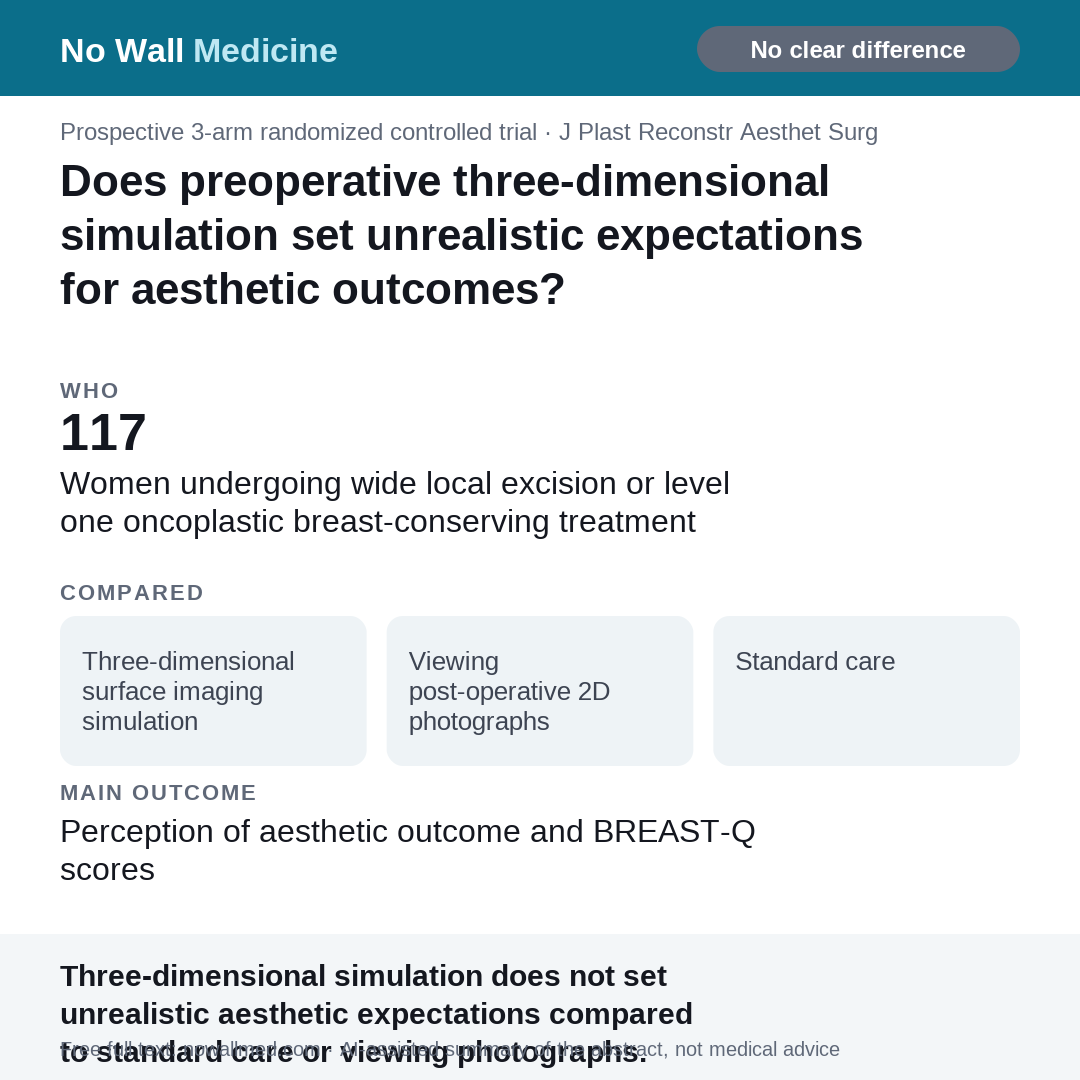
Clinical question: Does preoperative three-dimensional simulation set unrealistic expectations for aesthetic outcomes?
Why it matters: It was unknown if preoperative 3D surface imaging simulation of breast appearance matches a patient's actual perception of their results or affects their quality of life.
Key points
- Researchers conducted a randomized controlled trial with 117 women who received verbal descriptions, 2D photographs, or 3D surface imaging simulation of their expected surgical results.
- At one-year follow-up, 3D simulation was not associated with different perceptions of aesthetic outcomes (p = 0.40) or satisfaction scores compared to other methods.
- The simulation did not show different results for satisfaction with information (p = 0.76), satisfaction with breasts (p = 0.70), or psychosocial wellbeing (p = 0.81).
Headline and key points written with AI from the paper’s abstract, with every number checked against it. Read the paper before relying on them.
Was this summary helpful?
Subject terms
Cite this article
Godden AR, Micha A, Barry PA, Krupa KDC, Pitches CA, Kirby AM. Preoperative three-dimensional simulation of the breast appearance after wide local excision or level one oncoplastic techniques for breast-conserving treatment does not set unrealistic expectations for aesthetic outcome: One-year follow-up of a randomised controlled trial. J Plast Reconstr Aesthet Surg. 2024. doi:10.1016/j.bjps.2024.07.027
Spotted a mistake? Suggest a correction
Top studies every Monday
The week’s key trials and guidelines in your specialties, plus any topics you follow. By email, free.
Get the weekly digest