Preparing for responsive management and dialysis showed similar quality of life outcomes
Preparing for responsive management versus renal dialysis in older people living with kidney failure and frailty or multimorbidity in the UK (Prepare for Kidney Care): a two-arm, superiority, parallel-group, open-label, pragmatic, phase 3, individually randomised controlled trial
Randomized, open-label trialNo clear difference
Is responsive management better than dialysis for older people with kidney failure?
Who
445
Older people with kidney failure and frailty or multimorbidity · 31 kidney centres in the UK
Compared
1.354Responsive management (95% CI 1.201 to 1.508)
1.472Renal dialysis (1.288 to 1.655)
Main outcome
Quality-adjusted life-years
Result: Adjusted mean difference -0.147 (95% CI -0.350 to 0.056)
Bottom line: No evidence that one approach is superior
Funded by: National Institute for Health Research
Lancet · 2026-11-04Download image
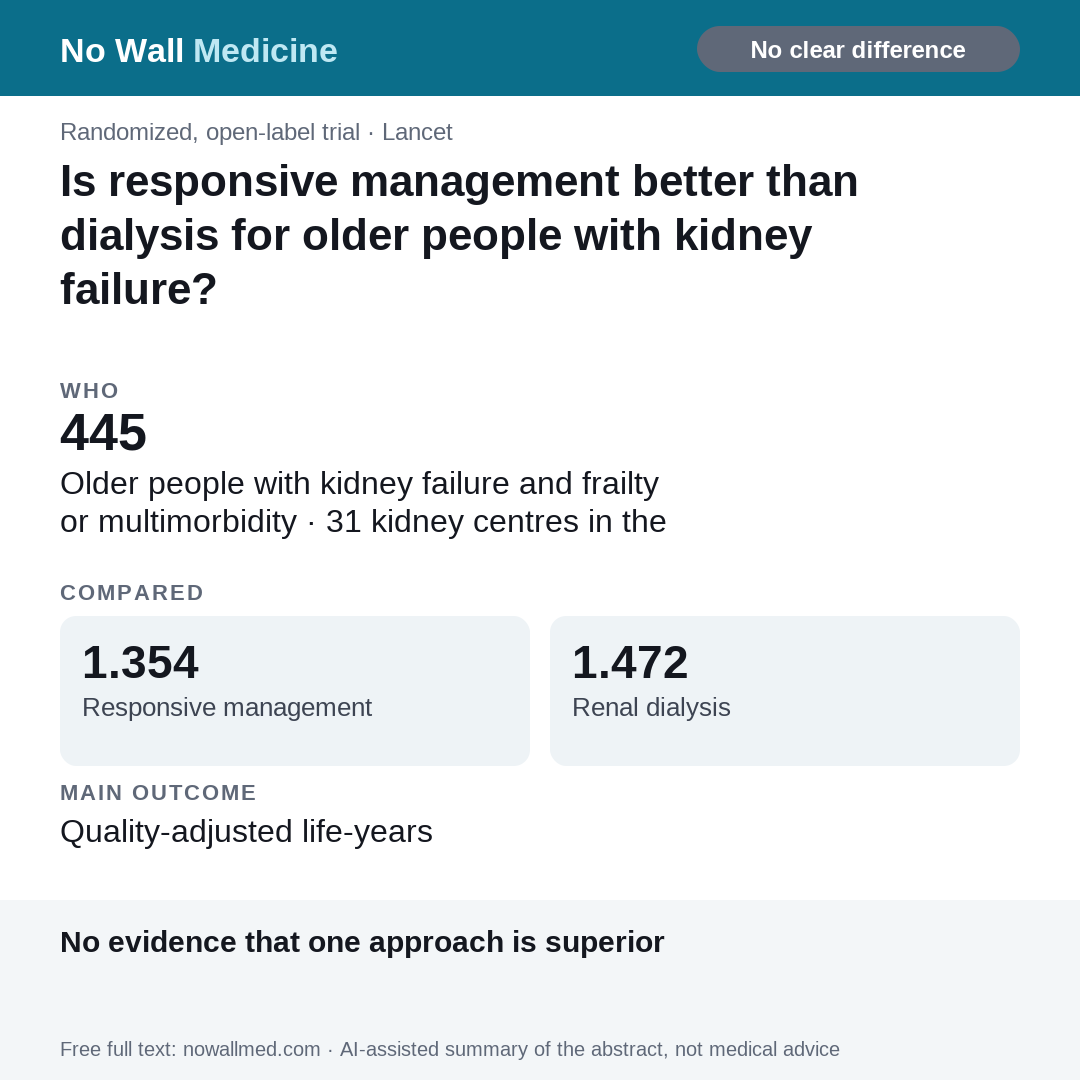
Clinical question: Is responsive management better than dialysis for older people with kidney failure?
Key points
- Researchers studied 445 patients with kidney failure, comparing preparing for responsive management and preparing for renal dialysis.
- Mean quality-adjusted life-years were 1·354 in the responsive management group and 1·472 in the dialysis group, with no significant difference.
- Dialysis access complications were significantly lower in the prepare for responsive management group, with an adjusted incident rate ratio of 0·41.
Headline and key points written with AI from the paper’s abstract, with every number checked against it. Read the paper before relying on them.
Abstract
Background
The comparative effectiveness of conservative kidney management and dialysis in older people (aged ≥80 years regardless of frailty and comorbidity or aged 65-79 years if frailty or multimorbidity are present) living with kidney failure is unknown. We aimed to assess the relative effectiveness of preparing for responsive management-a protocolised version of conservative kidney management-and preparing for renal dialysis. Methods
Prepare for Kidney Care was a two-arm, superiority, parallel-group, open-label, pragmatic, phase 3, individually randomised controlled trial conducted in 31 kidney centres in England, Wales, Scotland, and Northern Ireland. Eligible patients had an estimated glomerular filtration rate below 15 mL/min per 1·73 m2, confirmed by at least one additional reading in the 12 months preceding consent that was not due to acute kidney injury, and were either aged 80 years or older, or aged 65-79 years with a WHO performance status of at least 3 or a Davies comorbidity score of at least 2. Eligible participants were randomly assigned (1:1) to prepare for responsive management-a patient-centred approach focused on slowing disease progression, active symptom management, and preserving quality of life without the use of dialysis or kidney transplantation-or to prepare for renal dialysis. Randomisation was stratified by centre and minimised by age; a centralised system ensured allocation concealment until randomisation had taken place. The primary outcome was the mean difference in quality-adjusted life-years (QALYs), combining length and health-related quality of life from the patient-reported EQ-5D-5L scale, including all follow-up from randomisation to Aug 31, 2025. The primary outcome was analysed by intention to treat in the full analysis set, which included all randomly assigned participants, with missing EQ-5D-5L values for living participants imputed. Harms (hospital admissions and dialysis access complications) and adverse events (deaths and hospital admissions, by cause) were assessed in the full analysis set. The trial was registered with ISRCTN, 17133653 (completed). Findings
From July 1, 2017, to Aug 31, 2024, 6120 patients were screened across 31 kidney centres in the UK, 445 (7%) of whom were eligible and agreed to be randomly assigned. 228 (51%) of 445 participants were randomly assigned to prepare for responsive management and 217 (49%) of 445 participants were randomly assigned to prepare for renal dialysis. Median age was 82 years (IQR 80 to 86) and 137 (31%) of 445 participants were female. After a mean follow-up duration of 4·5 years (SD 2·1), mean QALYs were 1·354 (95% CI 1·201 to 1·508) in the prepare for responsive management group and 1·472 (1·288 to 1·655) in the prepare for renal dialysis group (adjusted mean difference -0·147 [95% CI -0·350 to 0·056] p=0·16). Specific harms outcomes were not prespecified, but hospital admission rates were similar in the two groups and dialysis access complications were significantly lower in the prepare for responsive management group (adjusted incident rate ratio 0·41 [95% CI 0·19 to 0·88]), based on 74 events in 36 participants across both groups. There were 667 serious adverse events in the prepare for responsive management group (157 [69%] of 228 participants died, with 510 hospital admissions) and 578 in the prepare for renal dialysis group (136 [63%] of 217 participants died, with 442 hospital admissions). None of these serious adverse events met the criteria for expedited reporting. Interpretation
Among older people living with kidney failure and frailty or multimorbidity, we found no evidence that either preparing for responsive management or preparing for renal dialysis was superior in terms of QALYs over a mean follow-up duration of 4·5 years. This trial provides novel comparative information for clinical decision making. Funding
National Institute for Health Research Health Technology Assessment programme.
Abstract reproduced under the article’s CC BY licence.
Spotted a mistake? Suggest a correction