Prescription Drug Monitoring Program Reminder Emails, Program Use, and Prescribing: A Randomized Clinical Trial
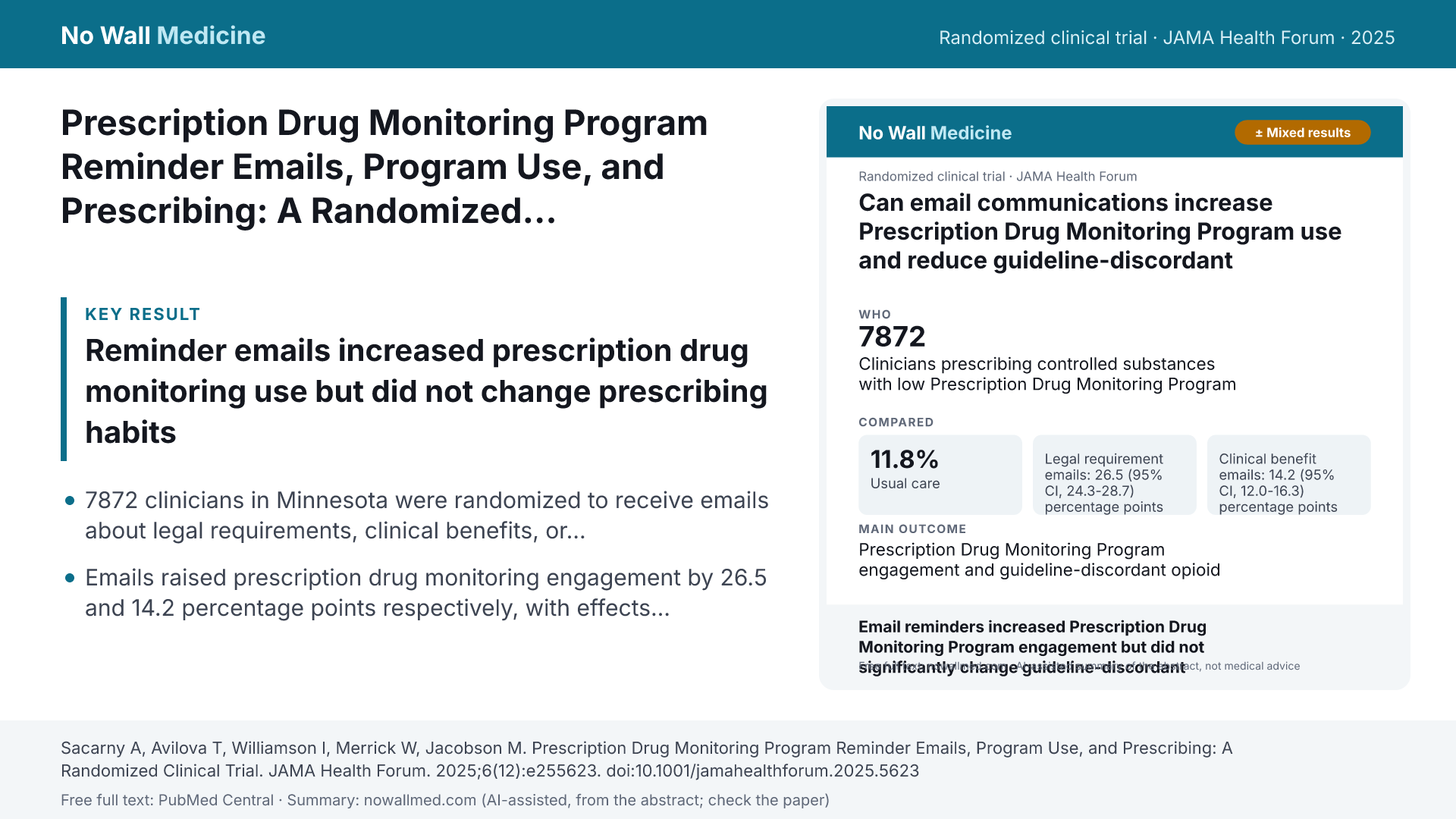
Key result: Reminder emails increased prescription drug monitoring use but did not change prescribing habits
Randomized clinical trialMixed results
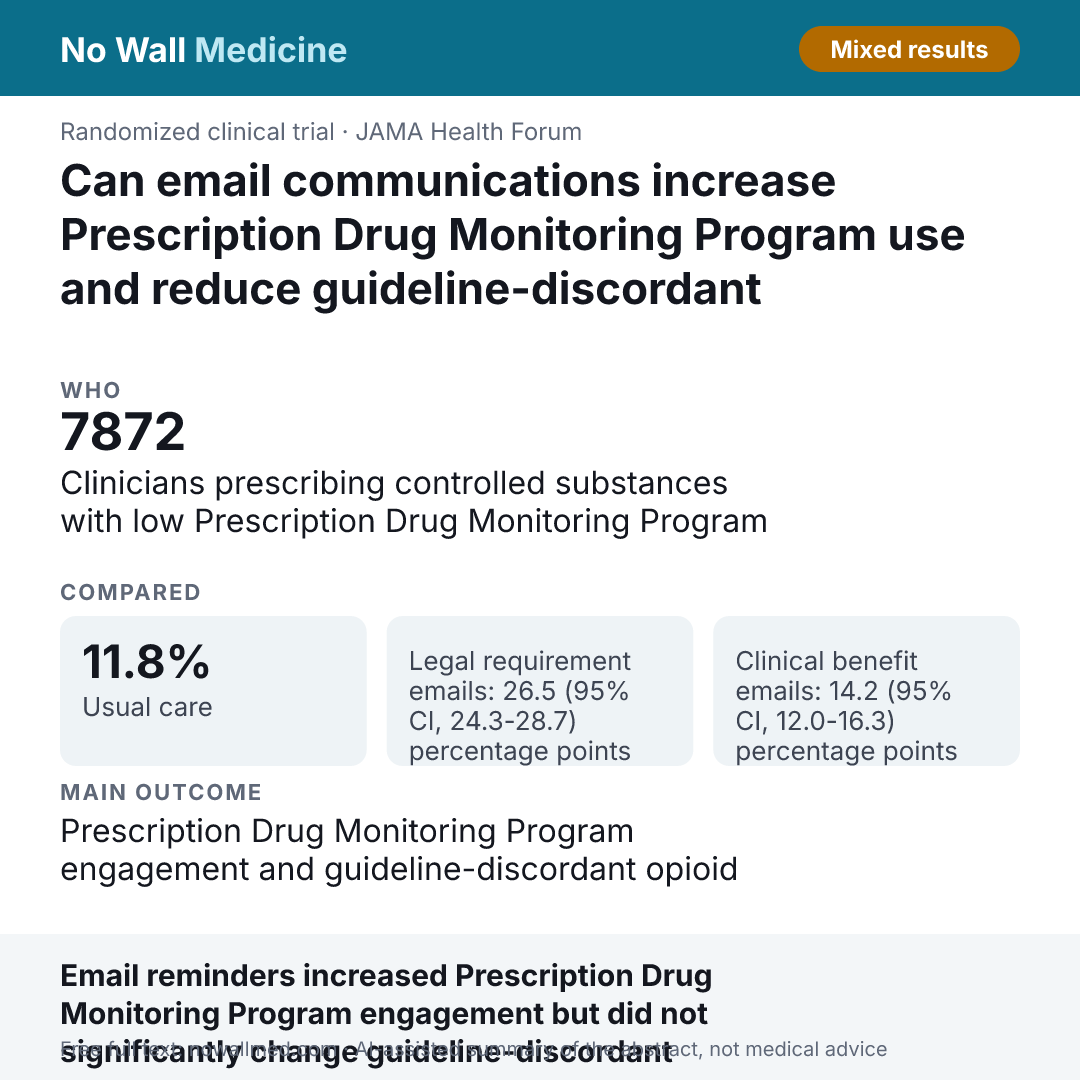
Can email communications increase Prescription Drug Monitoring Program use and reduce guideline-discordant prescribing?
Who
7872
Clinicians prescribing controlled substances with low Prescription Drug Monitoring Program engagement · Minnesota, United States
Compared
11.8%Usual care (309 clinicians)
Legal requirement emails: 26.5 (95% CI, 24.3-28.7) percentage points
Clinical benefit emails: 14.2 (95% CI, 12.0-16.3) percentage points
Main outcome
Prescription Drug Monitoring Program engagement and guideline-discordant opioid prescribing
Bottom line: Email reminders increased Prescription Drug Monitoring Program engagement but did not significantly change guideline-discordant opioid prescribing.
Limitation: Emails did not trigger large-scale changes in prescribing.
JAMA Health Forum · 2025-12-05 · Save PNG
Key points
- 7872 clinicians in Minnesota were randomized to receive emails about legal requirements, clinical benefits, or no intervention.
- Emails raised prescription drug monitoring engagement by 26.5 and 14.2 percentage points respectively, with effects lasting at least 7 months.
- Guideline-discordant opioid prescribing did not differ significantly across the three study groups.
Why it matters: Evidence on whether email campaigns can increase clinician engagement with prescription drug monitoring programs was limited.
Discussion prompts
- Would these patients look like yours? Who was left out?
- Is the main outcome one that matters to patients?
- Is the difference large enough to change what you do?
Cite: Sacarny A, Avilova T, Williamson I, Merrick W, Jacobson M. Prescription Drug Monitoring Program Reminder Emails, Program Use, and Prescribing: A Randomized Clinical Trial. JAMA Health Forum. 2025;6(12):e255623. doi:10.1001/jamahealthforum.2025.5623
Free full text: PubMed Central · Summary and visual abstract: nowallmed.com/a/prescription-drug-monitoring-program-reminder-emails-program-use-and-1jde4w0/ (AI-assisted from the abstract; check the paper before relying on it).