Teplizumab preserved beta cell function in children and adolescents with newly diagnosed type 1 diabetes
Preserving beta cell function in children and adolescents with newly diagnosed stage 3 type 1 diabetes: per-protocol population analysis from the PROTECT randomised trial
Randomized trialBenefit found
Does teplizumab preserve beta cell function in newly diagnosed stage 3 type 1 diabetes?
Who
275
Children and adolescents aged 8-17 years with stage 3 type 1 diabetes
Compared
teplizumab
placebo
Main outcome
change of stimulated C-peptide concentration from baseline
Result: least squares mean difference 0.14 nmol/l (95% CI 0.10, 0.18)
Bottom line: Teplizumab treatment per protocol led to greater beta cell function preservation compared with placebo.
Funded by: Provention Bio, a Sanofi company
Diabetologia · 2026-09-10Download image
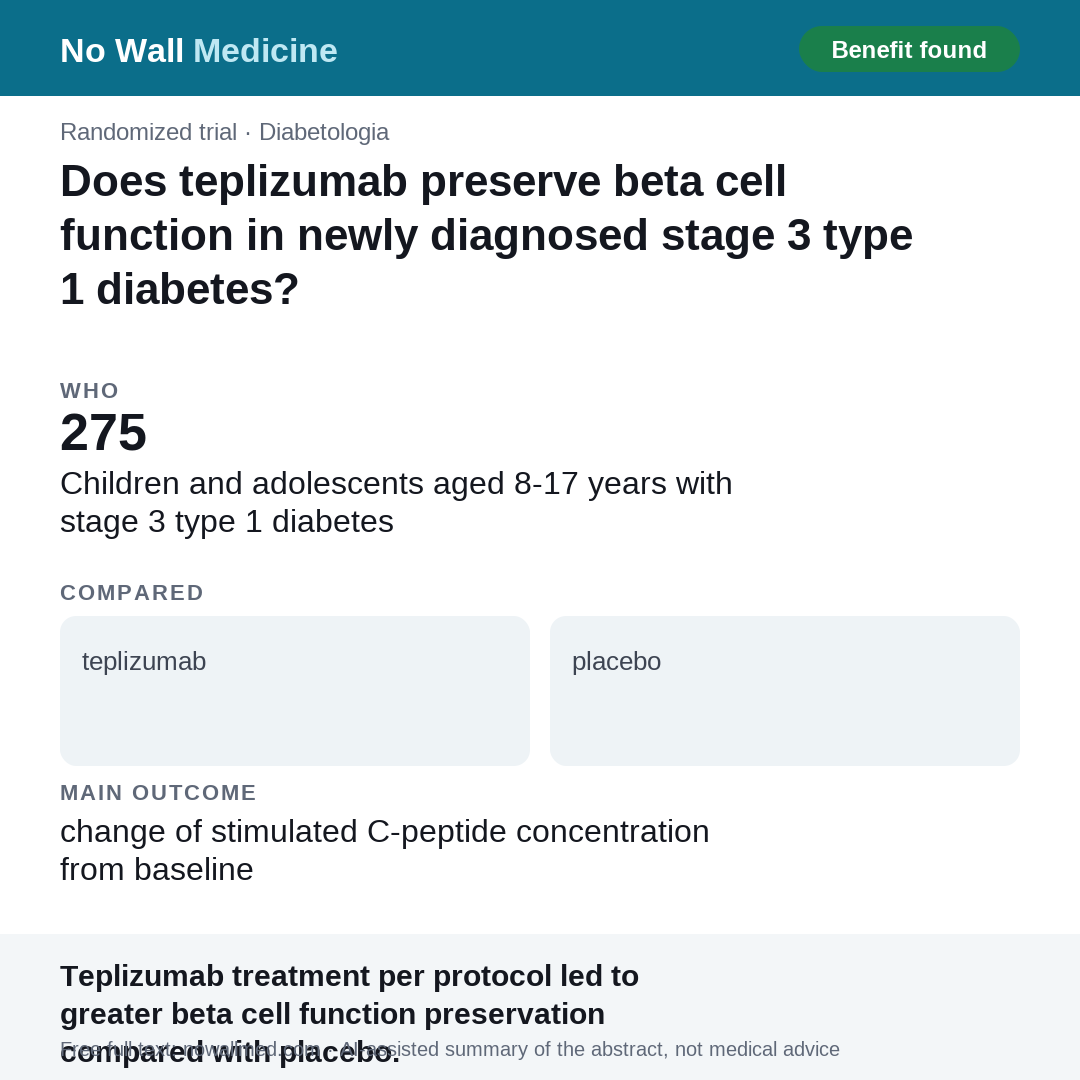
Clinical question: Does teplizumab preserve beta cell function in newly diagnosed stage 3 type 1 diabetes?
Why it matters: Researchers sought to evaluate the efficacy of teplizumab in preserving beta cell function, which is the ability of the pancreas to produce insulin.
Key points
- The study analyzed 275 participants aged 8 to 17 years with stage 3 type 1 diabetes who received either teplizumab or a placebo.
- At week 78, the difference in change of stimulated C-peptide concentration between the teplizumab and placebo groups was 0.14 nmol/l.
- Teplizumab treatment led to greater time in range and lower use of insulin injected from outside the body compared to placebo.
Headline and key points written with AI from the paper’s abstract, with every number checked against it. Read the paper before relying on them.
Topics
Spotted a mistake? Suggest a correction