Pretreatment attrition was 18% among patients diagnosed with rifampicin-resistant tuberculosis using Xpert testing
Pretreatment attrition after rifampicin-resistant tuberculosis diagnosis with Xpert MTB/RIF or ultra in high TB burden countries: a systematic review and meta-analysis
Systematic review and meta-analysisHarm found
What is the proportion of pretreatment attrition after rifampicin-resistant tuberculosis diagnosis using Xpert?
Who
Patients diagnosed with rifampicin-resistant tuberculosis using Xpert in high tuberculosis burden countries · 21 countries
Compared
18%Total attrition (95% CI: 12 to 25)
78%Pretreatment loss to follow-up (95% CI: 51% to 92%)
30%Pretreatment mortality (95% CI: 15% to 52%)
Main outcome
Pretreatment attrition proportion and reasons
Result: 18% (95% CI: 12 to 25)
Bottom line: Pretreatment attrition is widespread among rifampicin-resistant tuberculosis patients diagnosed with Xpert in high burden countries.
Limitation: Significant heterogeneity between included studies and most studies used routine programme data.
BMJ Glob Health · 2025-01-22Download image
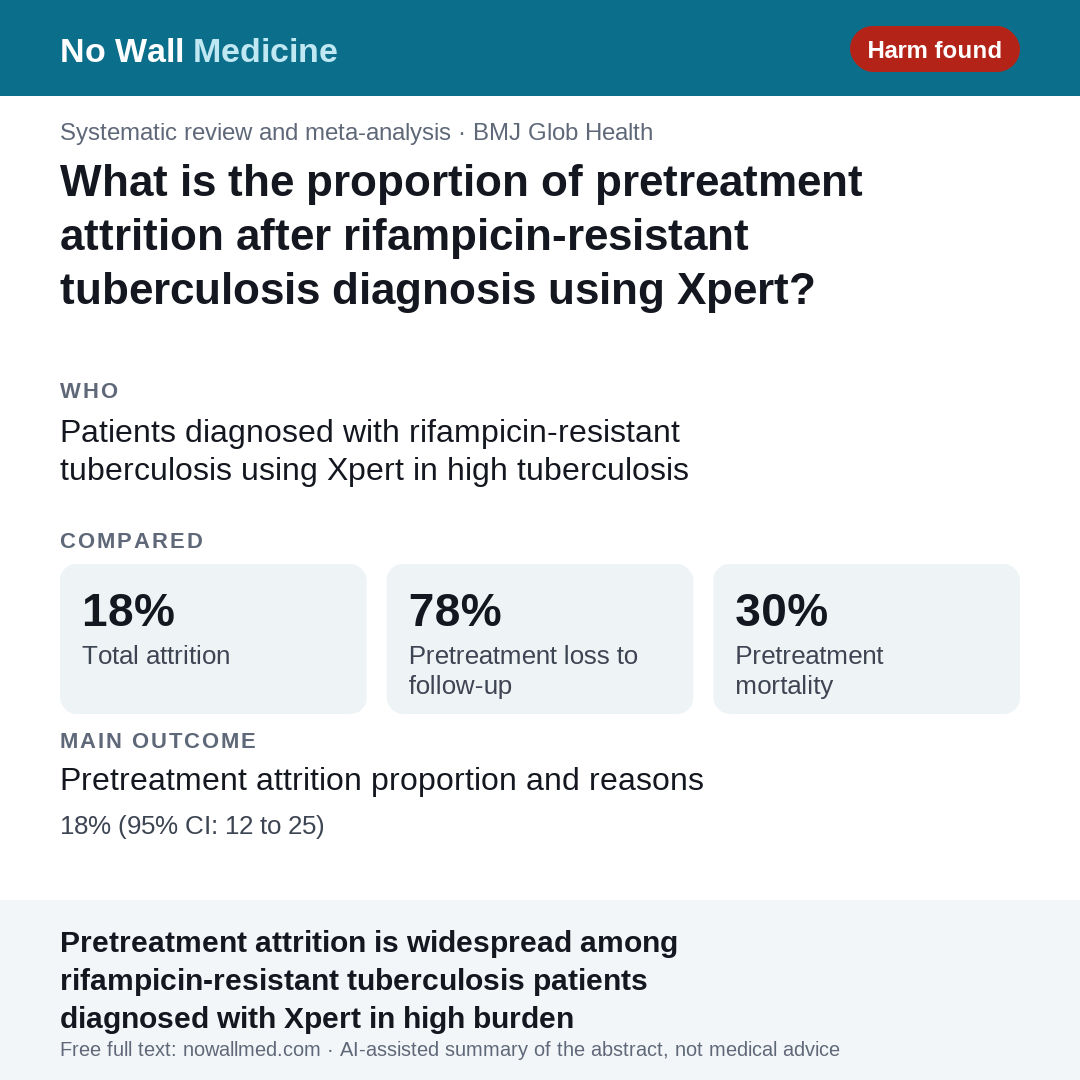
Clinical question: What is the proportion of pretreatment attrition after rifampicin-resistant tuberculosis diagnosis using Xpert?
Why it matters: The proportion of patients who do not start treatment after being diagnosed with rifampicin-resistant tuberculosis using Xpert testing was not previously quantified in high tuberculosis burden countries.
Key points
- Researchers analyzed 30 studies from 21 countries to measure the gap between rifampicin-resistant tuberculosis diagnosis and the start of treatment.
- The pooled proportion of pretreatment attrition was 18% (95% CI: 12 to 25).
- Loss to follow-up and death before starting treatment explained 78% (95% CI: 51% to 92%) and 30% (95% CI: 15% to 52%) of attrition, respectively.
Limitation the authors note: There was significant heterogeneity between the included studies.
Headline and key points written with AI from the paper’s abstract, with every number checked against it. Read the paper before relying on them.
Abstract
Introduction
The WHO endorsed the Xpert MTB/RIF (Xpert) technique since 2011 as initial test to diagnose rifampicin-resistant tuberculosis (RR-TB). No systematic review has quantified the proportion of pretreatment attrition in RR-TB patients diagnosed with Xpert in high TB burden countries.Pretreatment attrition for RR-TB represents the gap between patients diagnosed and those who effectively started anti-TB treatment regardless of the reasons (which include pretreatment mortality (death of a diagnosed RR-TB patient before starting adequate treatment) and/or pretreatment loss to follow-up (PTLFU) (drop-out of a diagnosed RR-TB patient before initiation of anti-TB treatment). Methods
In this systematic review and meta-analysis, we queried EMBASE, PubMed and Web of science to retrieve studies published between 2011 and 22 July 2024, that described pretreatment attrition for RR-TB using Xpert in high TB burden countries. Data on RR-TB patients who did not start treatment after diagnosis and reasons for not starting were extracted in an Excel table. A modified version of the Newcastle-Ottawa scale was used to evaluate the risk of bias among all included studies. The pooled proportion of pretreatment attrition and reasons were assessed using random-effects meta-analysis. Forest plots were generated using R software. Results
Thirty eligible studies from 21 countries were identified after full-text screening and included in the meta-analysis. Most studies used routine programme data. The pooled proportion of pretreatment attrition in included studies was 18% (95% CI: 12 to 25). PTLFU and pretreatment mortality were, respectively, reported in 10 and nine studies and explained 78% (95% CI: 51% to 92%) and 30% (95% CI: 15% to 52%) of attrition. Conclusion
Pretreatment attrition was widespread, with significant heterogeneity between included studies. National TB programmes should ensure accurate data collection and reporting of pretreatment attrition to enable reliable overall control strategies. Prospero registration number
CRD42022321509.
Abstract reproduced under the article’s CC BY NC licence.
Topics
Cite this article
Jouego CG, Decroo T, Netongo PM, Gils T. Pretreatment attrition after rifampicin-resistant tuberculosis diagnosis with Xpert MTB/RIF or ultra in high TB burden countries: a systematic review and meta-analysis. BMJ Glob Health. 2025. doi:10.1136/bmjgh-2024-015977
Spotted a mistake? Suggest a correction
Top studies every Monday
The week’s key trials and guidelines in your specialties, by email. Free.
Get the weekly digest