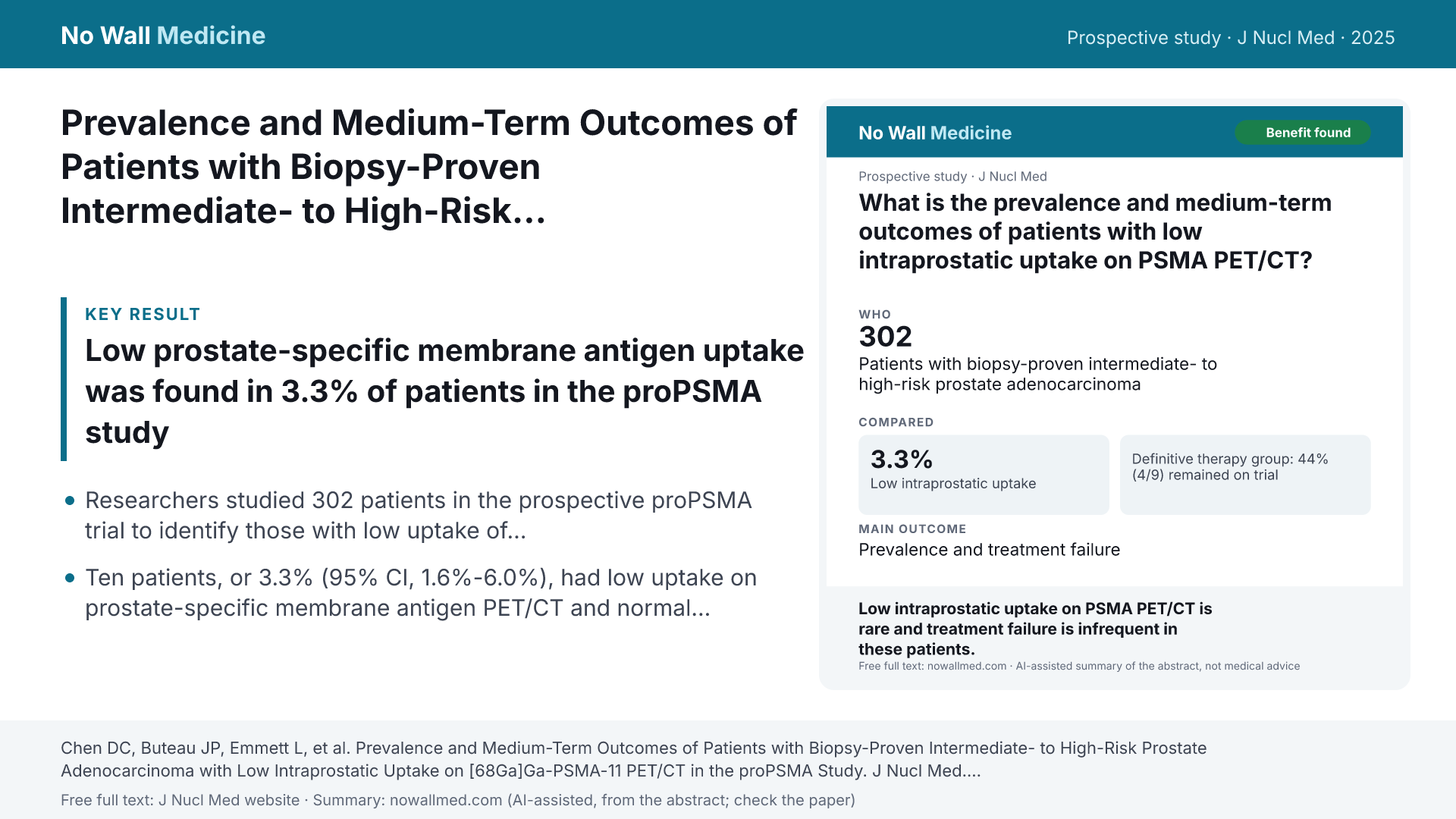
Low prostate-specific membrane antigen uptake was found in 3.3% of patients in the proPSMA study
Prevalence and Medium-Term Outcomes of Patients with Biopsy-Proven Intermediate- to High-Risk Prostate Adenocarcinoma with Low Intraprostatic Uptake on [68Ga]Ga-PSMA-11 PET/CT in the proPSMA Study
Prospective studyBenefit found
What is the prevalence and medium-term outcomes of patients with low intraprostatic uptake on PSMA PET/CT?
Who
302
Patients with biopsy-proven intermediate- to high-risk prostate adenocarcinoma
Compared
3.3%Low intraprostatic uptake (10/302)
Definitive therapy group: 44% (4/9) remained on trial
Main outcome
Prevalence and treatment failure
Bottom line: Low intraprostatic uptake on PSMA PET/CT is rare and treatment failure is infrequent in these patients.
J Nucl Med · 2025-05-01 · Save PNG
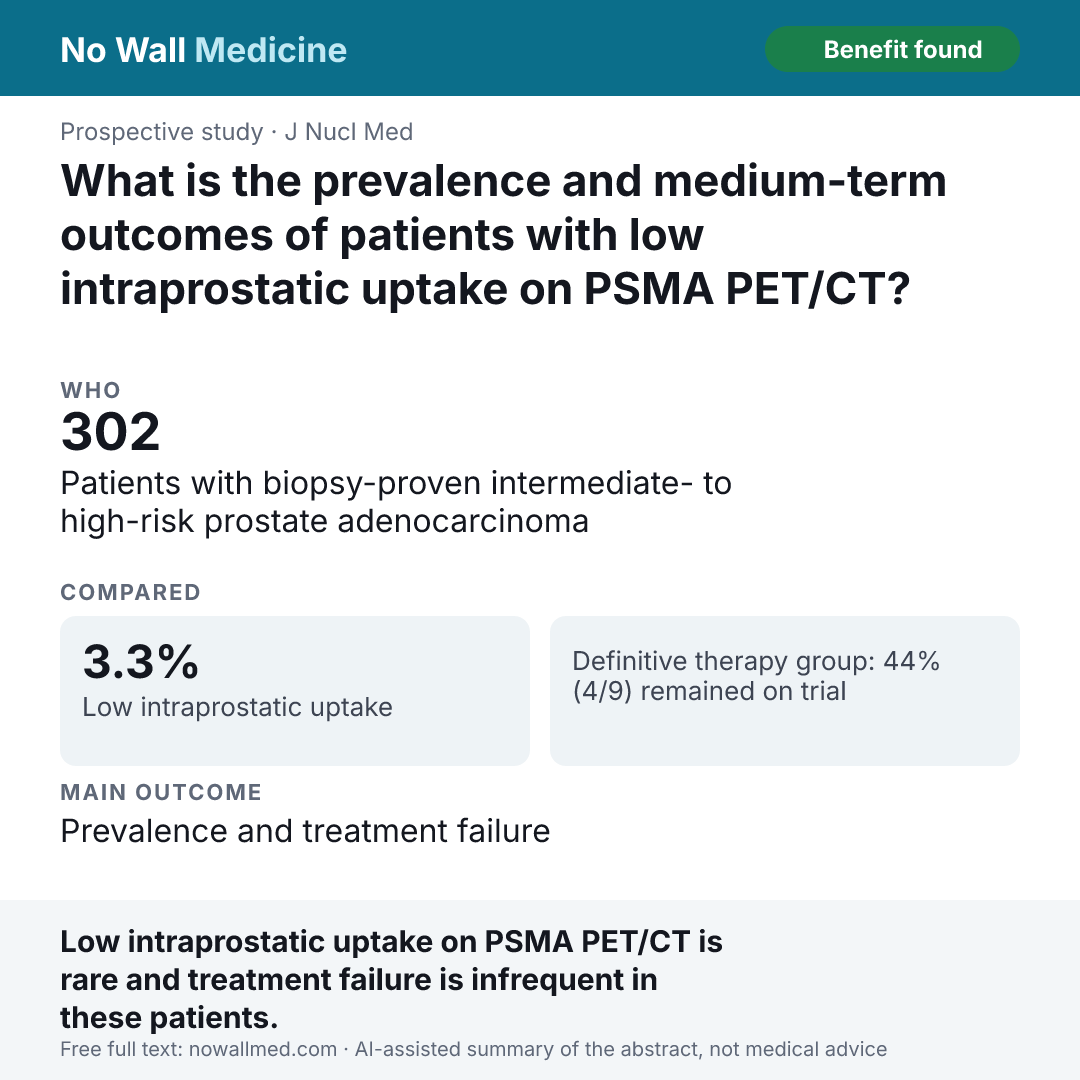
Clinical question: What is the prevalence and medium-term outcomes of patients with low intraprostatic uptake on PSMA PET/CT?
Why it matters: The prevalence and medium-term outcomes of patients with low intraprostatic uptake on prostate-specific membrane antigen PET/CT are not well defined.
Key points
- Researchers studied 302 patients in the prospective proPSMA trial to identify those with low uptake of the prostate-specific membrane antigen tracer on imaging.
- Ten patients, or 3.3% (95% CI, 1.6%-6.0%), had low uptake on prostate-specific membrane antigen PET/CT and normal findings on conventional CT and bone scans.
- Among the 9 patients who received definitive treatment, 4 (44%) remained on trial at the 42-month follow-up without evidence of treatment failure.
Headline and key points written with AI from the paper’s abstract, with every number checked against it. Read the paper before relying on them.
Was this summary helpful?
Subject terms
Headline, design, result, key points, caveat and citation as plain text.
Cite this article
Chen DC, Buteau JP, Emmett L, et al. Prevalence and Medium-Term Outcomes of Patients with Biopsy-Proven Intermediate- to High-Risk Prostate Adenocarcinoma with Low Intraprostatic Uptake on [68Ga]Ga-PSMA-11 PET/CT in the proPSMA Study. J Nucl Med. 2025;66(5):713-718. doi:10.2967/jnumed.124.268901
Spotted a mistake? Suggest a correction