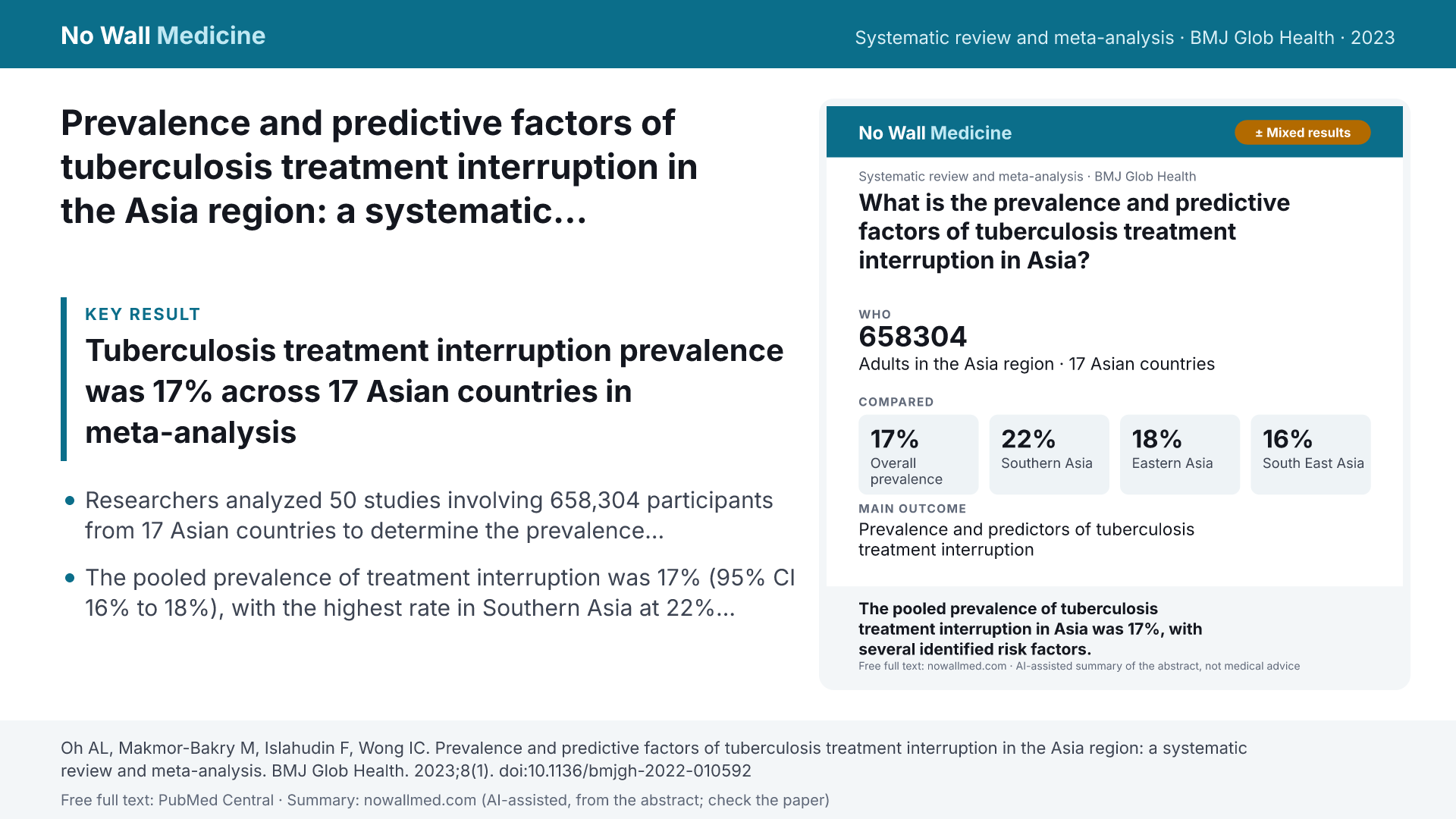
Tuberculosis treatment interruption prevalence was 17% across 17 Asian countries in meta-analysis
Prevalence and predictive factors of tuberculosis treatment interruption in the Asia region: a systematic review and meta-analysis
Systematic review and meta-analysisMixed results
What is the prevalence and predictive factors of tuberculosis treatment interruption in Asia?
Who
658304
Adults in the Asia region · 17 Asian countries
Compared
17%Overall prevalence (95% CI 16% to 18%)
22%Southern Asia (95% CI 16% to 29%)
18%Eastern Asia (95% CI 16% to 20%)
16%South East Asia (95% CI 4% to 28%)
Main outcome
Prevalence and predictors of tuberculosis treatment interruption
Bottom line: The pooled prevalence of tuberculosis treatment interruption in Asia was 17%, with several identified risk factors.
Limitation: All predictors demonstrated substantial heterogeneity except employment and HIV status
BMJ Glob Health · 2023-01-17 · Save PNG
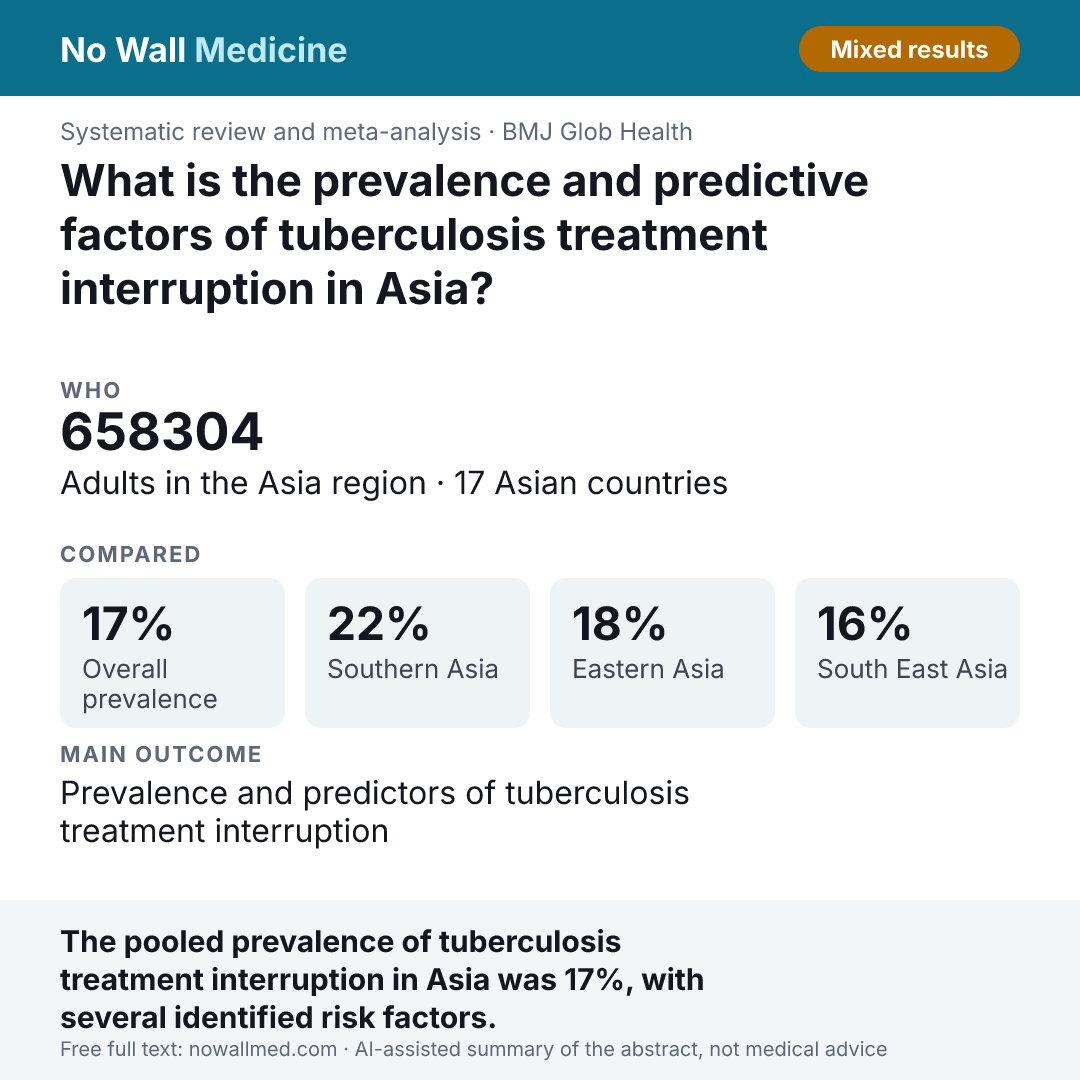
Clinical question: What is the prevalence and predictive factors of tuberculosis treatment interruption in Asia?
Why it matters: Findings regarding the prevalence and specific predictors of tuberculosis treatment interruption in Asian populations have been variable.
Key points
- Researchers analyzed 50 studies involving 658,304 participants from 17 Asian countries to determine the prevalence and predictors of tuberculosis treatment interruption.
- The pooled prevalence of treatment interruption was 17% (95% CI 16% to 18%), with the highest rate in Southern Asia at 22% (95% CI 16% to 29%).
- Factors associated with interruption included smoking (OR 2.74 (95% CI 1.98 to 3.78)), alcohol intake (OR 2.24 (95% CI 1.58 to 3.18)), and adverse drug reactions (OR 2.01 (95% CI 1.20 to 3.34)).
Headline and key points written with AI from the paper’s abstract, with every number checked against it. Read the paper before relying on them.
Was this summary helpful?
Abstract
Introduction
Tuberculosis (TB) treatment interruption remains a critical challenge leading to poor treatment outcomes. Two-thirds of global new TB cases are mostly contributed by Asian countries, prompting systematic analysis of predictors for treatment interruption due to the variable findings. Methods
Articles published from 2012 to 2021 were searched through seven databases. Studies that established the relationship for risk factors of TB treatment interruption among adult Asian were included. Relevant articles were screened, extracted and appraised using Joanna Briggs Institute's checklists for cohort, case-control and cross-sectional study designs by three reviewers. Meta-analysis was performed using the random effect model in Review Manager software. The pooled prevalence and predictors of treatment interruption were expressed in ORs with 95% CIs; heterogeneity was assessed using the I2 statistic. The publication bias was visually inspected using the funnel plot. Results
Fifty eligible studies (658 304 participants) from 17 Asian countries were included. The overall pooled prevalence of treatment interruption was 17% (95% CI 16% to 18%), the highest in Southern Asia (22% (95% CI 16% to 29%)), followed by Eastern Asia (18% (95% CI 16% to 20%)) and South East Asia (16% (95% CI 4% to 28%)). Seven predictors were identified to increase the risk of treatment interruption, namely, male gender (OR 1.38 (95% CI 1.26 to 1.51)), employment (OR 1.43 (95% CI 1.11 to 1.84)), alcohol intake (OR 2.24 (95% CI 1.58 to 3.18)), smoking (OR 2.74 (95% CI 1.98 to 3.78)), HIV-positive (OR 1.50 (95% CI 1.15 to 1.96)), adverse drug reactions (OR 2.01 (95% CI 1.20 to 3.34)) and previously treated cases (OR 1.77 (95% CI 1.39 to 2.26)). All predictors demonstrated substantial heterogeneity except employment and HIV status with no publication bias. Conclusion
The identification of predictors for TB treatment interruption enables strategised planning and collective intervention to be targeted at the high-risk groups to strengthen TB care and control in the Asia region.
Abstract reproduced under the article’s CC BY NC licence.
Subject terms
Headline, design, result, key points, caveat and citation as plain text.
Cite this article
Oh AL, Makmor-Bakry M, Islahudin F, Wong IC. Prevalence and predictive factors of tuberculosis treatment interruption in the Asia region: a systematic review and meta-analysis. BMJ Glob Health. 2023;8(1). doi:10.1136/bmjgh-2022-010592
Spotted a mistake? Suggest a correction