Vitamin A deficiency affects up to 59% of patients after certain bariatric surgeries
Prevalence, Ocular Manifestations, and Treatment Response in Postbariatric Vitamin A Deficiency: A Systematic Review and Meta-Analysis
Systematic review and meta-analysisBenefit found
What is the prevalence and ocular manifestation of vitamin A deficiency after bariatric surgery?
Who
455
Patients undergoing various bariatric surgery procedures
Compared
18.0%Roux-en-Y gastric bypass
59.0%Biliopancreatic diversion
37.8%BPD with duodenal switch
42.5%Jejunoileal bypass
Main outcome
Prevalence of biochemical vitamin A deficiency
Result: 26.1% (95% CI, 18.5-35.4)
Bottom line: Vitamin A deficiency is common after bariatric surgery and ocular symptoms often improve with timely repletion.
Limitation: Certainty limited by heterogeneity, small subgroup cohorts, and selective reporting of ocular outcomes.
Am J Ophthalmol · 2026-09-24Download image
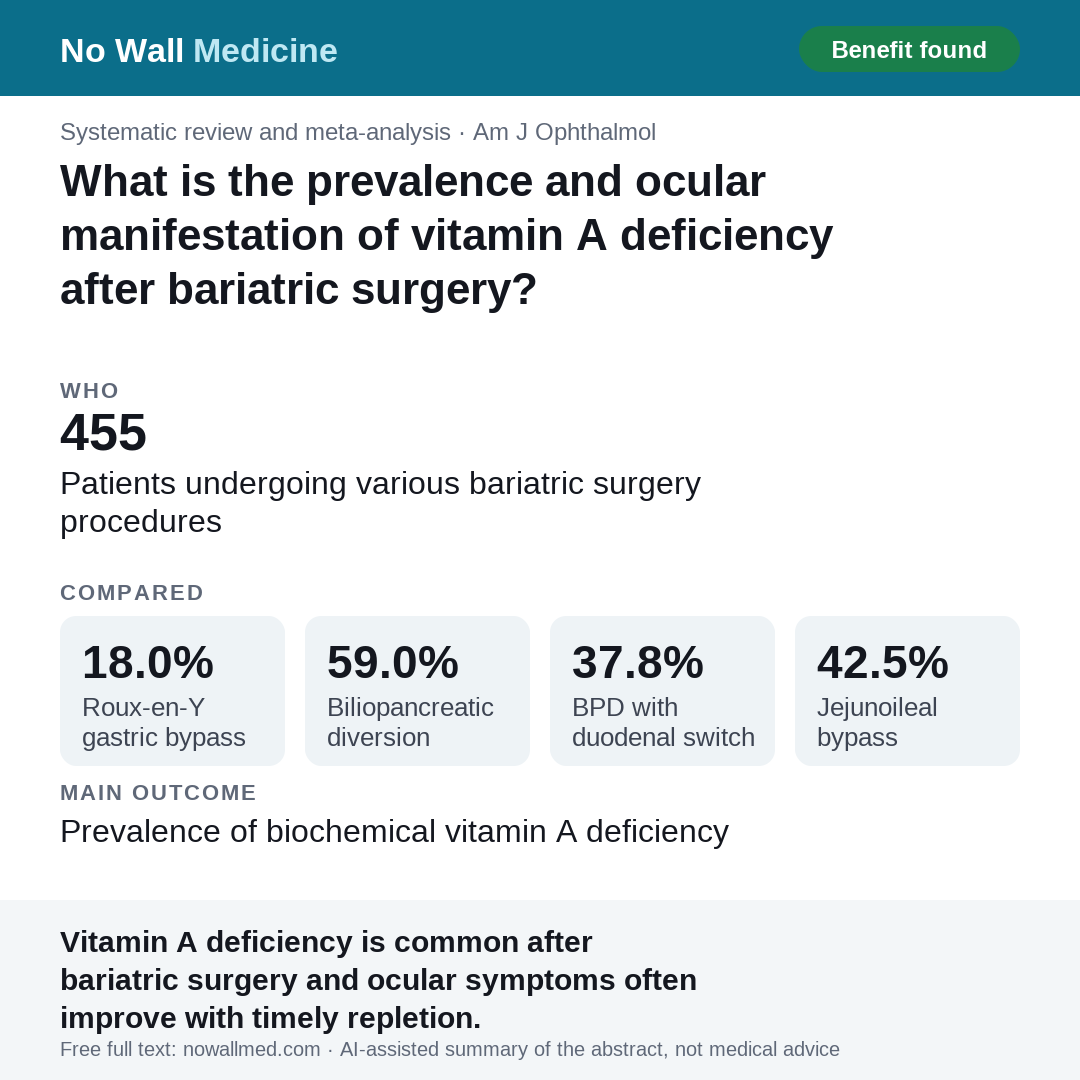
Clinical question: What is the prevalence and ocular manifestation of vitamin A deficiency after bariatric surgery?
Why it matters: Doctors need to recognize procedure-specific vitamin A deficiency and its eye-related symptoms to improve surveillance and timely treatment in patients after weight loss surgery.
Key points
- Researchers analyzed 21 studies involving 455 participants to measure vitamin A deficiency rates after different weight loss surgeries.
- The prevalence of deficiency was 18.0% after Roux-en-Y gastric bypass, 59.0% after biliopancreatic diversion, 37.8% after biliopancreatic diversion with duodenal switch, and 42.5% after jejunoileal bypass.
- Among 14 records with assessable ocular outcomes, 13 patients, or 93%, showed improvement or resolution after vitamin A treatment.
Limitation the authors note: The certainty of evidence was limited by heterogeneity, small numbers of cohorts for some subgroups, and selective reporting of ocular outcomes.
Headline and key points written with AI from the paper’s abstract, with every number checked against it. Read the paper before relying on them.
Topics
Cite this article
Abdel-Sayyed A, Bigam S, Alizada A, Milad D, Al-Ani A. Prevalence, Ocular Manifestations, and Treatment Response in Postbariatric Vitamin A Deficiency: A Systematic Review and Meta-Analysis. Am J Ophthalmol. 2026. doi:10.1016/j.ajo.2026.09.026
Spotted a mistake? Suggest a correction