Chronic postsurgical pain prevalence in children is estimated at 28.2% in updated meta-analysis
Prevalence of and recommendation for measuring chronic postsurgical pain in children: an updated systematic review and meta-analysis
Systematic review and meta-analysisNo clear difference
What is the updated prevalence of chronic postsurgical pain in children?
Who
Children and adolescents after major surgeries
Compared
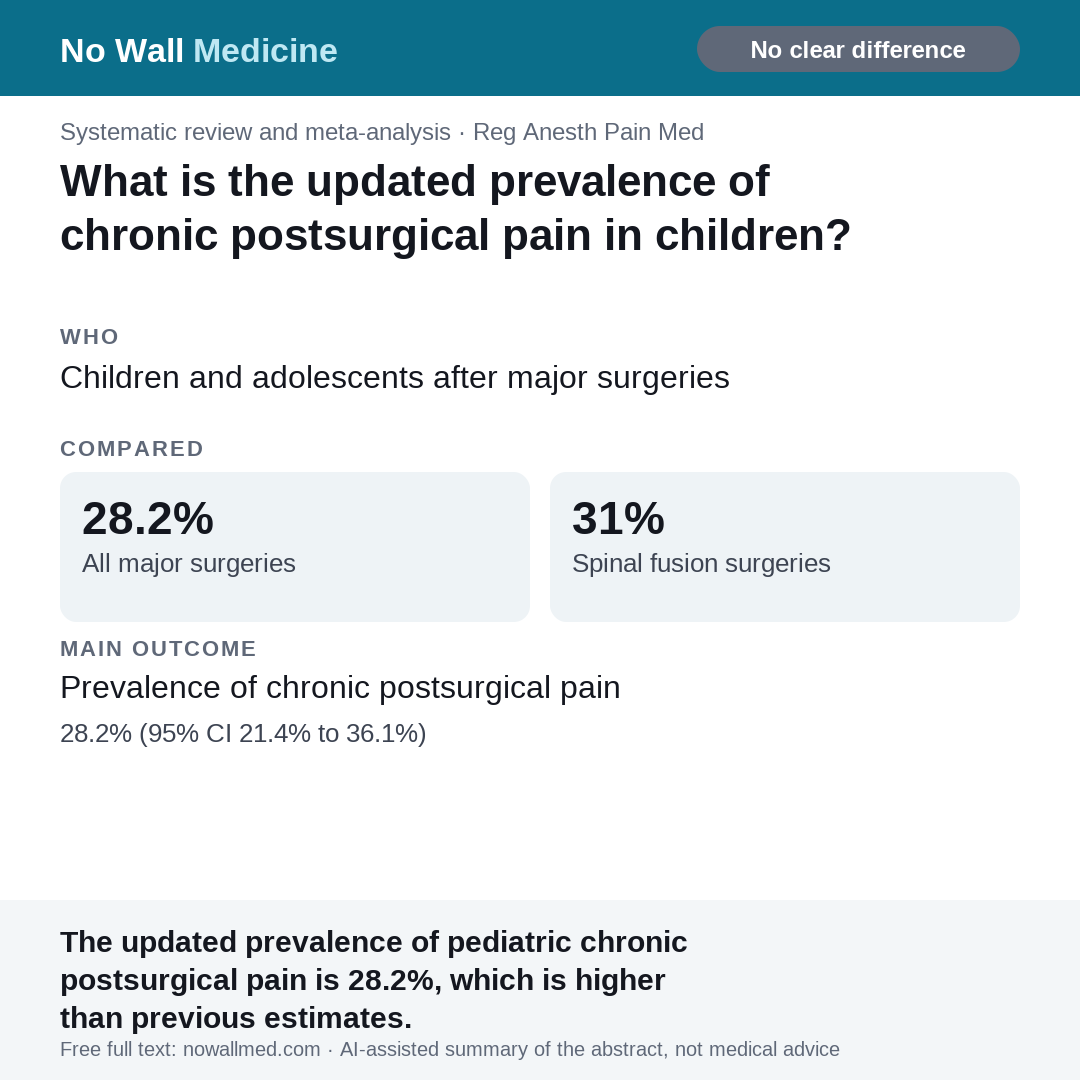
28.2%All major surgeries (95% CI 21.4% to 36.1%)
31%Spinal fusion surgeries (95% CI 21.4% to 43.5%)
Main outcome
Prevalence of chronic postsurgical pain
Result: 28.2% (95% CI 21.4% to 36.1%)
Bottom line: The updated prevalence of pediatric chronic postsurgical pain is 28.2%, which is higher than previous estimates.
Limitation: Studies often used pain intensity measures without pain interference or quality of life measures.
Reg Anesth Pain Med · 2025-02-05Download image
Clinical question: What is the updated prevalence of chronic postsurgical pain in children?
Why it matters: The prevalence of chronic postsurgical pain in children was previously estimated at 20%, but variable definitions of the condition made updated estimates uncertain.
Key points
- Researchers analyzed 20 prospective, observational studies to estimate the prevalence of chronic postsurgical pain, which is pain lasting more than 3 months after surgery, in children.
- The pooled prevalence of chronic postsurgical pain after mostly major surgeries was 28.2% (95% CI 21.4% to 36.1%).
- In a subgroup of spinal fusion surgeries, the prevalence of chronic postsurgical pain was 31% (95% CI 21.4% to 43.5%).
Limitation the authors note: The certainty in the prevalence estimates was moderate and there was some heterogeneity among the studies.
Headline and key points written with AI from the paper’s abstract, with every number checked against it. Read the paper before relying on them.
Was this summary helpful?
Abstract
Background
According to the prior 2017 review (Rabbitts et al), approximately 20% of children and adolescents develop chronic postsurgical pain (CPSP; ie, pain persisting >3 months after surgery) after major surgeries, which is associated with adverse functional and psychological consequences. A major barrier was that definitions of CPSP applied were highly variable. Since that prior review was conducted (n=4 studies in meta-analysis), numerous relevant studies have been published warranting an update. Objective
The aims of this current review were to: (1) provide an updated prevalence estimate for pediatric CPSP and (2) examine definitions of pediatric CPSP applied in current research. Evidence review
Prospective, observational studies examining CPSP using a validated self-report pain intensity measure in children were included. 4884 unique publications were screened with 20 articles meeting inclusion criteria. Risk of bias using Quality in Prognostic Study tool ranged from low to high. Findings
The pooled prevalence of CPSP among mostly major surgeries was 28.2% (95% CI 21.4% to 36.1%). Subgroup analysis of spinal fusion surgeries identified a prevalence of 31% (95% CI 21.4% to 43.5%). Using Grading of Recommendations, Assessment, Development, and Evaluation, the certainty in prevalence estimates was moderate. Studies used a range of valid pain intensity measures to classify CPSP (eg, Numeric Rating Scale), often without pain interference or quality of life measures. Conclusions
The overall prevalence of pediatric CPSP is higher than estimated in the prior review, and quality of studies generally improved though with some heterogeneity. Standardizing the measurement of CPSP will facilitate future efforts to combine and compare data across studies. Prospero registration number
CRD42022306340.
Abstract reproduced under the article’s CC BY NC licence.
Subject terms
Cite this article
Rosenbloom BN, Frederiksen SD, Wang V, Birnie KA, Park CS, Gordon G. Prevalence of and recommendation for measuring chronic postsurgical pain in children: an updated systematic review and meta-analysis. Reg Anesth Pain Med. 2025. doi:10.1136/rapm-2024-105697
Spotted a mistake? Suggest a correction
Top studies every Monday
The week’s key trials and guidelines in your specialties, plus any topics you follow. By email, free.
Get the weekly digest