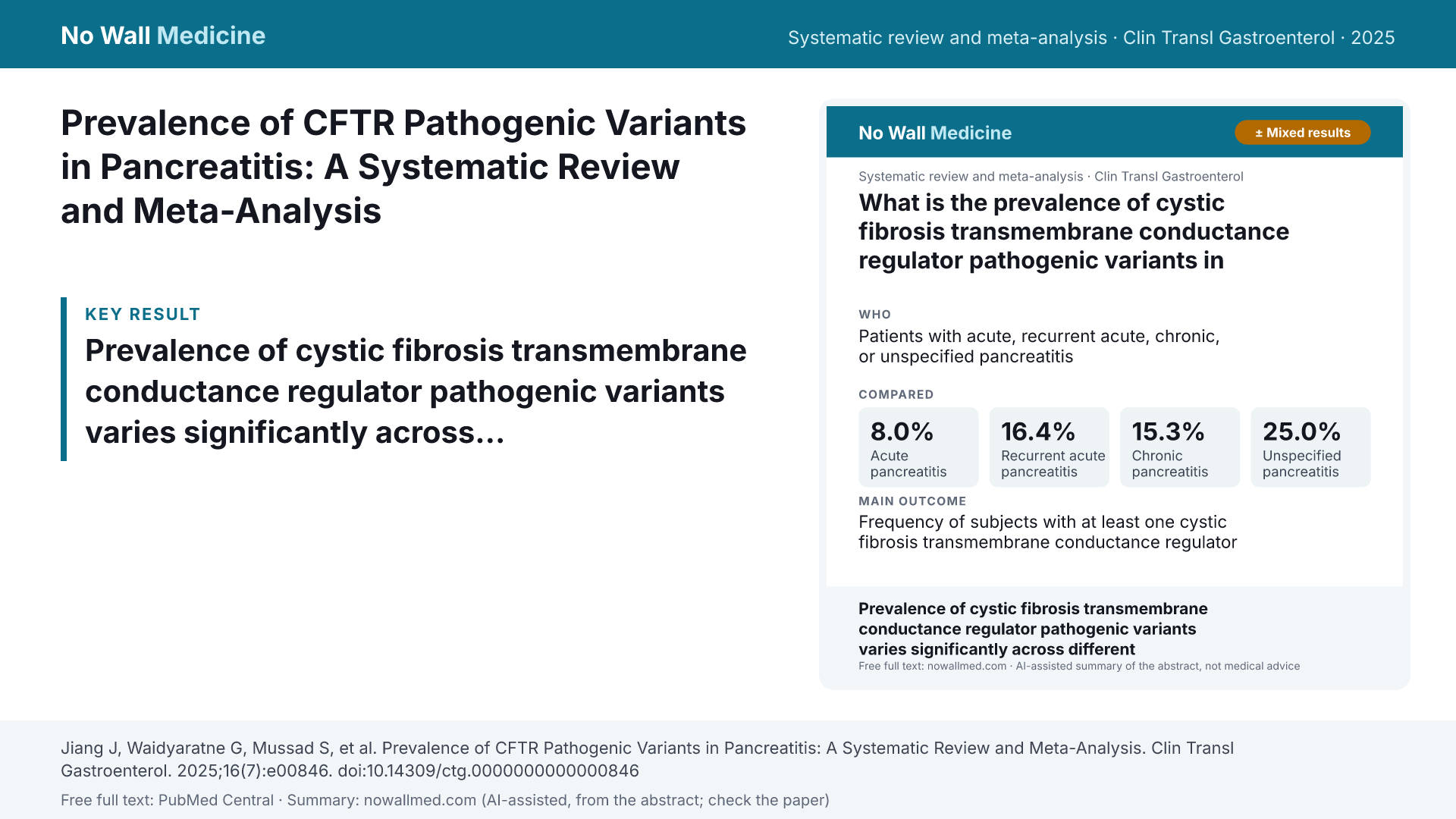
Prevalence of CFTR Pathogenic Variants in Pancreatitis: A Systematic Review and Meta-Analysis
Systematic review and meta-analysisMixed results
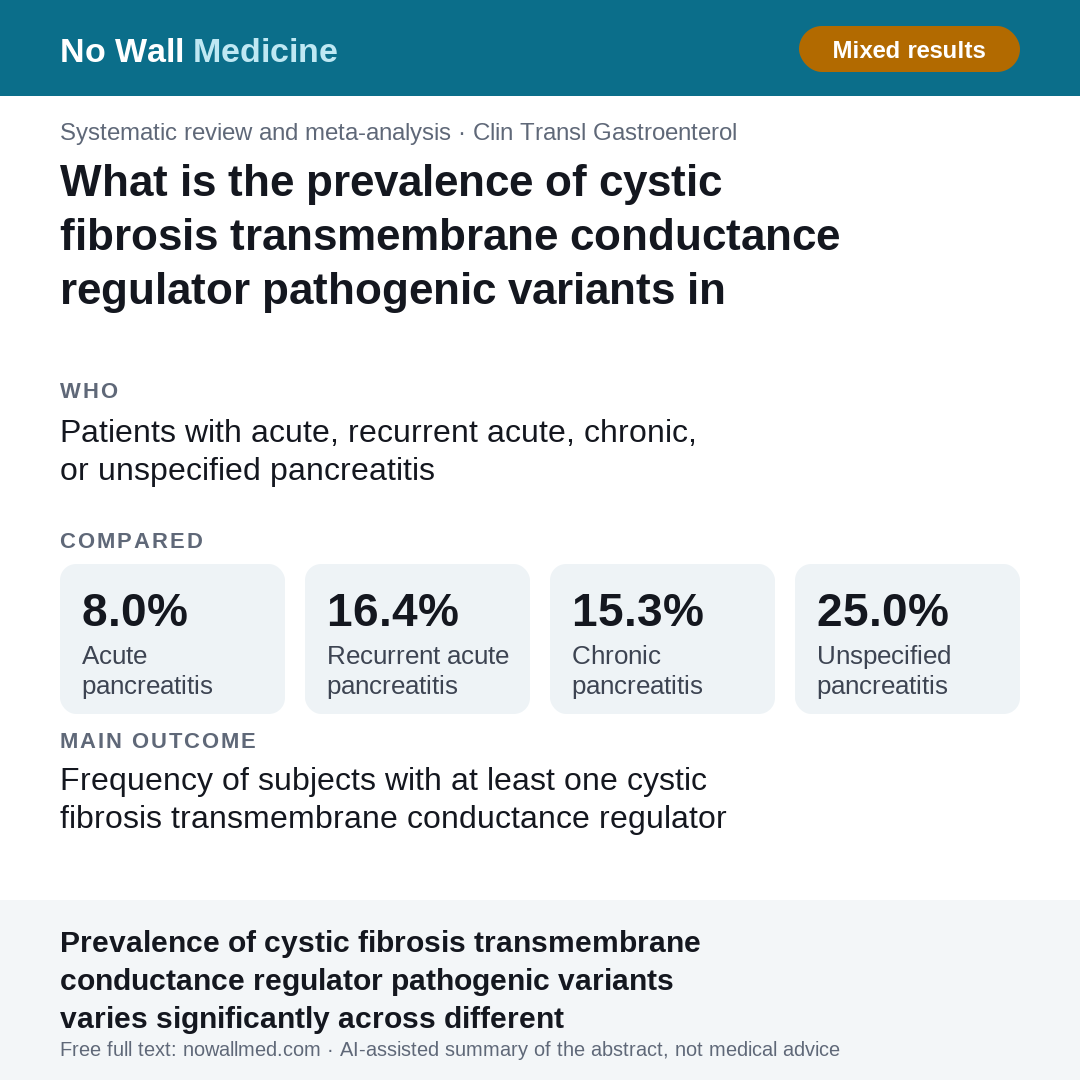
What is the prevalence of cystic fibrosis transmembrane conductance regulator pathogenic variants in pancreatitis?
Who
Patients with acute, recurrent acute, chronic, or unspecified pancreatitis
Compared
8.0%Acute pancreatitis (95% CI: 4.3%-14.4%)
16.4%Recurrent acute pancreatitis (95% CI: 10.2%-25.4%)
15.3%Chronic pancreatitis (95% CI: 12.2%-19.0%)
25.0%Unspecified pancreatitis (95% CI: 17.5%-34.3%)
Main outcome
Frequency of subjects with at least one cystic fibrosis transmembrane conductance regulator pathogenic variant
Bottom line: Prevalence of cystic fibrosis transmembrane conductance regulator pathogenic variants varies significantly across different pancreatitis phenotypes.
Clin Transl Gastroenterol · 2025-04-18Download image
Clinical question: What is the prevalence of cystic fibrosis transmembrane conductance regulator pathogenic variants in pancreatitis?
Abstract
Introduction
Pathogenic variants (PVs) in the cystic fibrosis transmembrane conductance regulator ( CFTR ) gene are commonly reported across the spectrum of pancreatitis, including acute (AP), recurrent acute (RAP), and chronic pancreatitis (CP). We aimed to define the pooled prevalence of CFTR PVs according to pancreatitis phenotype. Methods
A systematic search using synonyms for CFTR and pancreatitis was performed in Embase and Pubmed databases. The primary outcome was the frequency of subjects with at least one CFTR PV among those who underwent germline CFTR testing. Subgroup analyses included age, pancreatitis etiology, and genetic testing strategy. Confidence intervals (CIs) were obtained using the exact binomial method (Clopper-Pearson), and a Sidik-Jonkman random-effects model was used to calculate pooled prevalence. Results
In total, 138 studies were included in the final analysis; 17 (n = 1,873) reported populations with AP, 21 (n = 1,172) with RAP, 86 (n = 13,428) with CP, and 36 (n = 4,521) with unspecified pancreatitis type. The pooled prevalence of at least one CFTR PV was 8.0% (95% CI: 4.3%-14.4%) of AP, 16.4% (95% CI: 10.2%-25.4%) of RAP, 15.3% (95% CI: 12.2%-19.0%) of CP, and 25.0% (95% CI: 17.5%-34.3%) of unspecified pancreatitis. Heterogeneity was high in each phenotype (I 2 value range 88.3%-96.7%). Discussion
These findings underscore the complex landscape of CFTR PVs in pancreatitis, emphasizing the importance of tailored approaches in addressing this genetic component across diverse patient groups and phenotypic presentations. In addition, these data are useful for pretest genetic counseling and provide a justification for developing CFTR -directed interventions.
Subject terms
Cite this article
Jiang J, Waidyaratne G, Mussad S, Harris S, Roberts ME, Gokun Y. Prevalence of CFTR Pathogenic Variants in Pancreatitis: A Systematic Review and Meta-Analysis. Clin Transl Gastroenterol. 2025. doi:10.14309/ctg.0000000000000846
Spotted a mistake? Suggest a correction