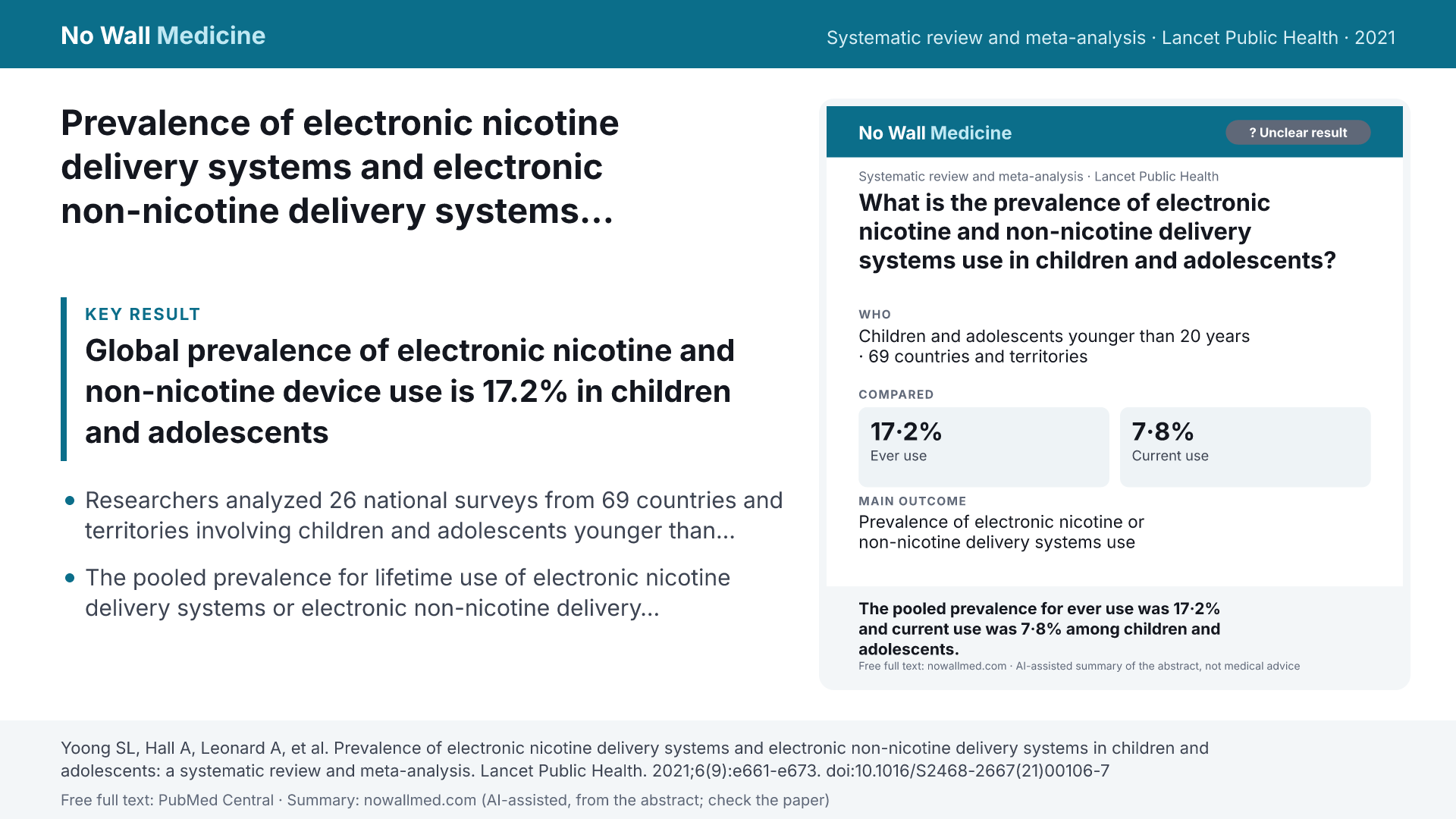
Global prevalence of electronic nicotine and non-nicotine device use is 17.2% in children and adolescents
Prevalence of electronic nicotine delivery systems and electronic non-nicotine delivery systems in children and adolescents: a systematic review and meta-analysis
Systematic review and meta-analysisUnclear result
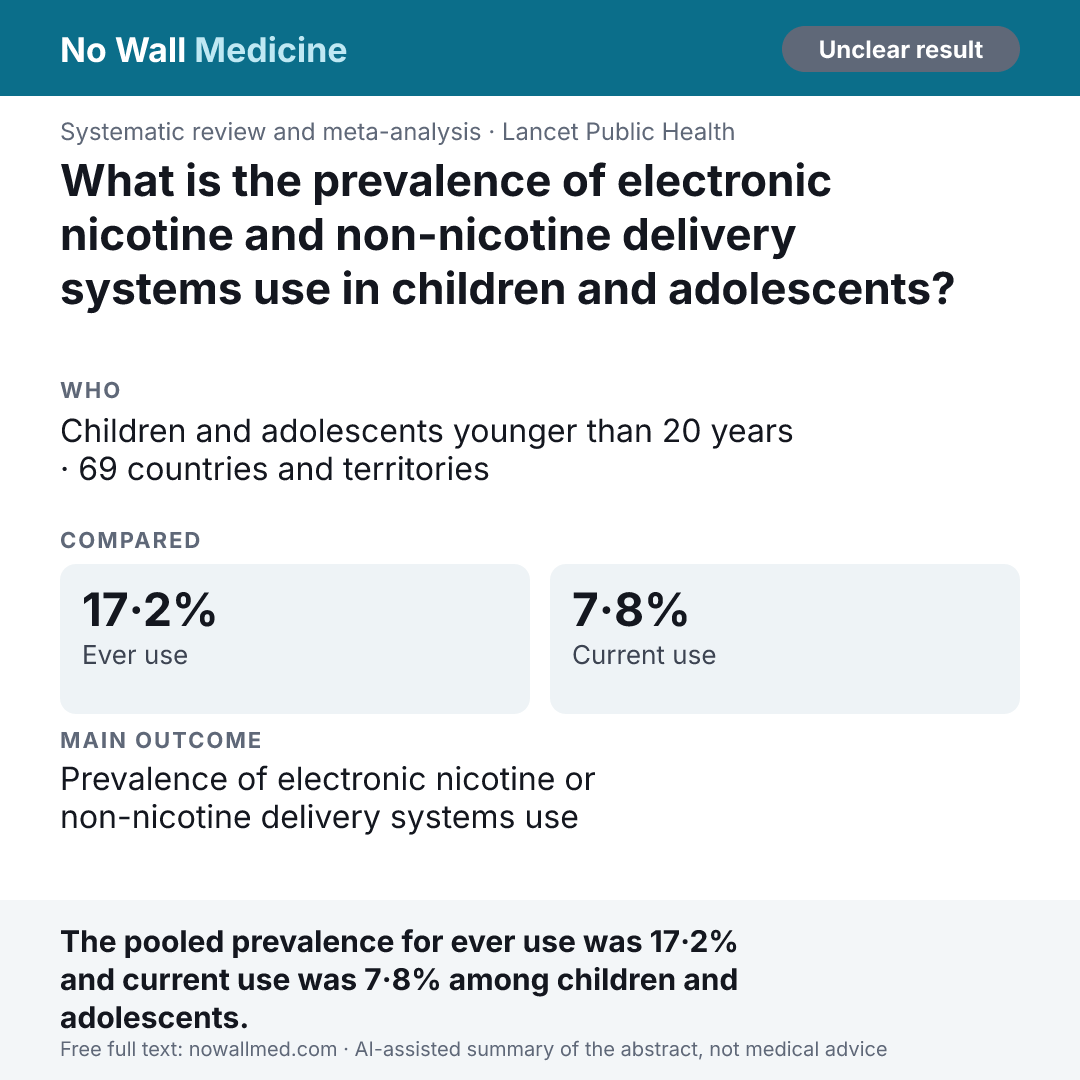
What is the prevalence of electronic nicotine and non-nicotine delivery systems use in children and adolescents?
Who
Children and adolescents younger than 20 years · 69 countries and territories
Compared
17·2%Ever use (95% CI 15-20)
7·8%Current use (6-9)
Main outcome
Prevalence of electronic nicotine or non-nicotine delivery systems use
Bottom line: The pooled prevalence for ever use was 17·2% and current use was 7·8% among children and adolescents.
Limitation: The most poorly conducted methodological feature was subjects and setting described in detail.
Funded by: World Health Organization and Bill & Melinda Gates Foundation
Lancet Public Health · 2021-07-16 · Save PNG
Clinical question: What is the prevalence of electronic nicotine and non-nicotine delivery systems use in children and adolescents?
Why it matters: The extent of electronic nicotine and non-nicotine device use among children and adolescents is needed to inform public health policy.
Key points
- Researchers analyzed 26 national surveys from 69 countries and territories involving children and adolescents younger than 20 years.
- The pooled prevalence for lifetime use of electronic nicotine delivery systems or electronic non-nicotine delivery systems was 17.2%, while current use in the past 30 days was 7.8%.
- Daily use was estimated at 0.8% and occasional use was estimated at 7.5% among the studied population.
Limitation the authors note: The most poorly conducted methodological feature of the included studies was subjects and setting described in detail.
Headline and key points written with AI from the paper’s abstract, with every number checked against it. Read the paper before relying on them.
Was this summary helpful?
Abstract
Background
There are concerns that the use of electronic nicotine delivery systems (ENDS) and electronic non-nicotine delivery systems (ENNDS) in children and adolescents could potentially be harmful to health. Understanding the extent of use of these devices is crucial to informing public health policy. We aimed to synthesise the prevalence of ENDS or ENNDS use in children and adolescents younger than 20 years. Methods
In this systematic review and meta-analysis, we undertook an electronic search in five databases (MEDLINE, Web of Science, Cumulative Index to Nursing and Allied Health Literature, Embase, and Wiley Cochrane Library) from Jan 1, 2016, to Aug 31, 2020, and a grey literature search. Included studies reported on the prevalence of ENDS or ENNDS use in nationally representative samples in populations younger than 20 years and collected data between the years 2016 and 2020. Studies were excluded if they were done in those aged 20 years or older, used data from specialist panels that did not apply appropriate weighting, or did not use methods that ensured recruitment of a nationally representative sample. We included the most recent data for each country. We combined multiple national estimates for a country if they were done in the same year. We undertook risk of bias assessment for all surveys included in the review using the Joanna Briggs Institute Critical Appraisal Checklist (by two reviewers in the author list). A random effects meta-analysis was used to pool overall prevalence estimates for ever, current, occasional, and daily use. This study was prospectively registered with PROSPERO, CRD42020199485. Findings
The most recent prevalence data from 26 national surveys representing 69 countries and territories, with a median sample size of 3925 (IQR 1=2266, IQR 3=10 593) children and adolescents was included. In children and adolescents aged between 8 years and younger than 20 years, the pooled prevalence for ever (defined as any lifetime use) ENDS or ENNDS use was 17·2% (95% CI 15-20, I2=99·9%), whereas for current use (defined as use in past 30 days) the pooled prevalence estimate was 7·8% (6-9, I2=99·8%). The pooled estimate for occasional use was 0·8% (0·5-1·2, I2=99·4%) for daily use and 7·5% (6·1-9·1, I2=99·4%) for occasional use. Prevalence of ENDS or ENNDS use was highest in high-income geographical regions. In terms of study quality, all surveys scored had a low risk of bias for the sampling frame used, due to the nationally representative nature of the studies. The most poorly conducted methodological feature of the included studies was subjects and setting described in detail. Few surveys reported on the use of flavours or types of ENDS or ENNDS. Interpretation
There is significant variability in the prevalence of ENDS and ENNDS use in children and adolescents globally by country income status. These findings are possibly due to differences in regulatory context, market availability, and differences in surveillance systems. Funding
World Health Organization and the Bill & Melinda Gates Foundation.
Abstract reproduced under the article’s CC BY licence.
Subject terms
Headline, design, result, key points, caveat and citation as plain text.
Cite this article
Yoong SL, Hall A, Leonard A, et al. Prevalence of electronic nicotine delivery systems and electronic non-nicotine delivery systems in children and adolescents: a systematic review and meta-analysis. Lancet Public Health. 2021;6(9):e661-e673. doi:10.1016/S2468-2667(21)00106-7
Spotted a mistake? Suggest a correction