Long-term right ventricular dysfunction remains prevalent in patients after acute pulmonary embolism
Prevalence of long-term right ventricular dysfunction after acute pulmonary embolism: a systematic review and meta-analysis
Systematic review and meta-analysisMixed results
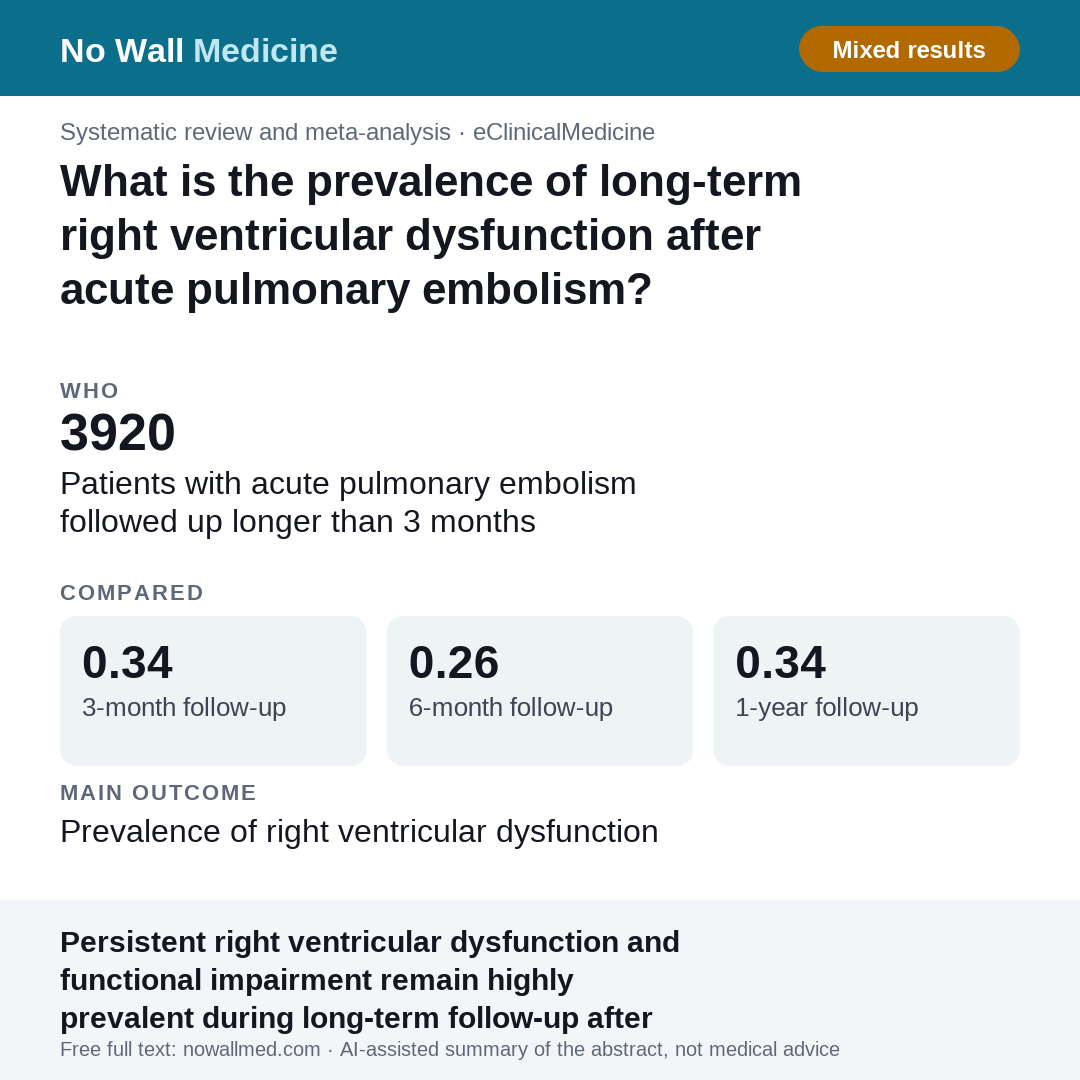
What is the prevalence of long-term right ventricular dysfunction after acute pulmonary embolism?
Who
3920
Patients with acute pulmonary embolism followed up longer than 3 months
Compared
0.343-month follow-up (95% CI 0.21-0.48)
0.266-month follow-up (95% CI 0.17-0.36)
0.341-year follow-up (95% CI 0.19-0.48)
Main outcome
Prevalence of right ventricular dysfunction
Bottom line: Persistent right ventricular dysfunction and functional impairment remain highly prevalent during long-term follow-up after acute pulmonary embolism.
Limitation: High heterogeneity from varied study designs, inclusion criteria and definition of right ventricular dysfunction.
Funded by: CAMS Innovation Fund, National Key Research and Development Program of China
eClinicalMedicine · 2023-08-11Download image
Clinical question: What is the prevalence of long-term right ventricular dysfunction after acute pulmonary embolism?
Why it matters: The long-term prevalence of right ventricular structural and functional parameters after an acute pulmonary embolism was unknown.
Key points
- Researchers analyzed 33 studies involving 3920 patients to measure right ventricular dysfunction after acute pulmonary embolism.
- The prevalence of right ventricular dysfunction was 0.34 at 3 months, 0.26 at 6 months, and 0.34 at 1 year.
- At 1 year, the pooled 6-minute walk test distance was 462.98 m and the proportion of patients with New York Heart Association class III-IV symptoms was 0.06.
Limitation the authors note: The authors state the conclusion may be limited by high heterogeneity from varied study designs, inclusion criteria, and definitions of right ventricular dysfunction.
Headline and key points written with AI from the paper’s abstract, with every number checked against it. Read the paper before relying on them.
Was this summary helpful?
Cite this article
Wang D, Fan G, Zhang X, Xi L, Chen Y, Li A. Prevalence of long-term right ventricular dysfunction after acute pulmonary embolism: a systematic review and meta-analysis. eClinicalMedicine. 2023. doi:10.1016/j.eclinm.2023.102153
Spotted a mistake? Suggest a correction
Top studies every Monday
The week’s key trials and guidelines in your specialties, plus any topics you follow. By email, free.
Get the weekly digest