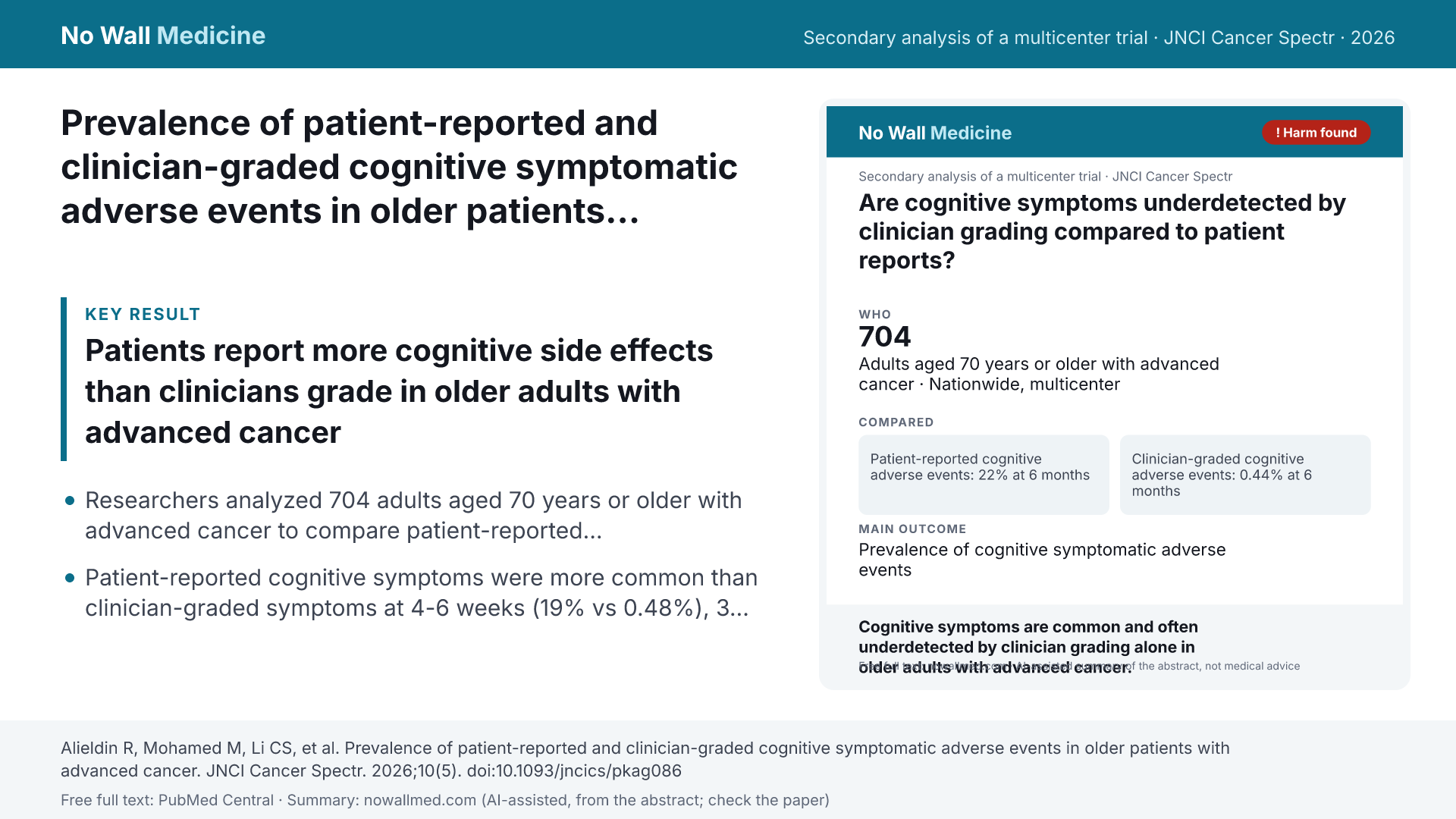
Patients report more cognitive side effects than clinicians grade in older adults with advanced cancer
Prevalence of patient-reported and clinician-graded cognitive symptomatic adverse events in older patients with advanced cancer
Secondary analysis of a multicenter trialHarm found
Are cognitive symptoms underdetected by clinician grading compared to patient reports?
Who
704
Adults aged 70 years or older with advanced cancer · Nationwide, multicenter
Compared
Patient-reported cognitive adverse events: 22% at 6 months
Clinician-graded cognitive adverse events: 0.44% at 6 months
Main outcome
Prevalence of cognitive symptomatic adverse events
Bottom line: Cognitive symptoms are common and often underdetected by clinician grading alone in older adults with advanced cancer.
JNCI Cancer Spectr · 2026-08-24 · Save PNG
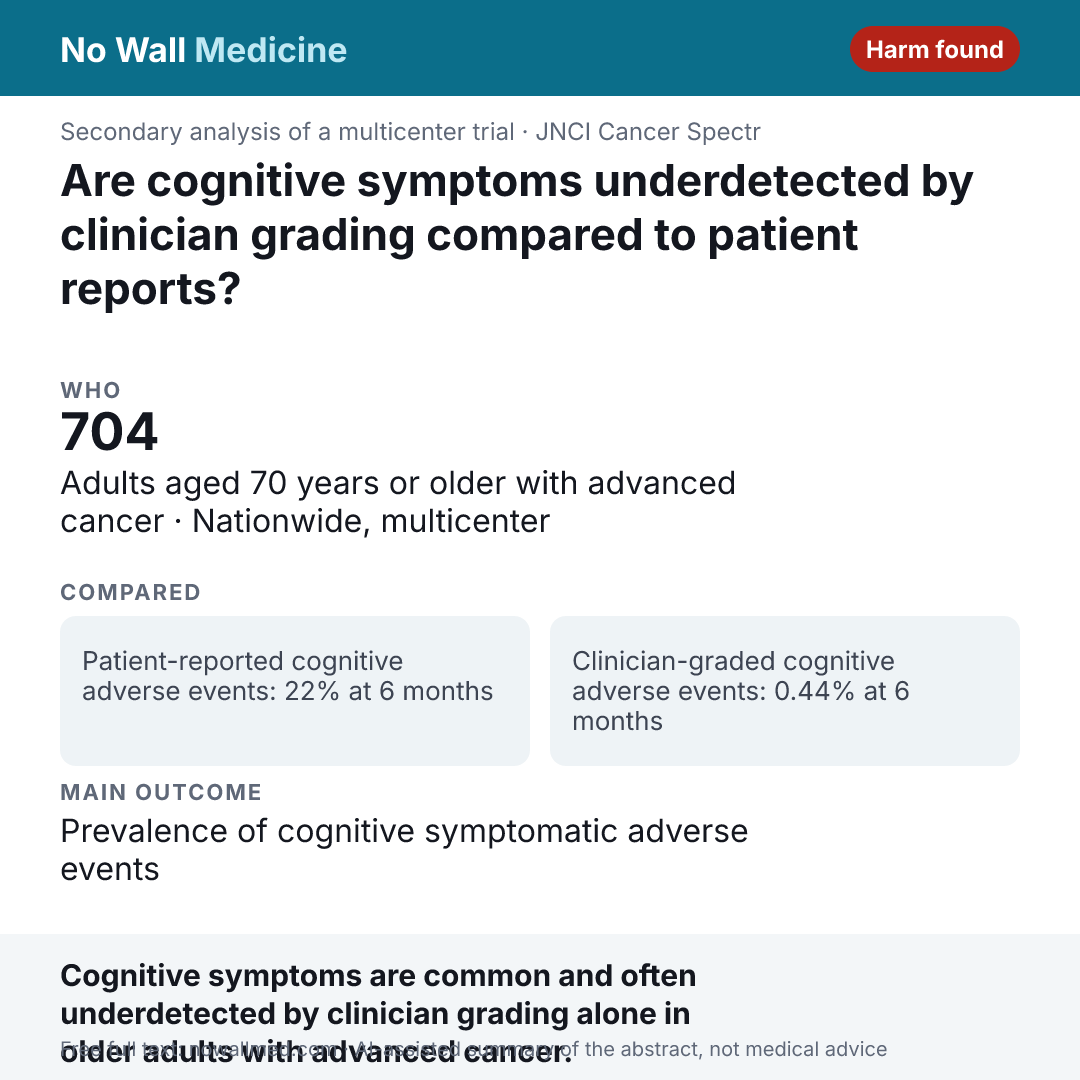
Clinical question: Are cognitive symptoms underdetected by clinician grading compared to patient reports?
Why it matters: Cancer-related cognitive impairment is common during treatment but may be underdetected when using only clinician-graded adverse events.
Key points
- Researchers analyzed 704 adults aged 70 years or older with advanced cancer to compare patient-reported and clinician-graded cognitive adverse events.
- Patient-reported cognitive symptoms were more common than clinician-graded symptoms at 4-6 weeks (19% vs 0.48%), 3 months (18% vs 2.5%), and 6 months (22% vs 0.44%).
- Impaired results on the Mini-Cog, a brief cognitive screening tool, were associated with higher rates of patient-reported cognitive symptoms at all follow-up intervals.
Headline and key points written with AI from the paper’s abstract, with every number checked against it. Read the paper before relying on them.
Was this summary helpful?
Subject terms
Headline, design, result, key points, caveat and citation as plain text.
Cite this article
Alieldin R, Mohamed M, Li CS, et al. Prevalence of patient-reported and clinician-graded cognitive symptomatic adverse events in older patients with advanced cancer. JNCI Cancer Spectr. 2026;10(5). doi:10.1093/jncics/pkag086
Spotted a mistake? Suggest a correction