Common nonmotor outcomes after stroke often persist over time according to meta-analysis
Prevalence, Trajectory, and Factors Associated With Patient-Reported Nonmotor Outcomes After Stroke: A Systematic Review and Meta-Analysis
Systematic review and meta-analysisBenefit found
What is the prevalence, natural history, and associated factors of patient-reported nonmotor outcomes after stroke?
Who
117440
117,440 participants with stroke
Compared
59.9%Sleep disturbance (95% CI, 53.9%-63.9%)
59.8%Sexual dysfunction (95% CI, 50.0%-69.5%)
58.2%Constipation (95% CI, 53.9%-62.6%)
56.5%Reduced social participation (95% CI, 52.1%-60.8%)
Main outcome
Prevalence of multidomain nonmotor outcomes
Bottom line: Patient-reported nonmotor outcomes are common after stroke and often persist over time, especially in women and older adults.
Limitation: The heterogeneity ranged between 52% and 98% across all studies.
JAMA Netw Open · 2025-02-03Download image
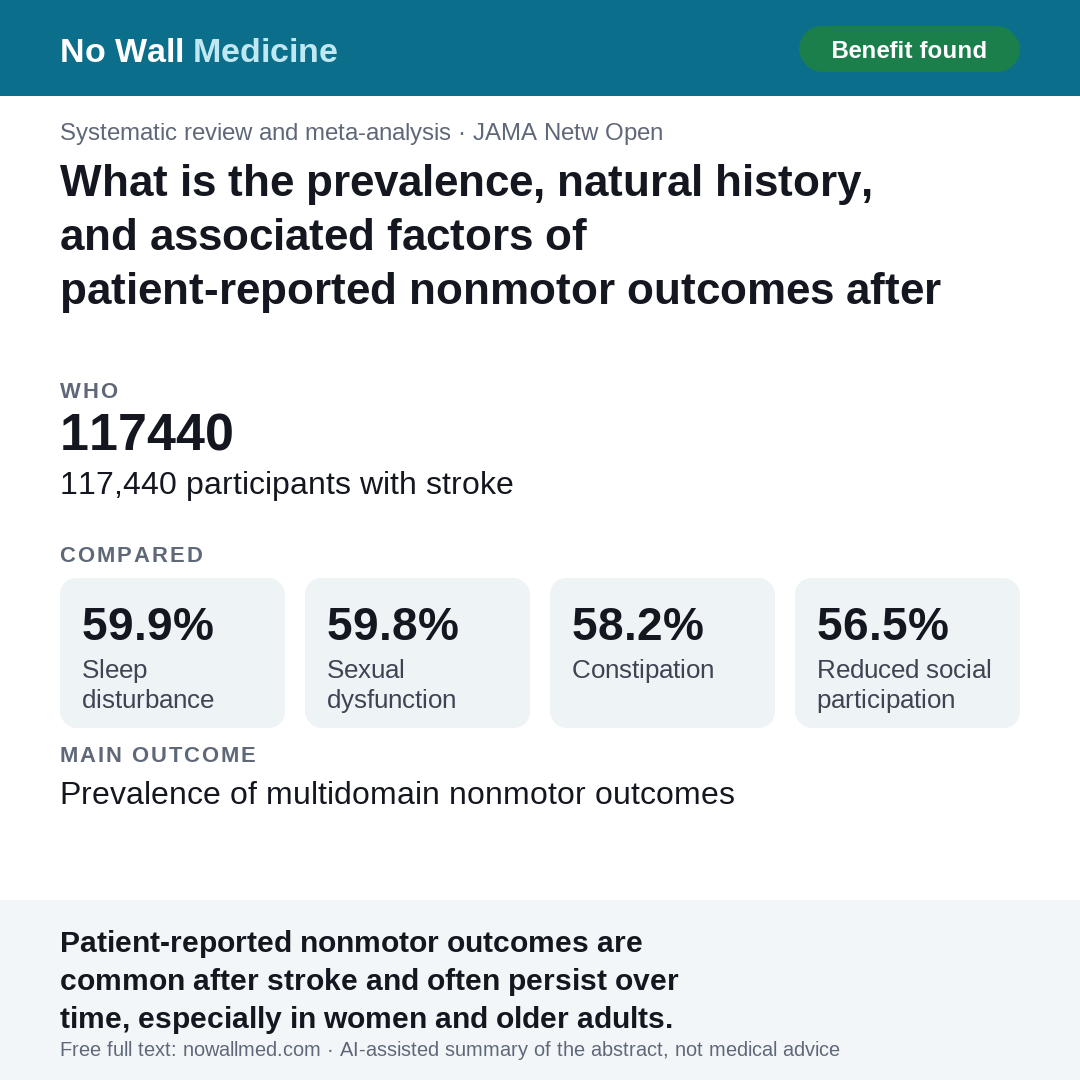
Clinical question: What is the prevalence, natural history, and associated factors of patient-reported nonmotor outcomes after stroke?
Why it matters: The prevalence, natural history, and factors associated with multidomain nonmotor outcome burden in patients with stroke are unclear.
Key points
- Researchers analyzed 279 prospective cohort studies involving 117,440 stroke participants to measure patient-reported symptoms like anxiety, fatigue, and sleep issues.
- The most common outcomes were sleep disturbance at 59.9%, sexual dysfunction at 59.8%, constipation at 58.2%, reduced social participation at 56.5%, bladder dysfunction at 45.9%, and fatigue at 45.2%.
- Most symptoms showed no significant improvement over time, though pain and sexual dysfunction showed some changes.
Limitation the authors note: The heterogeneity ranged between 52% and 98% across all studies.
Headline and key points written with AI from the paper’s abstract, with every number checked against it. Read the paper before relying on them.
Was this summary helpful?
Subject terms
Cite this article
Ozkan H, Ambler G, Esmail T, Banerjee G, Simister RJ, Werring DJ. Prevalence, Trajectory, and Factors Associated With Patient-Reported Nonmotor Outcomes After Stroke: A Systematic Review and Meta-Analysis. JAMA Netw Open. 2025. doi:10.1001/jamanetworkopen.2024.57447
Spotted a mistake? Suggest a correction
Top studies every Monday
The week’s key trials and guidelines in your specialties, plus any topics you follow. By email, free.
Get the weekly digest