Pilot trial assesses feasibility of using enoxaparin to prevent blood clots after childbirth
Preventing Postpartum Venous Thromboembolism With Low-Molecular-Weight Heparin: The PP-HEP Pilot Randomised Controlled Trial
Pragmatic, open-label pilot randomized controlled trialUnclear result
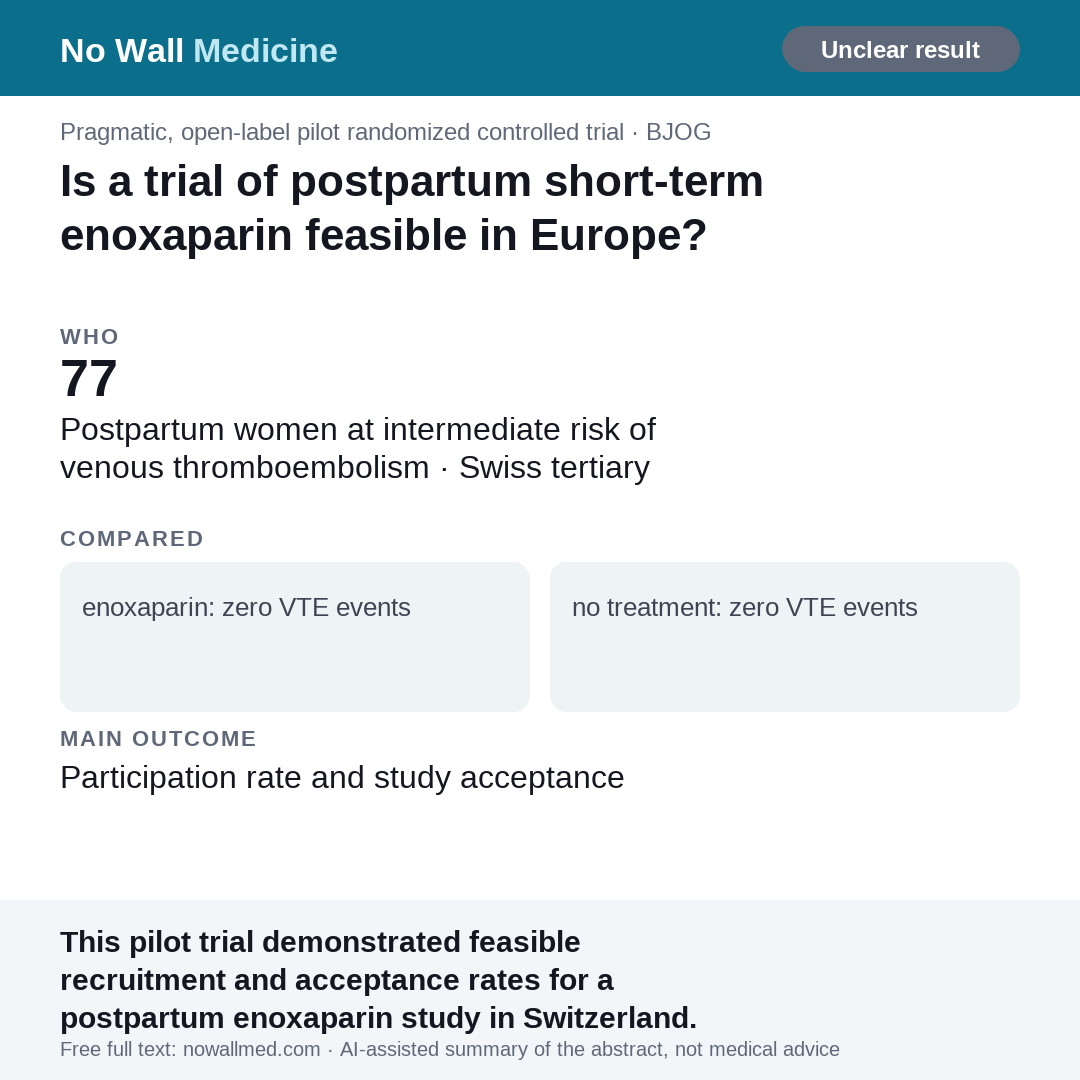
Is a trial of postpartum short-term enoxaparin feasible in Europe?
Who
77
Postpartum women at intermediate risk of venous thromboembolism · Swiss tertiary hospital
Compared
enoxaparin: zero VTE events
no treatment: zero VTE events
Main outcome
Participation rate and study acceptance
Bottom line: This pilot trial demonstrated feasible recruitment and acceptance rates for a postpartum enoxaparin study in Switzerland.
BJOG · 2024-09-05Download image
Clinical question: Is a trial of postpartum short-term enoxaparin feasible in Europe?
Why it matters: Uncertainty exists regarding the risk-benefit of using low-molecular-weight heparin to prevent blood clots after delivery.
Key points
- Researchers studied 77 postpartum women at intermediate risk of venous thromboembolism, comparing 10 days of enoxaparin to no treatment.
- The study achieved a recruitment rate of 3.1 per week and a study acceptance rate of 23.8%.
- No venous thromboembolism events occurred during the 3-month follow-up, though one major and one nonmajor obstetrical bleeding occurred in the enoxaparin group.
Limitation the authors note: The study was a pilot randomized controlled trial with a small sample size of 77 participants.
Headline and key points written with AI from the paper’s abstract, with every number checked against it. Read the paper before relying on them.
Topics
Cite this article
Blondon M, Claver M, Celetta E, Righini M, de Tejada BM. Preventing Postpartum Venous Thromboembolism With Low-Molecular-Weight Heparin: The PP-HEP Pilot Randomised Controlled Trial. BJOG. 2024. doi:10.1111/1471-0528.17943
Spotted a mistake? Suggest a correction
Top studies every Monday
The week’s key trials and guidelines in your specialties, by email. Free.
Get the weekly digest