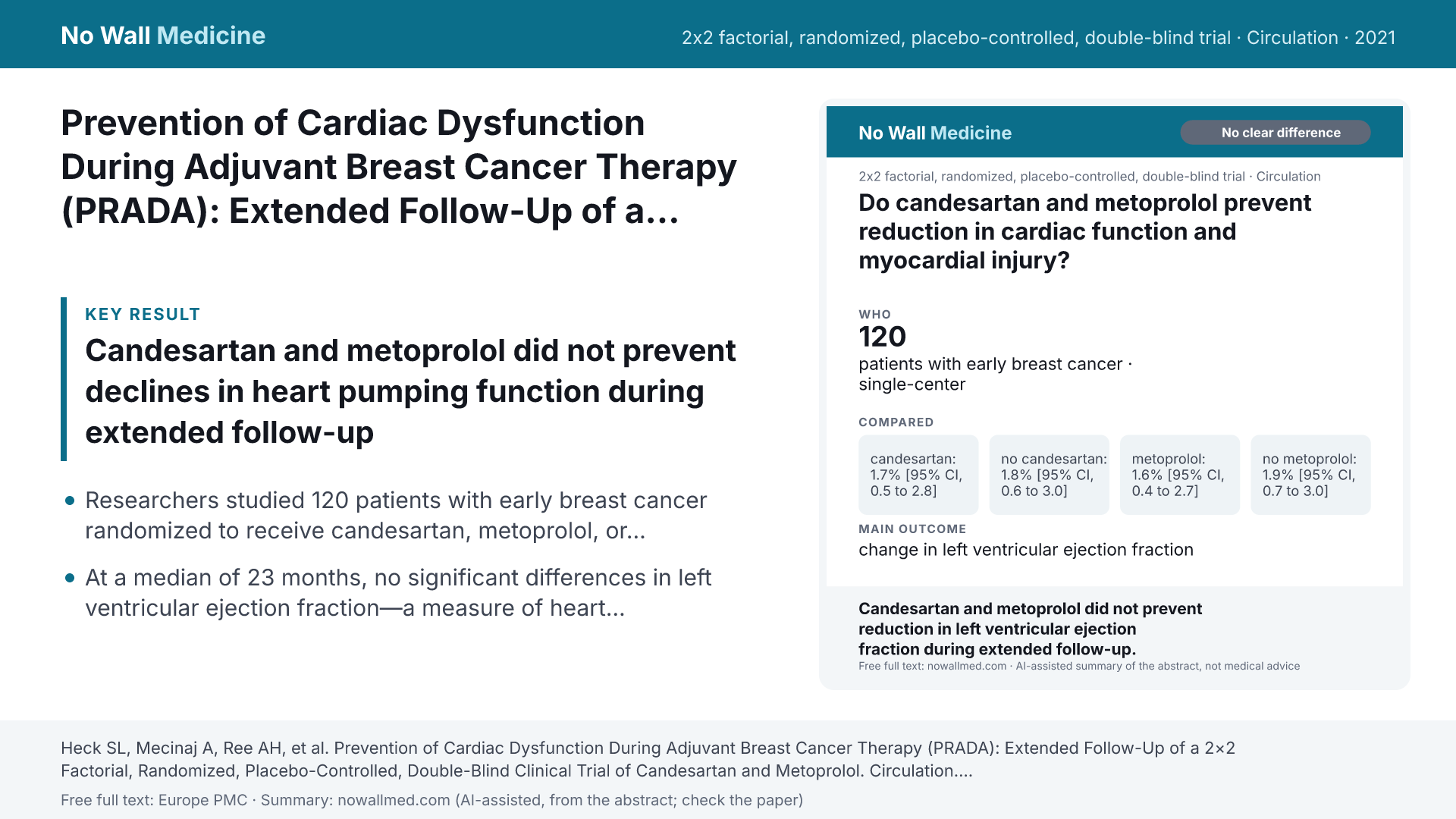
Candesartan and metoprolol did not prevent declines in heart pumping function during extended follow-up
Prevention of Cardiac Dysfunction During Adjuvant Breast Cancer Therapy (PRADA): Extended Follow-Up of a 2×2 Factorial, Randomized, Placebo-Controlled, Double-Blind Clinical Trial of Candesartan and Metoprolol
2x2 factorial, randomized, placebo-controlled, double-blind trialNo clear difference
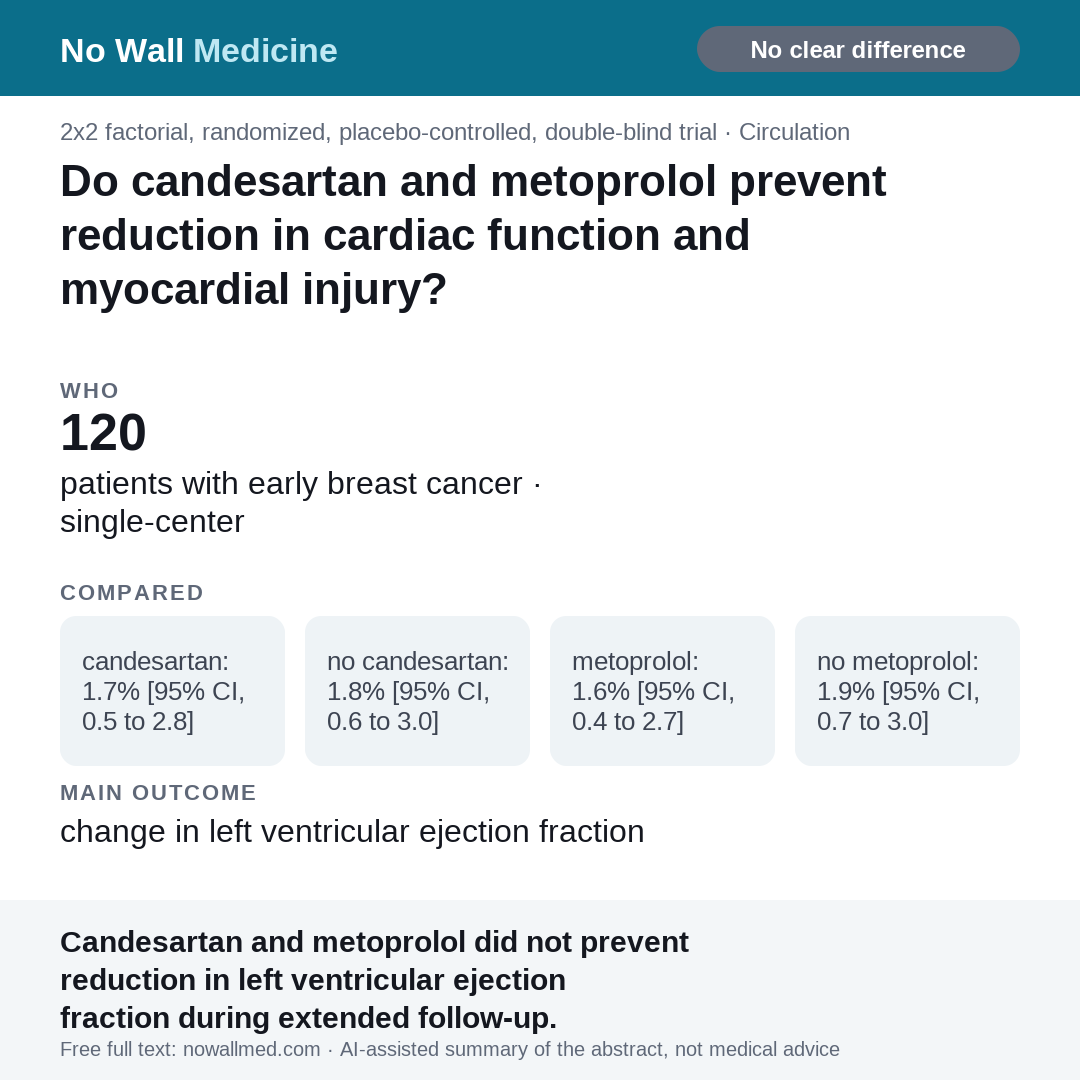
Do candesartan and metoprolol prevent reduction in cardiac function and myocardial injury?
Who
120
patients with early breast cancer · single-center
Compared
candesartan: 1.7% [95% CI, 0.5 to 2.8]
no candesartan: 1.8% [95% CI, 0.6 to 3.0]
metoprolol: 1.6% [95% CI, 0.4 to 2.7]
no metoprolol: 1.9% [95% CI, 0.7 to 3.0]
Main outcome
change in left ventricular ejection fraction
Bottom line: Candesartan and metoprolol did not prevent reduction in left ventricular ejection fraction during extended follow-up.
Circulation · 2021-05-16Download image
Clinical question: Do candesartan and metoprolol prevent reduction in cardiac function and myocardial injury?
Why it matters: It was unknown if the long-term effects of candesartan and metoprolol prevent reductions in cardiac function and myocardial injury after adjuvant breast cancer therapy.
Key points
- Researchers studied 120 patients with early breast cancer randomized to receive candesartan, metoprolol, or placebos during adjuvant therapy.
- At a median of 23 months, no significant differences in left ventricular ejection fraction—a measure of heart pumping strength—were found between groups.
- Candesartan treatment was associated with a significant reduction in left ventricular end-diastolic volume and preserved global longitudinal strain compared to no candesartan.
Limitation the authors note: The study was a single-center trial with a small sample of 120 patients.
Headline and key points written with AI from the paper’s abstract, with every number checked against it. Read the paper before relying on them.
Was this summary helpful?
Abstract
Background
Adjuvant breast cancer therapy containing anthracyclines with or without anti-human epidermal growth factor receptor-2 antibodies and radiotherapy is associated with cancer treatment-related cardiac dysfunction. In the PRADA trial (Prevention of Cardiac Dysfunction During Adjuvant Breast Cancer Therapy), concomitant treatment with the angiotensin receptor blocker candesartan attenuated the reduction in left ventricular ejection fraction (LVEF) in women receiving treatment for breast cancer, whereas the β-blocker metoprolol attenuated the increase in cardiac troponins. This study aimed to assess the long-term effects of candesartan and metoprolol or their combination to prevent a reduction in cardiac function and myocardial injury.Methods
In this 2×2 factorial, randomized, placebo-controlled, double-blind, single-center trial, patients with early breast cancer were assigned to concomitant treatment with candesartan cilexetil, metoprolol succinate, or matching placebos. Target doses were 32 and 100 mg, respectively. Study drugs were discontinued after adjuvant therapy. All 120 validly randomized patients were included in the intention-to-treat analysis. The primary outcome measure was change in LVEF assessed by cardiovascular magnetic resonance imaging from baseline to extended follow-up. Secondary outcome measures included changes in left ventricular volumes, echocardiographic peak global longitudinal strain, and circulating cardiac troponin concentrations.Results
A small decline in LVEF but no significant between-group differences were observed from baseline to extended follow-up, at a median of 23 months (interquartile range, 21 to 28 months) after randomization (candesartan, 1.7% [95% CI, 0.5 to 2.8]; no candesartan, 1.8% [95% CI, 0.6 to 3.0]; metoprolol, 1.6% [95% CI, 0.4 to 2.7]; no metoprolol, 1.9% [95% CI, 0.7 to 3.0]). Candesartan treatment during adjuvant therapy was associated with a significant reduction in left ventricular end-diastolic volume compared with the noncandesartan group (P=0.021) and attenuated decline in global longitudinal strain (P=0.046) at 2 years. No between-group differences in change in cardiac troponin I and T concentrations were observed.Conclusions
Anthracycline-containing adjuvant therapy for early breast cancer was associated with a decline in LVEF during extended follow-up. Candesartan during adjuvant therapy did not prevent reduction in LVEF at 2 years, but was associated with modest reduction in left ventricular end-diastolic volume and preserved global longitudinal strain. These results suggest that a broadly administered cardioprotective approach may not be required in most patients with early breast cancer without preexisting cardiovascular disease. Registration: URL: https://www.clinicaltrials.gov; Unique identifier: NCT01434134.
Abstract reproduced under the article’s CC BY-NC-ND licence.
Subject terms
Cite this article
Heck SL, Mecinaj A, Ree AH, et al. Prevention of Cardiac Dysfunction During Adjuvant Breast Cancer Therapy (PRADA): Extended Follow-Up of a 2×2 Factorial, Randomized, Placebo-Controlled, Double-Blind Clinical Trial of Candesartan and Metoprolol. Circulation. 2021. doi:10.1161/CIRCULATIONAHA.121.054698
Spotted a mistake? Suggest a correction