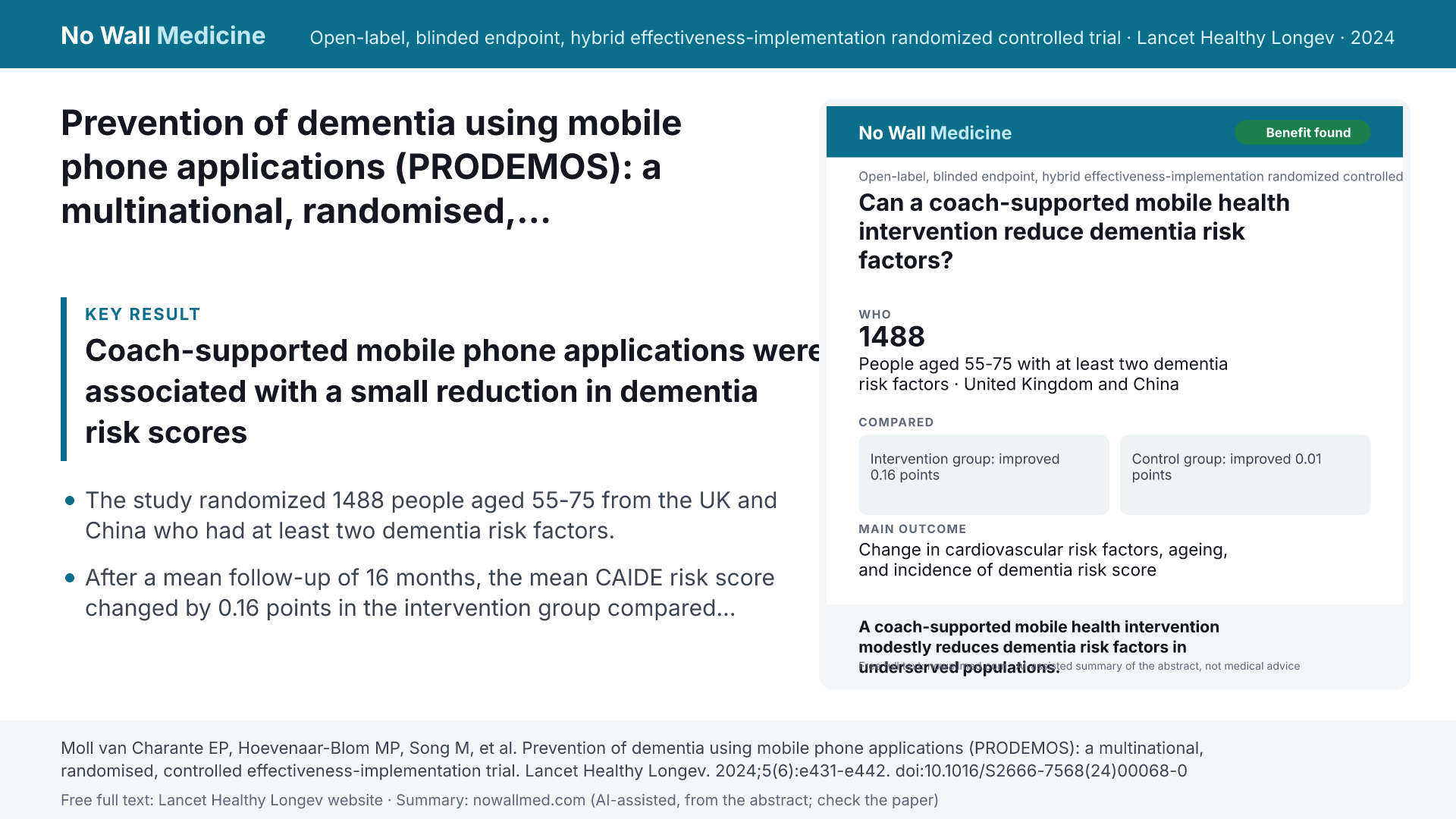
Coach-supported mobile phone applications were associated with a small reduction in dementia risk scores
Prevention of dementia using mobile phone applications (PRODEMOS): a multinational, randomised, controlled effectiveness-implementation trial
Open-label, blinded endpoint, hybrid effectiveness-implementation randomized controlled trialBenefit found
Can a coach-supported mobile health intervention reduce dementia risk factors?
Who
1488
People aged 55-75 with at least two dementia risk factors · United Kingdom and China
Compared
Intervention group: improved 0.16 points
Control group: improved 0.01 points
Main outcome
Change in cardiovascular risk factors, ageing, and incidence of dementia risk score
Result: mean difference -0.16, 95% CI -0.29 to -0.03
Bottom line: A coach-supported mobile health intervention modestly reduces dementia risk factors in underserved populations.
Funded by: EU Horizon 2020 and National Key R&D Programmes of China
Lancet Healthy Longev · 2024-05-16Download image
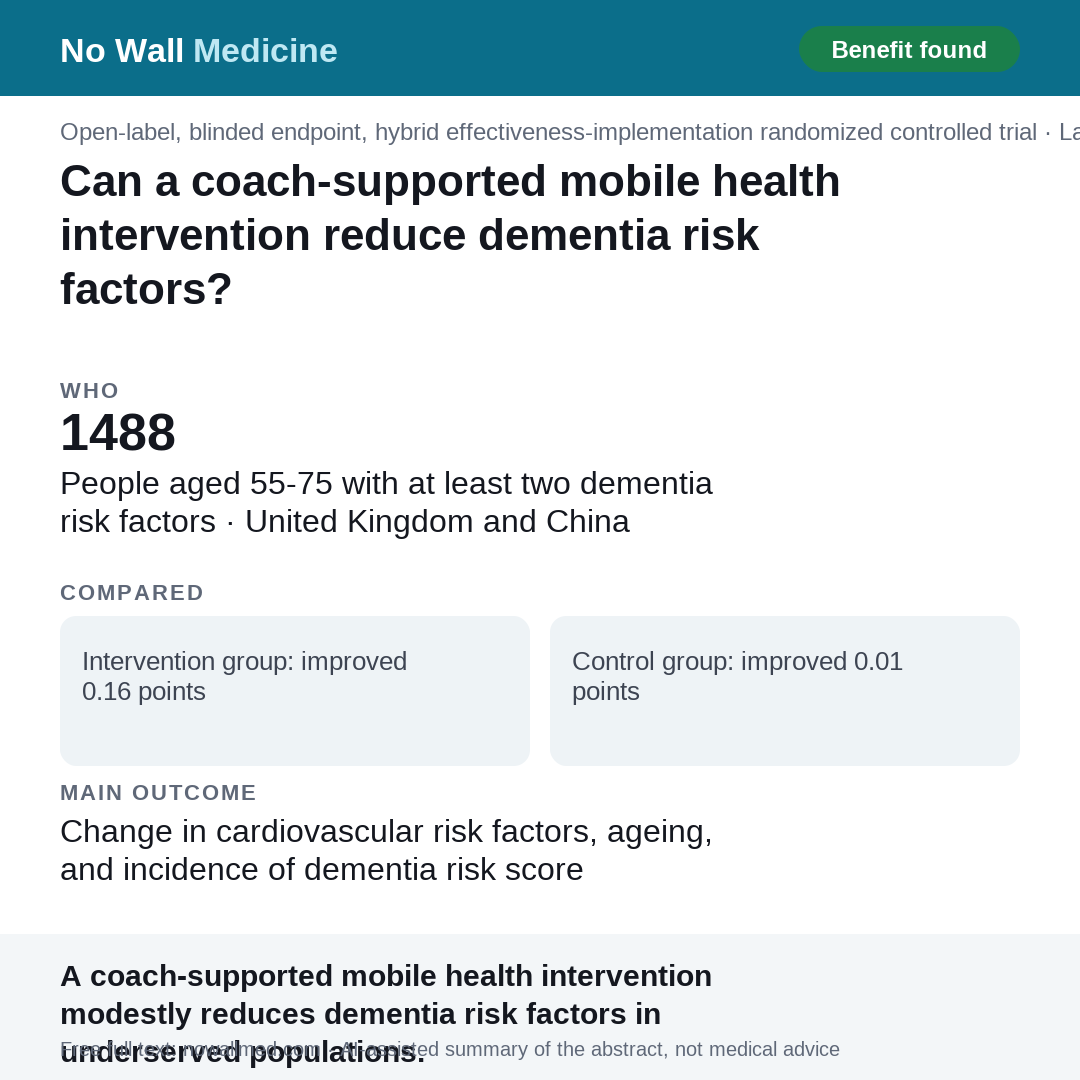
Clinical question: Can a coach-supported mobile health intervention reduce dementia risk factors?
Why it matters: It is unknown if coach-supported mobile health interventions can reduce dementia risk factors in underserved populations with low socioeconomic status.
Key points
- The study randomized 1488 people aged 55-75 from the UK and China who had at least two dementia risk factors.
- After a mean follow-up of 16 months, the mean CAIDE risk score changed by 0.16 points in the intervention group compared to 0.01 in the control group.
- While 81% of intervention participants adopted the mobile health tool, only 50% of those participants continued active participation throughout the study.
Headline and key points written with AI from the paper’s abstract, with every number checked against it. Read the paper before relying on them.
Was this summary helpful?
Abstract
Background
The expected increase of dementia prevalence in the coming decades will mainly be in low-income and middle-income countries and in people with low socioeconomic status in high-income countries. This study aims to reduce dementia risk factors in underserved populations at high-risk using a coach-supported mobile health (mHealth) intervention. Methods
This open-label, blinded endpoint, hybrid effectiveness-implementation randomised controlled trial (RCT) investigated whether a coach-supported mHealth intervention can reduce dementia risk in people aged 55-75 years of low socioeconomic status in the UK or from the general population in China with at least two dementia risk factors. The primary effectiveness outcome was change in cardiovascular risk factors, ageing, and incidence of dementia (CAIDE) risk score from baseline to after 12-18 months of intervention. Implementation outcomes were coverage, adoption, sustainability, appropriateness, acceptability, fidelity, feasibility, and costs assessed using a mixed-methods approach. All participants with complete data on the primary outcome, without imputation of missing outcomes were included in the analysis (intention-to-treat principle). This trial is registered with ISRCTN, ISRCTN15986016, and is completed. Findings
Between Jan 15, 2021, and April 18, 2023, 1488 people (601 male and 887 female) were randomly assigned (734 to intervention and 754 to control), with 1229 (83%) of 1488 available for analysis of the primary effectiveness outcome. After a mean follow-up of 16 months (SD 2·5), the mean CAIDE score improved 0·16 points in the intervention group versus 0·01 in the control group (mean difference -0·16, 95% CI -0·29 to -0·03). 1533 (10%) invited individuals responded; of the intervention participants, 593 (81%) of 734 adopted the intervention and 367 (50%) of 734 continued active participation throughout the study. Perceived appropriateness (85%), acceptability (81%), and fidelity (79%) were good, with fair overall feasibility (53% of intervention participants and 58% of coaches), at low cost. No differences in adverse events between study arms were found. Interpretation
A coach-supported mHealth intervention is modestly effective in reducing dementia risk factors in those with low socioeconomic status in the UK and any socioeconomic status in China. Implementation is challenging in these populations, but those reached actively participated. Whether this intervention will result in less cognitive decline and dementia requires a larger RCT with long follow-up. Funding
EU Horizon 2020 Research and Innovation Programme and the National Key R&D Programmes of China. Translation
For the Mandarin translation of the abstract see Supplementary Materials section.
Abstract reproduced under the article’s CC BY NC ND licence.
Subject terms
Cite this article
Moll van Charante EP, Hoevenaar-Blom MP, Song M, et al. Prevention of dementia using mobile phone applications (PRODEMOS): a multinational, randomised, controlled effectiveness-implementation trial. Lancet Healthy Longev. 2024. doi:10.1016/S2666-7568(24)00068-0
Spotted a mistake? Suggest a correction